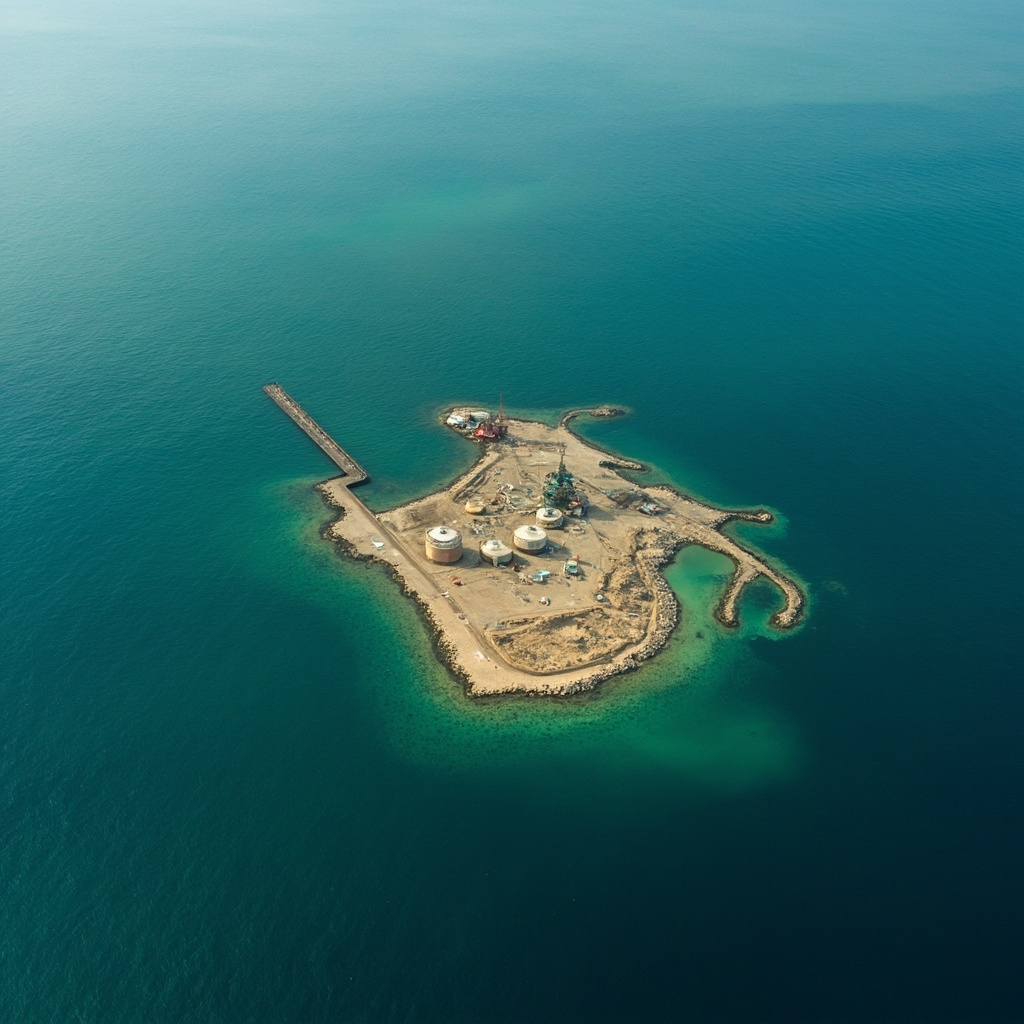
The US struck military targets on Kharg Island on March 14 — the first time Iran's principal oil export terminal had been touched since the war began February 28. President Trump announced US forces had "totally obliterated" military facilities on the island [1]. Pentagon officials have declined to elaborate on what that means operationally.
The refusal to elaborate is doing heavy rhetorical work, because "obliterated military facilities" leaves open the only question that actually prices oil: what happened to the loading infrastructure. A terminal is not a building. It is jetties, loading arms, metering skids, storage tanks, ballast systems, and the undersea pipeline feeding all of it from the mainland. Barracks rebuild in weeks. Loading arms are custom-fabricated steel with lead times measured in months; a ruptured export trunk line is a marine salvage project before it is a welding project. The difference between cratered quarters and severed jetties is the difference between a headline and 1.5 million barrels a day off the market for a quarter. [2]
Kharg Island is smaller than Manhattan, bare as a scraped bone, and sitting in waters that are now among the most dangerous in the world. Iran's main terminal for more than sixty years. A place where supertankers load crude and Iran's economy converts into foreign currency. One of the most watched coordinates in the global energy system.
Sixty Years at the Loading Arm
Kharg's role in Iran's economy predates the revolution that now guards it. The terminal was built in the late 1950s to export the output of the onshore fields, linked to the coast by causeway and undersea pipeline, and it has survived every catastrophe Iranian history has supplied since. During the Iran-Iraq war, Saddam Hussein's air force made the island its single most targeted objective, attacking it repeatedly between 1984 and 1988 in a deliberate attempt to strangle the oil income funding Tehran's defense. [2] Exports fell. They never stopped. Engineers rigged shuttle tankers, shifted storage to Lavan Island, and repaired jetties between raids through eight years of declared enemy priority targeting. That history explains why Iranian officials treat threats against Kharg as survivable rather than existential — and why the IRGC Navy commanders who built the current blockade, trained on the Tanker War, assumed Washington would never touch the node at all until March 14 proved them wrong.
What the Tanker War Teaches, and What It Doesn't
The last time the Gulf's energy plumbing became a battlefield, the fighting ran from 1984 to 1988 and struck more than 450 merchant vessels. The United States answered Kuwaiti appeals by reflagging Kuwaiti tankers under the American ensign and escorting them through the Strait — Operation Earnest Will, the largest convoy operation since World War II. Escort duty did not keep America out of that war; it put America inside it. An Iraqi Exocet misdirected into the USS Stark killed 37 sailors in 1987. When an American frigate hit an Iranian mine the following spring, Operation Praying Mantis destroyed half of Iran's navy in a single day. Four months later the USS Vincennes shot down Iran Air Flight 655 over these same waters, killing 290 civilians, and by summer the war was ending. [2]
The lesson Washington carried out of that decade — escalation punishes Iran faster than it punishes anyone else — is real. The caveat is that Iran's navy in 1988 was a collection of fast attack craft and sea mines. Its arsenal today includes ballistic and cruise missiles, swarms of drones, and a blockade architecture already extracting tolls from the world's most important waterway. [6] The 1988 script assumes the other side cannot reach back. This one can.
The X discourse immediately split into three camps.
@OilTrader04 posting scenario analysis: Hormuz reopens, Kharg spared, Brent averages $85-$90 through year-end. Manageable but elevated. @EnergyInsights running the numbers: Strait contested, Kharg intact, $100-plus through mid-year. Then the third scenario, the one that went viral.
"$150 the floor, not the ceiling."
A London-based trader's assessment of what happens if Kharg is destroyed or seized — removing 1-2 million barrels per day from global supply [3]. The quote got quote-tweeted 6,000 times. Half the replies were "this is fine." None of them sounded like they meant it.
Kharg's significance is straightforward: before the war, Iran exported roughly 1.5 million barrels per day through the terminal — nearly all of its oil exports [2]. The terminal loads the largest tankers directly, without transhipment. It's the critical node in Iran's oil supply chain.
The scenarios divide along two variables traders can actually observe. The first is loadings. Satellite tracking of tanker movements at the island gives the market a daily referendum on whether exports continue, and any sustained gap shows up in physical crude differentials before it reaches the screen price. The second is spare capacity. The world's cushion against a Persian Gulf catastrophe is roughly three million barrels a day, nearly all of it held by Saudi Arabia and the UAE — both of which sit inside the Gulf their own crude must exit. Spare capacity that cannot safely transit Hormuz is not spare capacity at all. That is the arithmetic beneath the London trader's floor: remove Kharg's 1.5 million barrels and choke the Strait's 20 percent of world supply simultaneously, and no producer outside the Gulf can plug the hole on any timeline that matters to a refinery. [3]
The US has discussed options to send ground forces to secure the terminal rather than destroy it, according to sources familiar with the deliberations [4]. A Republican lawmaker argued deploying Marines to secure an oil facility wouldn't constitute "boots on the ground" — constitutional lawyers dispute that interpretation. One former US official called holding Kharg "very high risk": within range of Iranian missiles and drones, requiring sustained military commitment.
A seizure scenario reads cleanly on a map and brutally in an after-action review. The island lies 25 kilometers off the coast, inside the engagement envelope of Iranian coastal anti-ship missile batteries that five weeks of strikes have degraded but demonstrably not erased. An amphibious assault means minesweeping ahead of the landing and suppression batteries ashore — and then, the clause planners underline twice, holding the island afterward. A garrison on Kharg must be supplied by sea through waters within range of the same missiles, indefinitely, against an adversary whose entire strategic identity is resistance. The retired general who called publicly for exactly this operation framed it as a limited action [4]. The former official who called it very high risk identified why: taking an island is an operation. Keeping one is a war.
China complicates the calculus. Beijing is Iran's largest oil customer, purchasing roughly a quarter of exports through long-term agreements [5]. Whether China has communicated to Washington that Kharg's destruction would be acceptable is not publicly known.
What is known is where the barrels go. Most of Iran's discounted crude feeds independent "teapot" refineries in China, bought through intermediaries under terms settled around sanctions rather than despite them. A destroyed or captured Kharg does not merely embarrass Beijing commercially; it strands contracted cargoes and throws Chinese buyers into the same Atlantic-basin spot market every other importer is already raiding. Chinese customs records have continued to show Iranian crude arriving throughout the war, which means the tankers, and the terminal that loads them, are somebody's working infrastructure even while Washington models their destruction. [5]
Trump has warned Iran: "If Iran does anything that stops the flow of oil within the Strait of Hormuz, they will be hit TWENTY TIMES harder" [6]. Whether that threat extends to destroying Kharg, holding it, or something in between — that's the question the Pentagon is working through right now.
While oil traders run their models and X does what X does.
— YOSEF STERN, Jerusalem