The outside fantasy of this war was simple: kill the leader, shock the system, split the regime, watch the structure sag under the weight of its own fear.
The real story has turned out to be slower and more durable than that.
Tulsi Gabbard told Congress this week that the Iranian regime appears intact, though largely degraded. [1] Al Jazeera's reporting on the post-assassination chain of command arrives at a complementary conclusion from the ground up: yes, key figures are dead, yes, command is in flux, yes, younger hardliners may gain power — but no, the system itself has not toppled into paralysis. [2]
That matters because a great deal of commentary around this war still treats the killing of Ali Khamenei as if it should have ended the question. It did not. It only changed the form of it.
Durable by Design
Yesterday this paper's regime-survival feature argued that the Islamic Republic was built to survive decapitation. The March 20 delta is that even U.S. public intelligence language now sounds more compatible with that thesis than with the fantasy of imminent collapse.
Gabbard's phrasing is important. "Intact" is not a casual word. It does not suggest normality, and it certainly does not suggest strength, but it does suggest continuity. [1] A regime can be degraded, frightened, factionalized, and bloodied while still being operational enough to fight, punish, and reorganize.
Al Jazeera's reporting helps explain how. Mojtaba Khamenei has been announced as successor, but analysts quoted there point to a wider field of power: parliament speaker Mohammad Bagher Ghalibaf, former security and military figures, the IRGC, the Basij, and a Supreme National Security Council that still functions even after Ali Larijani's assassination. [2]
The succession itself deserves more scrutiny than it has received. On paper, the Assembly of Experts — a body of elected clerics that most Iranians could not name — chooses a new Supreme Leader behind closed doors. In 1989 the transition from Khomeini was managed by amending the constitution in advance and staging a coronation-shaped selection within hours of the death. No equivalent ritual has been performed for Mojtaba. He holds no elected office, commands no militia personally, and carries only lineage plus the patronage of the guards. A hereditary succession inside an anti-monarchical revolution is a legitimacy problem before it is a governance problem, which is why analysts keep pointing past him to the institutions that will actually run the war regardless of who wears the title. [2]
No one outside the innermost circles appears able to sketch the chain of command with perfect confidence. That uncertainty is real. It is simply not the same thing as collapse.
The Men With Off-Ramps Are Fewer
What may have changed most is not the regime's ability to continue, but the type of people left standing to shape what "continue" means.
Al Jazeera's analysts make a crucial point: killings like Larijani's remove potential off-ramps. [2] Officials with diplomatic memory, negotiating habit, or institutional authority to cool a crisis are increasingly gone, sidelined, or overshadowed. The surviving center of gravity tilts toward security services, intelligence organs, and commanders whose political education came less from bargaining than from fighting.
The diplomatic class was thinning even before the bombs. The Rouhani-Zarif generation that delivered the 2015 nuclear deal was discredited at home when Washington abandoned the agreement, then discredited again by association with an economy under sanctions. What remains is a security elite whose formative experience is survival under pressure — men who ran procurement networks, proxy wars, and domestic repression while diplomats flew home empty-handed. Asking that cohort to negotiate surrender is asking it to sign its own obsolescence.
That does not make Iran more stable. It may make it more securitized, more brittle, and more dangerous. But those are not the same as less capable of sustaining war.
The War Economy Underneath
There is also a material answer to the puzzle of persistence: the hardest men in this system own things. The Revolutionary Guards are not merely a military; they are a business empire — construction conglomerates that take state contracts by default, foundations holding confiscated assets, import channels built over four decades of sanctions. An elite whose wealth depends on controlled borders, rationed currency, and wartime scarcity does not experience escalation the way a trading economy would. It experiences it as market share.
This is the uncomfortable truth many outside powers prefer not to hear. Decapitation can degrade a regime without solving the war that justified the decapitation. In some cases it narrows the available exits and sharpens the logic of continuation.
A Regime That Can Still Absorb Blows
Funerals as Infrastructure
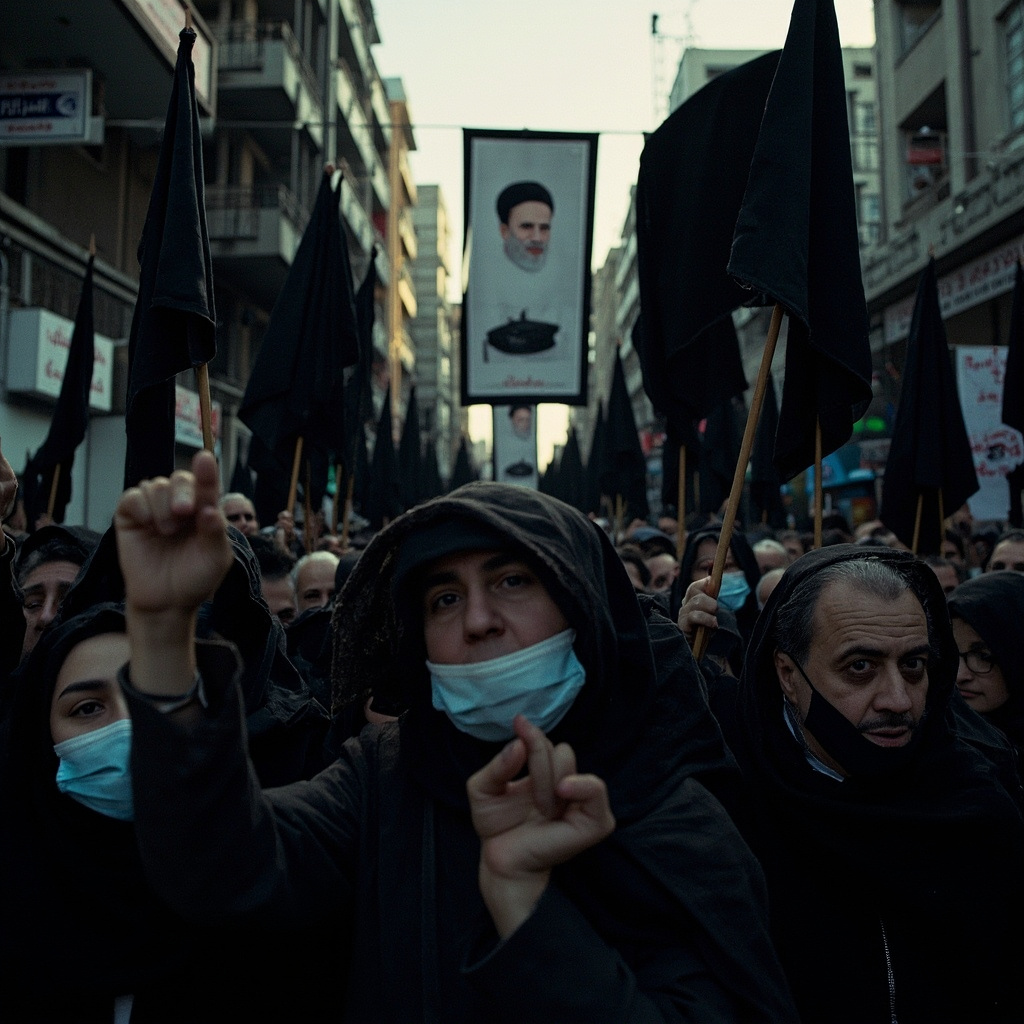
The regime's answer to decapitation is visible in its streets. Mass funerals for killed commanders have become the state's principal public ritual since the war began — processions through Tehran and the provincial capitals, coffins carried by comrades in uniform, eulogies broadcast into mourning halls. The template predates this war: when Qassem Soleimani was killed in 2020, his funeral route drew millions across multiple cities, and grief was converted into enlistment within days. Mourning is not a cost of this system. It is a production process. Each funeral supplies martyrdom narratives, recruitment imagery, and proof to a shaken public that the dead are being honored rather than avenged — an important distinction when vengeance against the United States remains beyond the regime's reach.
X read those crowds as either staged loyalty or incipient rage. Both readings miss what funerals do: they let the state perform continuity at scale, which is precisely the thing decapitation is supposed to interrupt.
The structure of this war rewards lazy metaphors. Remove the head, kill the snake, break the chain. Reality is uglier and more distributed. The Iranian state was never only one man, however powerful. It was also a web of institutions, commanders, provincial structures, ideological networks, and men trained to operate after shock.
The decapitation theory has been tested before, and the results should temper confidence. In March 2003, the war's opening strike aimed at Saddam Hussein in a Baghdad residential compound; he walked out alive, and the regime collapsed anyway three weeks later — but only because an army raised for conscripted defense chose mass surrender. Iran's parallel force is the IRGC, which has spent its entire existence fighting rather than garrisoning, and whose cadres have no tradition of capitulation to absorb them. Libya in 2011 offered the other lesson: kill or break the strongman without a successor order and the state does not transition, it dissolves. Neither precedent supports the outside fantasy that produced this campaign.
Iranians themselves carry a deeper memory: an eight-year war against Iraq fought after their founding leader's death, under bombardment, with hundreds of thousands buried, and the regime emerged more centralized and more ideological than it entered. The state has rehearsed catastrophe. It is the only kind of politics it has ever known.
That is why the key question for March 20 is no longer whether the regime has been hurt. It plainly has. The key question is whether the surviving structure has enough coercive depth to outlast the assumptions made about it.
So far, the answer appears to be yes.
And every day that answer remains yes, the war's opening logic looks less decisive than advertised.
A war that began as a test of whether decapitation could break this regime in days has become a slower experiment in whether pressure can bend it over months. The early answer favors the regime — degraded, leaderless at the top, and still standing in formation.
-- YOSEF STERN, Jerusalem