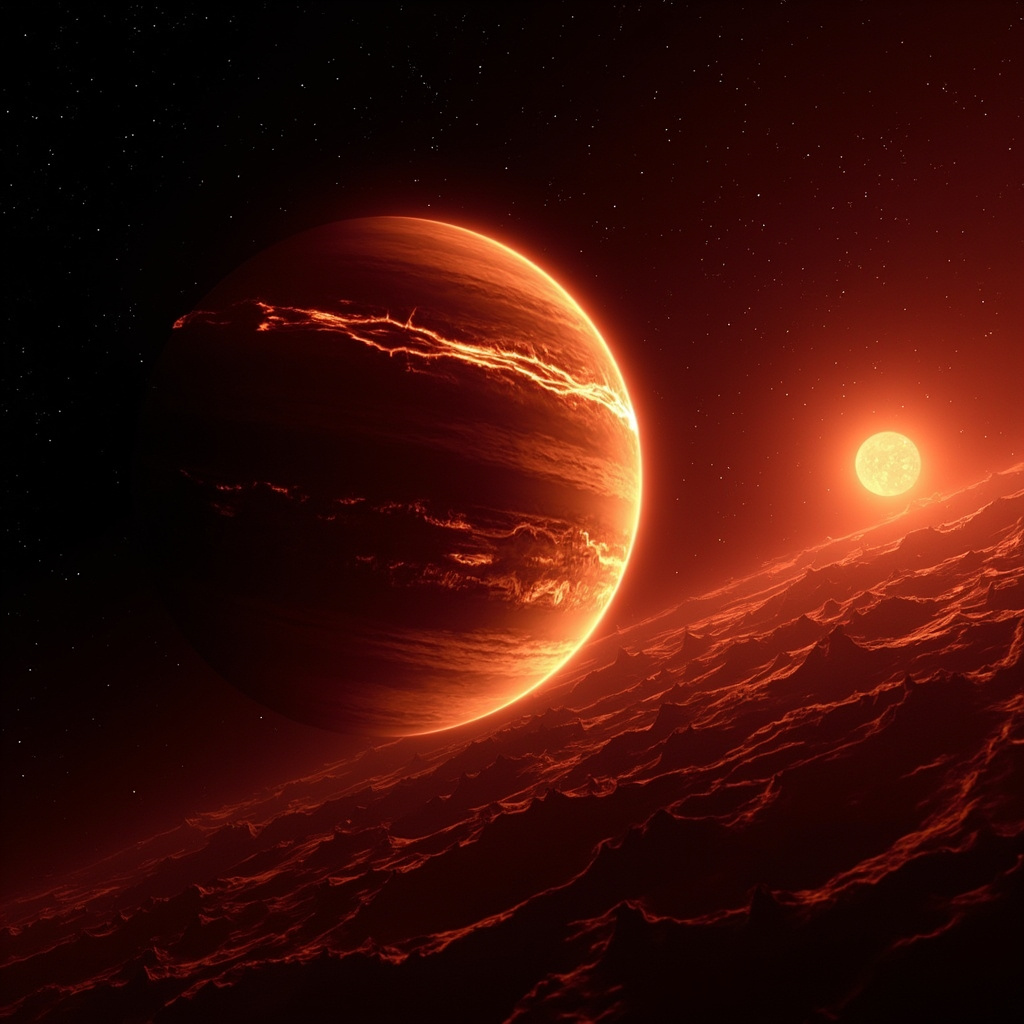
The exoplanet L 98-59 d, about 35 light-years from Earth, is not a rocky world and not a gas world. It is something new: a molten super-Earth with a global magma ocean that has persisted for approximately five billion years. [1]
An Oxford-led team published the finding in Nature Astronomy on March 16, using data from the James Webb Space Telescope. [2] Their models show that L 98-59 d's mantle is entirely molten silicate — lava, essentially — extending thousands of kilometers deep. The magma ocean stores large quantities of sulfur in its interior, producing a sulfurous atmosphere that smells, the researchers noted, like rotten eggs. [3]
The planet does not fit existing classification. Rocky super-Earths have solid surfaces. Sub-Neptunes have thick gaseous envelopes. L 98-59 d has neither. The authors suggest it is the first recognized member of a broader population of gas-rich, sulfur-laden planets sustaining permanent magma oceans — a class that had been theorized but never observed. [4]
A follow-up observation, reported March 22, found a "hidden atmosphere" on a separate molten super-Earth using the same JWST instrument. The new class may not be rare. It may simply have been invisible until now.
-- KENJI NAKAMURA, Tokyo