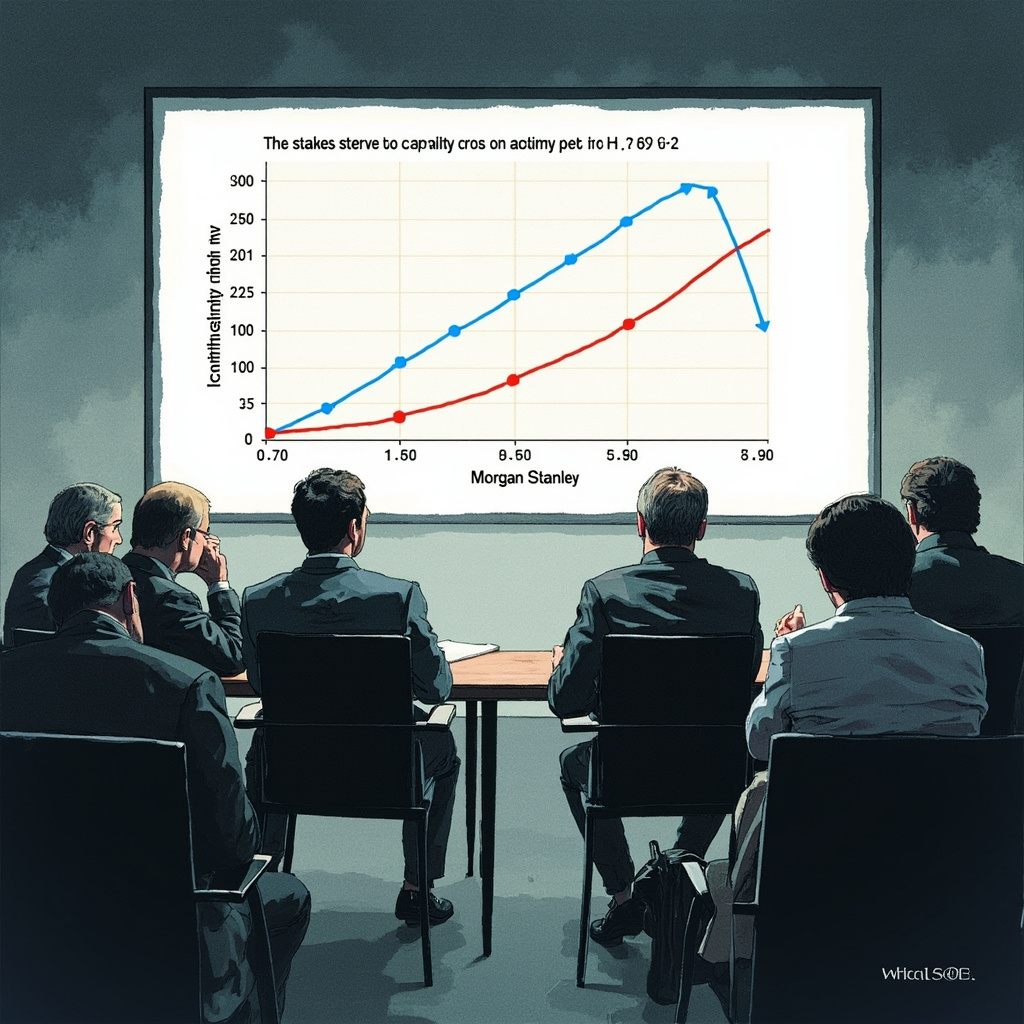
Morgan Stanley published a report in mid-March warning that a "massive AI breakthrough" driven by unprecedented compute scaling at U.S. labs could arrive in the first half of 2026, and that most investors, companies, and governments are unprepared. [1] The bank predicts next-generation AI models trained with roughly ten times more compute than current systems could produce approximately two times more capable outputs. [2]
Business Insider reported that Morgan Stanley sees AI models beginning to self-improve rapidly, which would further disrupt markets by mid-2026. [3] At the bank's annual TMT Conference in early March, Sam Altman, Jensen Huang, and a room of CEOs discussed AI's threat to the future of work. Fortune reported that the conference amounted to an acknowledgment that the disruption is no longer theoretical. [4]
Morgan Stanley's own research site offered a more measured framing, arguing that investor fears about AI disruption in software and data stocks may be "overblown" in the short term, even as the underlying capability jump is real. [5]
The report landed during a week when the world's attention was on war and energy. The AI timeline did not pause for either. Nearly $3 trillion in AI-related infrastructure investment is expected to flow through the global economy by 2028, according to Morgan Stanley Research — a figure that dwarfs the war's direct military costs.
-- DAVID CHEN, Beijing