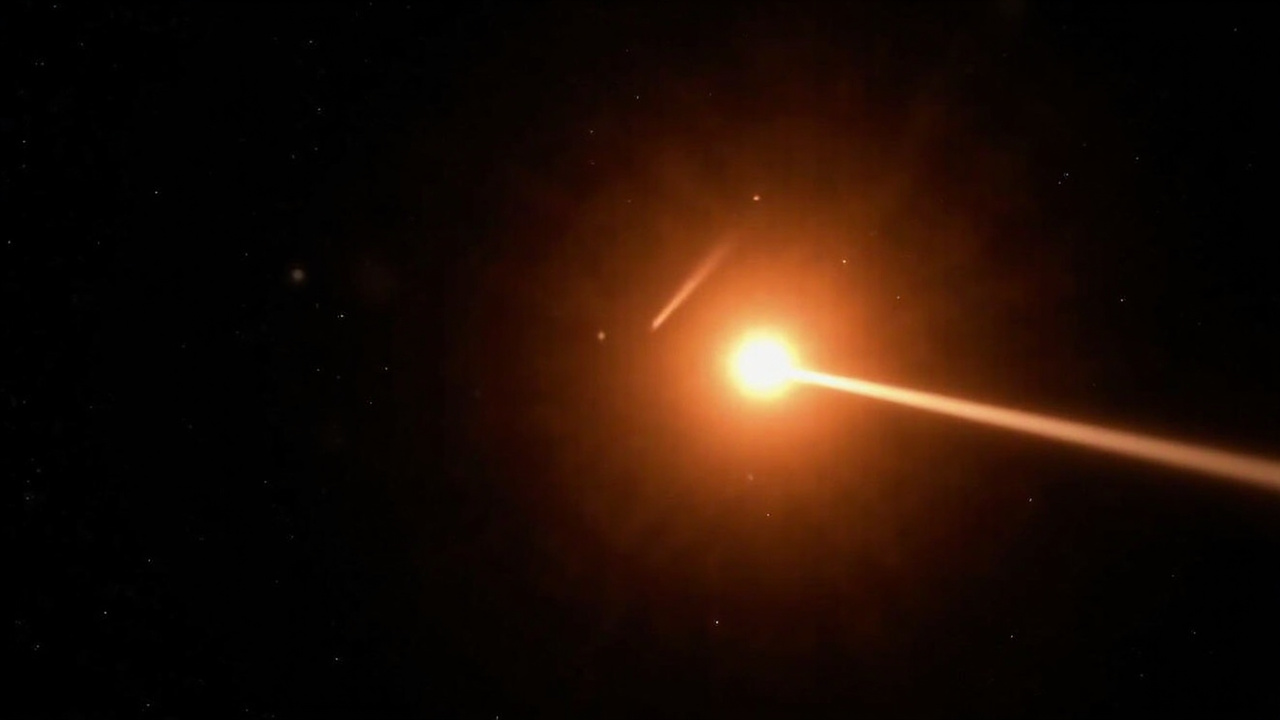
Comet C/2026 A1 (MAPS), a rare Kreutz family sungrazer that had been the subject of weeks of will-it-survive speculation, disintegrated during its perihelion passage on April 4, 2026. The comet passed within approximately 99,400 miles of the sun's surface -- roughly 1 percent of the Earth-sun distance -- at 10:22 a.m. EDT [1]. It never emerged from the other side.
The comet was discovered on January 13 by a group of French amateur astronomers using telescopes in Chile. The acronym MAPS represents the discoverers' surnames: Maury, Attard, Parrott, and Signoret [1]. Astronomers classified it as a Kreutz sungrazer, part of a family of comets believed to be fragments of a massive parent body that broke apart centuries ago, named after German astronomer Heinrich Kreutz [1].
SOHO coronagraph imagery captured the final hours. The comet brightened dramatically as it approached perihelion, moving at nearly 600 kilometers per second [2]. After perihelion, only a diffuse dust cloud appeared on the sun's far side -- no solid nucleus, no tail, no survival [3]. Scientists had warned that the comet's small size made disintegration the likely outcome. The intense heat and tidal forces at that proximity shred all but the largest nuclei.
Had it survived, MAPS would have been visible to the naked eye, potentially brighter than Venus. Instead, it became what most sungrazers become: dust.
-- KENJI NAKAMURA, Tokyo