TOKYO — Somewhere between the Earth and the Moon, traveling at a velocity that will reach 25,000 miles per hour during re-entry, four human beings are preparing to come home.
Commander Reid Wiseman, Pilot Victor Glover, Mission Specialist Christina Koch, and Canadian Space Agency astronaut Jeremy Hansen launched aboard the Orion spacecraft on April 1 from Kennedy Space Center. [1] On Sunday, they flew past the far side of the Moon, becoming the first humans to see large portions of the lunar far side with their own eyes. They eclipsed the distance record set by Apollo 13 in 1970, traveling farther from Earth than any human in history. [2]
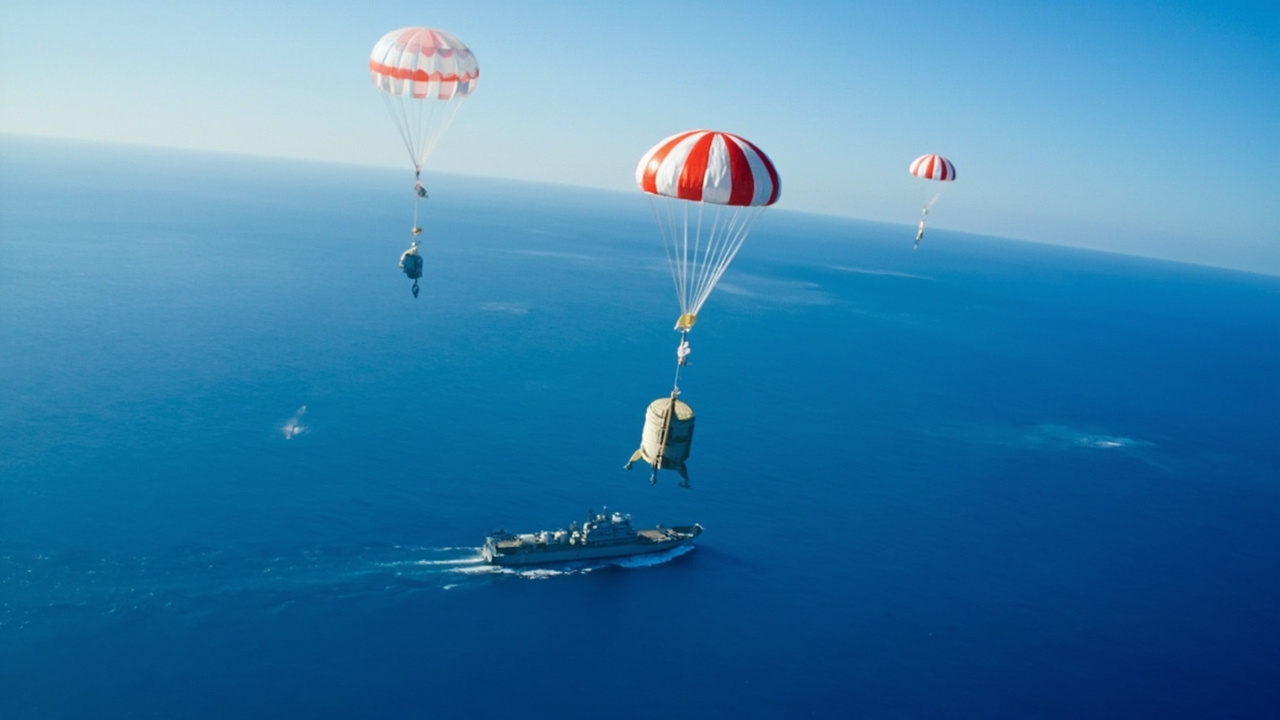
Now they are falling back to us. Splashdown is scheduled for approximately 8:07 p.m. EDT on Friday, April 10, in the Pacific Ocean off the coast of San Diego. [3] NASA is monitoring a Pacific storm system that could affect recovery operations, though current forecasts show favorable conditions at the landing site. [4]
The Crater Named Carroll
The mission's most publicly resonant moment came not from engineering but from grief. During the lunar flyby on Sunday, the crew proposed naming a crater on the Moon's far side "Carroll" — after Commander Wiseman's late wife, Carroll Wiseman, who died in 2020. [5]
The dispatch to Mission Control, broadcast live, was tearful. Wiseman's voice broke as he described what his wife would have thought of the view. Koch, floating beside him, placed a hand on his shoulder. The moment, captured on NASA's live feed, has been viewed over 40 million times across platforms. [5]
The New York Times reported that a second crater was proposed for naming after the Orion spacecraft itself, following the tradition of Apollo-era crews naming features they observed during their missions. [5] The International Astronomical Union will review the proposals, though historically such crew-nominated names have been approved.
The Science Behind the Sentiment
The mission's scientific objectives extend beyond symbolism. Artemis II is the crewed test flight for the Space Launch System and Orion combination that will eventually carry astronauts to the lunar surface on Artemis III, currently targeted for 2028. The crew conducted systems checkouts in high Earth orbit, tested Orion's life support during the extended transit, and performed the first crewed skip-entry re-entry maneuver — a technique where the capsule bounces off the upper atmosphere to reduce g-forces before final descent. [1]
The skip-entry is the mission's most critical untested element. Apollo capsules performed direct entries. Orion's skip-entry requires precise navigation at hypersonic speeds, with the capsule dipping into the atmosphere, rising back to space, and then descending for final splashdown. The maneuver has been tested uncrewed during Artemis I in 2022, but never with humans aboard. [1]
Recovery operations will be led by the U.S. Navy's USS John P. Murtha, stationed off San Diego. The crew will spend approximately two hours in the capsule after splashdown before being extracted by Navy divers and helicopter. [3]
For a world consumed by war and ceasefire arithmetic, the Artemis II crew offers a different kind of news: four people went farther than anyone has ever gone, named a crater after someone they loved, and are now coming home. The physics of their return is unforgiving. The parachutes must open. The heat shield must hold. Friday evening, the Pacific Ocean will either welcome them or not. There is no diplomatic ambiguity in splashdown.
-- KENJI NAKAMURA, Tokyo