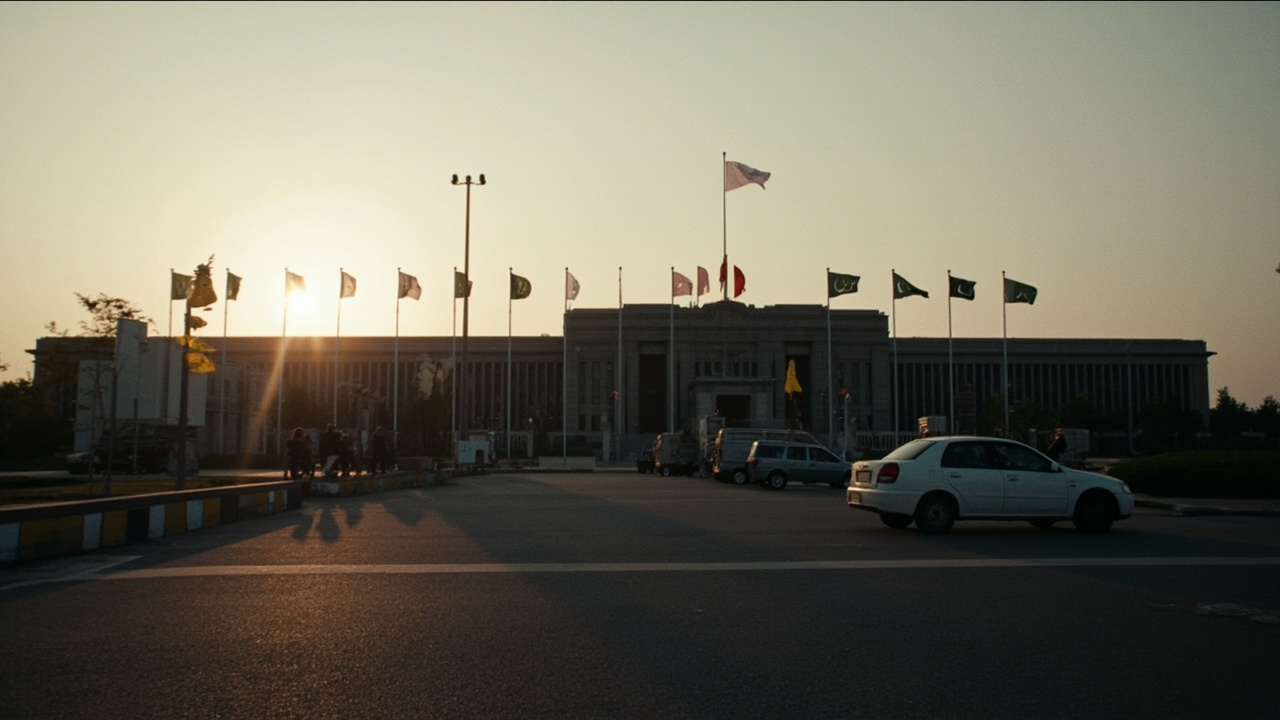
BRUSSELS — The delegations are assembling and the positions are irreconcilable. Vice President JD Vance, who spent Tuesday campaigning for Viktor Orbán in Budapest, departed Hungary on Wednesday to prepare for what the White House calls "in-person talks" with Iran in Islamabad on Friday. [1] Iran's Parliament Speaker Mohammad Baqer Qalibaf will lead Tehran's delegation. [2] Pakistan's Prime Minister Shehbaz Sharif, who brokered the venue, has framed the meeting as the path toward "a conclusive agreement to settle all disputes." [3]
The optimism is misplaced. Not because the parties are insincere, but because what they want is structurally incompatible.
Iran's 10-point plan, published ahead of the talks, demands that the United States accept Iran's right to enrich uranium, lift all primary and secondary sanctions, pay compensation for war damages, and agree to a permanent end to hostilities covering Lebanon and Gaza. [4] Trump called the plan "a workable basis on which to negotiate." [4] His own White House then clarified that the president's "red line" against Iranian nuclear enrichment remains firmly in place. [5]
This paper wrote yesterday that Iran's ten-point plan was an opening bid dressed as a framework. That assessment has not changed. But the gap between bid and baseline is not the kind that splits the difference. Enrichment is binary: either Iran enriches or it does not. The United States has treated denuclearization as a prerequisite for normalization since the Bush administration. Iran has treated enrichment as a sovereign right since the Ahmadinejad era. Twenty-three years of negotiations have not bridged this gap.
Who Is at the Table
Vance brings the authority of a vice president but not the flexibility of a foreign minister. His Budapest trip — in which he endorsed Orbán, accused the EU of "disgraceful interference" in Hungary's election, and praised illiberal governance — has already complicated his credibility with European allies who would need to endorse any eventual deal. [6]
Qalibaf brings institutional weight but not Supreme Leader authority. As parliament speaker, he can negotiate frameworks but cannot make binding commitments on enrichment or military posture without Khamenei's explicit approval. Iran's negotiating history is littered with agreements that parliament endorsed but the Guardian Council modified. [2]
The venue itself carries meaning. Pakistan, which shares a border with Iran and maintains a complex relationship with both Washington and Tehran, has positioned itself as a neutral facilitator. Sharif's invitation was issued within hours of the ceasefire announcement — a speed that suggests prior coordination rather than spontaneous diplomacy. [3]
The Enrichment Wall
The 10-point plan's demand for acceptance of enrichment is its most consequential clause and its most immovable. Points four and five call for the lifting of all sanctions — a position that, while ambitious, has precedent in the 2015 JCPOA framework. Points six and seven address compensation and reconstruction — expensive but negotiable. Point three, demanding a permanent end to hostilities including Lebanon, has been transformed by Wednesday's 254 deaths from a wish-list item into a demand Tehran cannot retract without domestic humiliation. [4]
But enrichment is the wall. The JCPOA permitted enrichment to 3.67 percent. Iran has since enriched to 60 percent and, according to IAEA reports, has accumulated enough material for multiple weapons at that level. The United States position, reiterated by the White House on Wednesday, is that any deal must address the nuclear dimension "comprehensively." [5]
A two-week ceasefire cannot resolve a nuclear dispute that outlived the Obama administration, the first Trump administration, the Biden administration, and now tests the second Trump administration. Islamabad may produce a framework for further talks, a timeline, or a communiqué. It will not produce a resolution on enrichment. The question is whether it can produce enough to keep Hormuz open.
-- HENDRIK VAN DER BERG, Brussels