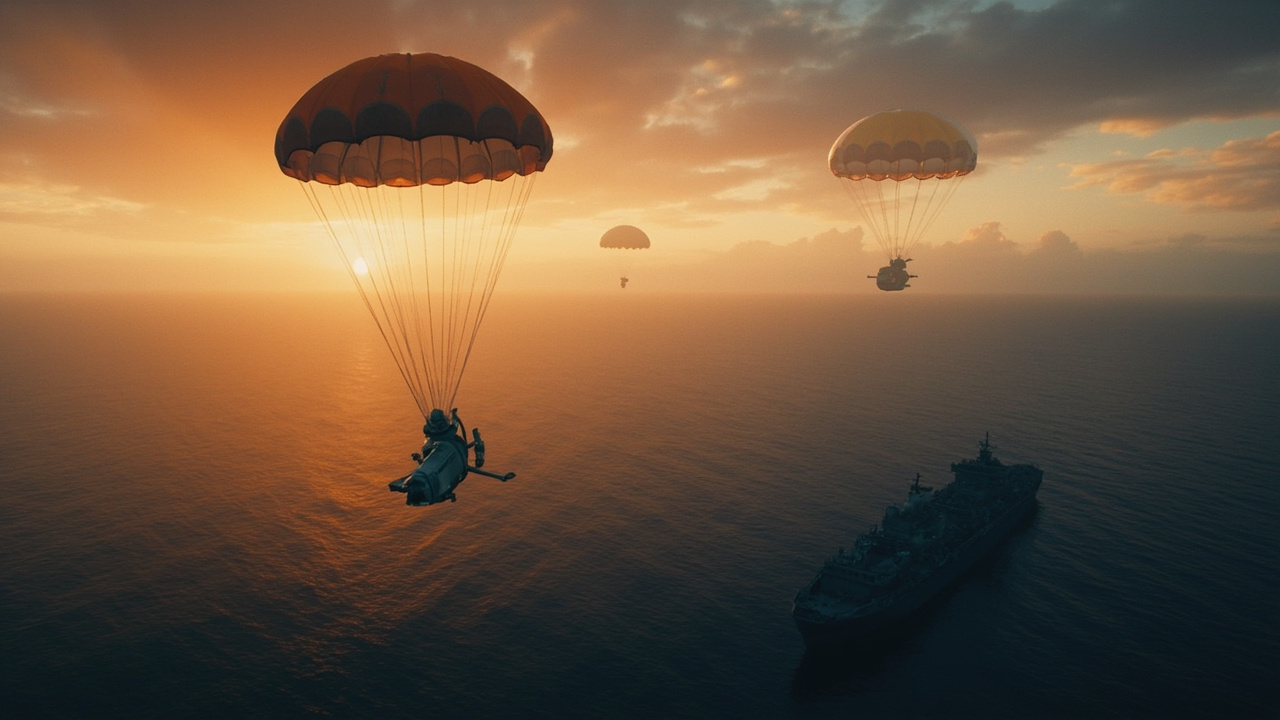
At 8:07 PM Eastern Time tonight, if everything goes as planned — and in spaceflight, the phrase carries a weight that ordinary language cannot convey — a 16.5-foot-wide capsule named Orion will slam into the upper atmosphere at approximately 24,500 miles per hour, the fastest any vehicle carrying human beings has ever travelled during re-entry [1]. Inside it, four people will experience forces pressing them at nearly four times their own body weight into custom-molded seats while a heat shield made of an ablative material called AVCOAT chars, cracks, and burns away at temperatures exceeding 5,000 degrees Fahrenheit. If the shield holds, three drogue parachutes will deploy at 25,000 feet, followed by three main canopies at 5,000 feet, and Orion will drift down to the Pacific Ocean off the coast of San Diego, where the USS John P. Murtha is already on station, her recovery swimmers briefed, her crane tested, her deck cleared [2].
If the shield holds.
This is the anxiety that has quietly threaded through every day of Artemis II's ten-day mission, the detail that NASA has addressed in press conferences with the measured calm of an institution that has practised catastrophe. During Artemis I, the unmanned test flight in 2022, more than one hundred small cracks were discovered in Orion's heat shield after splashdown — not in the AVCOAT itself but in the charred outer layer, the material that is supposed to ablate away in controlled fashion [1]. Engineers spent two years analyzing the cracks, modifying the shield's formulation, and running computational models. They concluded the cracks were cosmetic, not structural. They concluded the shield was safe. Tonight, four human beings are staking their lives on that conclusion.
Their names deserve saying. Commander Reid Wiseman, a Navy test pilot from Baltimore who has logged 165 days in space. Pilot Victor Glover, who in 2020 became the first Black astronaut to serve on a long-duration mission aboard the International Space Station. Mission Specialist Christina Koch, who holds the record for the longest single spaceflight by a woman — 328 days — and who was part of the first all-female spacewalk. And Mission Specialist Jeremy Hansen, a Canadian fighter pilot from London, Ontario, who has never been to space before and who, as yesterday's coverage of the crew preparing for splashdown noted, has spent the mission with the wide-eyed seriousness of a man who understands exactly how improbable his presence on this flight has been [3].
252,756 Miles
The number is worth pausing on. At the mission's farthest point, the four crew members were 252,756 miles from Earth — farther than any human being has ever travelled from the planet on which our species evolved, farther than the Apollo astronauts who walked on the Moon, farther than anyone in the 300,000-year history of Homo sapiens [1]. From that distance, Earth is not a marble. It is not the "pale blue dot" of Carl Sagan's famous photograph, which was taken from four billion miles away. At a quarter-million miles, Earth is a vivid blue-and-white disk, large enough to see the continents, small enough to cover with an outstretched thumb. The crew described it in a downlink on April 4 as "impossibly beautiful."
They did other things, too. On April 6, they watched a total solar eclipse from behind the Moon — an event that no human eye had ever witnessed. From their vantage point, the Sun disappeared behind the lunar far side, its corona visible for seven minutes as a ring of incandescent plasma framing a disk of absolute black [4]. Koch, who has a background in electrical engineering and physics, described the corona as "structured fire," which is both scientifically inaccurate and poetically precise.
Hansen, who had been relatively quiet on the public downlinks, spoke at length about the far side of the Moon, which the crew observed from a distance of approximately 5,600 miles. He described the craters as "violence frozen in time" — billions of years of asteroid impacts preserved in perfect detail because there is no atmosphere to erode them, no water to fill them, no life to soften their edges. During a private crew moment that was later shared with mission control, Wiseman named a small, unnamed crater on the far side after his late wife's grandmother, a gesture that has no legal standing under the Outer Space Treaty but that carries, in the silence of deep space, its own authority [4].
The Long Fall
The physics of return are merciless. Orion has been falling toward Earth since Wednesday, when its service module — the European-built cylinder that provided propulsion, power, and life support for the entire mission — was jettisoned in a planned separation [1]. The capsule, now alone, is following a trajectory that will bring it into the atmosphere at an angle of negative 6.2 degrees. Too steep and the deceleration forces will exceed human tolerance. Too shallow and the capsule will skip off the atmosphere like a stone off water — which is, in fact, part of the plan.
Orion uses what NASA calls a "skip entry" profile, a technique in which the capsule dips into the atmosphere, generates lift to skip back out briefly, and then re-enters for a final descent [2]. The skip serves two purposes: it reduces the peak heat load on any single point of the shield, and it allows for a more precise splashdown location. The technique was used on Apollo, abandoned for the Space Shuttle, and resurrected for Orion. It is one of those ideas in engineering that sounds alarming — the capsule will bounce off the atmosphere — but is in fact more conservative than the alternative.
The crew will experience the first phase of re-entry as a gradual increase in vibration and a faint orange glow outside the windows that deepens to white as the plasma sheath envelops the capsule. For approximately five minutes during each atmospheric pass, they will lose all communication with mission control — the plasma is too hot and too ionized for radio signals to penetrate [3]. These are the minutes that flight directors have described, in characteristically understated fashion, as "the quiet time."
Recovery
The USS John P. Murtha, an amphibious transport dock of the San Antonio class, has been on station in the Pacific recovery zone since Tuesday. Her crew has practised the recovery sequence fourteen times in the past six months, using a boilerplate capsule weighted to match Orion's mass [2]. When the real capsule splashes down — if the winds and currents cooperate, within two miles of the ship — Navy divers will approach in rigid-hulled inflatable boats, attach a sea anchor to prevent drift, and secure a tow line. The capsule will then be winched into the Murtha's well deck, a flooded compartment at the ship's stern that can be drained to leave Orion sitting on dry steel.
It will be the first time the United States Navy has recovered a crew from a lunar mission since December 19, 1972, when the USS Ticonderoga plucked Apollo 17's Gene Cernan, Ron Evans, and Harrison Schmitt from the Pacific. Fifty-four years. More than half a century in which no human being left low Earth orbit, in which the Moon receded from destination to symbol, in which the species that had walked on another world contented itself with circling its own [1].
What They Brought Back
Artemis II carried no lunar samples. The crew did not land. They flew around the Moon and came home, as Apollo 8 did in 1968, as Apollo 10 did in 1969 — scouting missions, proof-of-concept flights, rehearsals for the landing that Artemis III is supposed to attempt in 2028.
But they brought back something. The crew recorded a recreation of the opening credits of the television show Full House from inside the Orion capsule, using handheld cameras and a spirit of absurdity that seemed, from 252,756 miles away, like an act of defiance against the void [4]. They brought back Koch's description of the corona. They brought back Hansen's naming of a crater. They brought back ten days of data on how the human body responds to deep-space radiation beyond the Van Allen belts — data that will inform every crewed mission to the Moon and Mars for the next generation.
And tonight, if the heat shield holds, they will bring themselves back. Four people, falling through fire, aiming for a patch of ocean where a ship is waiting. The physics are merciless, and they are also, if you let yourself feel it, sublime.
Splashdown is scheduled for 8:07 PM Eastern. The quiet time begins at approximately 7:49 PM. After that, we wait.