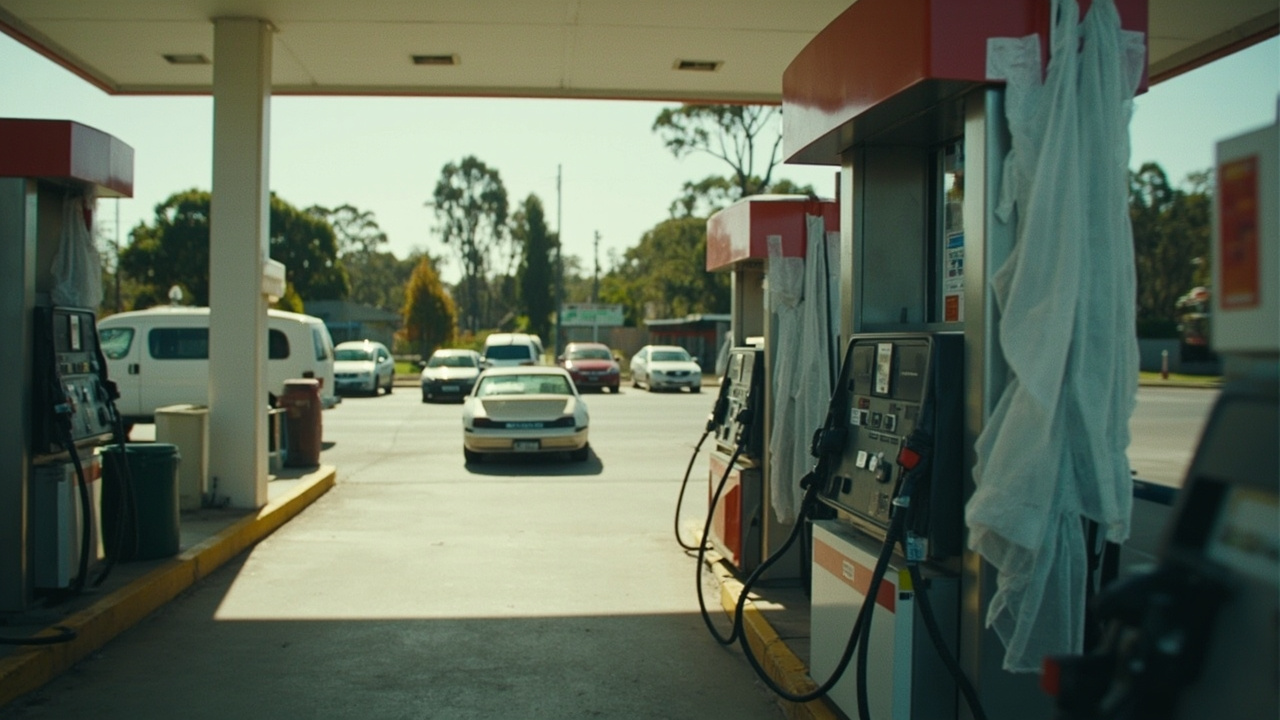
The number of dry petrol stations across Australia fell to 274 on Thursday, down from 555 on April 6 — a decline of more than half in four days. The improvement is being attributed to the US-Iran ceasefire agreement, which has eased panic buying and allowed delayed fuel shipments to work through the supply chain. But the government is warning Australians not to mistake a psychological signal for a physical solution. [1] [2]
Australia imports roughly 90 percent of its fuel. When the Strait of Hormuz — through which about 15 million barrels of crude pass daily — effectively closed at the start of the Iran conflict, the country found itself running on pre-war inventories. Hundreds of stations ran dry in late March, triggering panic buying that compounded the physical shortage. Traffic in Sydney and Melbourne roughly halved as commuters rationed their driving. [2] [3]
The ceasefire, fragile as it is, has calmed the speculative and behavioral dimensions of the crisis without yet solving the material one. Iran has not fully reopened the strait. Six ships passed through on Thursday, according to CBS, but that is a fraction of normal traffic. The fuel reaching Australian pumps now was ordered weeks ago. [1] [4]
"Australia is effectively running on pre-conflict fuel shipments, and there is no certainty about what replaces them," said Energy Minister Madeleine McDonald. "Prices this week are not an indicator of what lies ahead." The government has underwritten contracts with Australia's largest fuel suppliers, Ampol and Viva Energy, to secure gasoline and diesel imports, and has lowered diesel quality standards for six months to broaden the pool of acceptable product. [1] [3]
The political optics are delicate. Prime Minister Albanese's government faces criticism for Australia's vulnerability — a country that exports enormous quantities of gas and coal yet cannot fuel its own cars for more than a few weeks without imports. The Lowy Institute and other analysts have warned for years that Australia's fuel reserves fall well below the International Energy Agency's recommended 90-day buffer. [3]
What the ceasefire has done is buy time, not solve the problem. The behavioral improvement — fewer people topping off tanks out of fear — matters enormously for station-level availability. But if the strait remains partially closed and the ceasefire collapses, as several parties have threatened, Australia would be back at 500 dry stations within days. [2]
The fuel crisis has also exposed a structural truth that predates the war. Australia chose energy export revenue over energy self-sufficiency and assumed global supply chains would always deliver. For three weeks in March, they did not. The ceasefire gives the country breathing room, but the lesson is already visible at every empty pump: 90 percent import dependence is a policy choice, and choices have consequences.
-- CHARLES ASHFORD, London