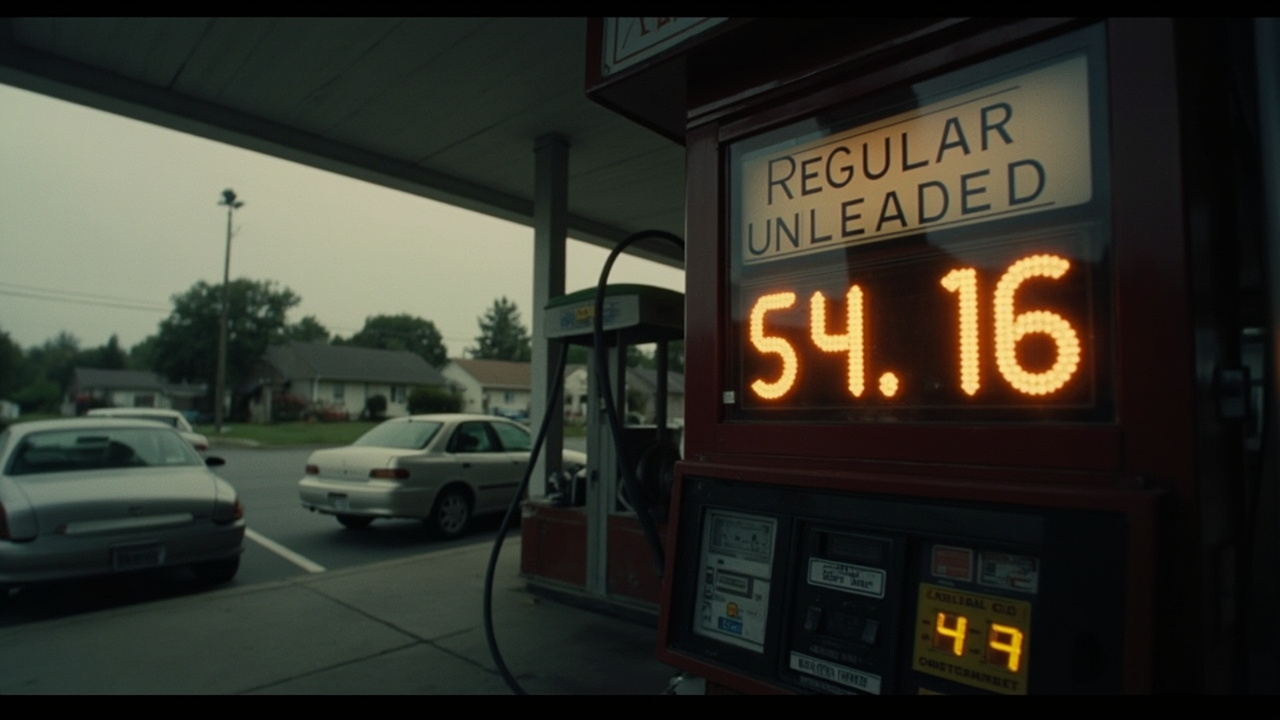
The number on the sign at the gas station is, in one sense, just a number. It is $4.16, which is what the American Automobile Association says the national average for a gallon of regular gasoline was on April 9, 2026 [1]. This is not, by itself, the kind of figure that makes history. History is made by the distance between where a number was and where it is now, and by the speed at which it traveled.
Six weeks ago, on February 26, the national average was $2.98. That was before the war. Since then, the price of gasoline in the United States has risen by roughly 40 percent — a dollar and eighteen cents per gallon — in what AAA describes as the fastest sustained increase since Hurricane Katrina swept through the Gulf Coast refineries in 2005 [1]. The number jumped a full dollar in a single month, from late February to late March, the kind of velocity that makes economists reach for superlatives and ordinary drivers reach for their credit cards [3].
What makes this particular price surge unusual is not merely its speed but its stubbornness. There is a concept in commodity markets known as a "war premium" — the surcharge that global uncertainty imposes on a barrel of crude oil, and which eventually trickles down through the refinery chain to the LED signs at every gas station in America. War premiums are supposed to be temporary. They spike, they linger, and then, as the situation stabilizes or the market adjusts, they fade. This one is not fading.
California, which has always occupied a special position in the American gasoline market — part victim of its own environmental regulations, part canary in the national coal mine — is now at $5.89 per gallon [2]. That figure, remarkable in isolation, becomes almost surreal when you remember that Californians were paying roughly $4.50 before the conflict began. Drivers in Arizona are at $4.70. In Nevada, $4.96. In Hawaii, $5.55. The national map published by AAA looks like a heat map of consumer pain, with the entire West Coast and the Sun Belt glowing red [1].
This is the first time the national average has exceeded $4 since August 2022, when the last energy shock was working its way through the system [1]. AAA confirmed on April 2 that the threshold had been crossed, and by April 9 the price had climbed another eight cents in a single week. The mechanics of the increase are straightforward: crude oil prices remain elevated, refinery capacity has not expanded to meet the shock, and the sanctions architecture that the United States has constructed around the conflict has disrupted supply chains that were already operating at thin margins [3].
The sanctions waiver — the temporary exemption that allows certain Iranian crude exports to continue flowing to allied nations — is set to expire on April 19. If it is not renewed, and there are growing signals from the administration that renewal is not guaranteed, the supply squeeze will tighten further. The ceasefire announced this week has introduced a flicker of hope, but commodity traders are not in the hope business. Futures markets have priced in continued elevation through the summer driving season.
Bank of America's commodity research team has forecast that the March Consumer Price Index, due for release next week, will show a 1.0 percent month-over-month increase, driven in large part by a 10.6 percent surge in the energy sub-index. If that forecast holds, it will be the largest single-month energy contribution to CPI since the early months of the pandemic recovery. Prediction markets — the crowdsourced betting platforms that have become a parallel source of economic forecasting — currently show a 90 percent probability that annual inflation will exceed 3.5 percent in 2026, a figure that would put it well above the Federal Reserve's target and complicate any plans for rate cuts.
The political arithmetic is equally stark. Democratic members of the Joint Economic Committee have estimated that American drivers have collectively paid $8.4 billion in additional fuel costs since the war began [4]. That figure, while difficult to verify precisely, captures a real phenomenon: the war tax that nobody voted for, the line item that appears on no budget but shows up at every pump.
There is a particular irony in all of this that the market, being amoral, is incapable of appreciating. The current president campaigned on a promise of cheap energy — "drill, baby, drill" — and took office with domestic oil production at record levels. The United States remains the world's largest producer of crude oil. And yet the price at the pump is 40 percent higher than it was six weeks ago, because the price of gasoline in America has never been purely a function of American production. It is a function of global supply, global demand, and global instability, and no amount of domestic drilling can fully insulate a market that is integrated into a world where tankers are rerouting around war zones and refineries are adjusting to sanctioned crude [3].
The question is no longer whether gas prices will come down. It is whether $4.16 is a waypoint or a destination. If the ceasefire holds and the sanctions waiver is renewed, analysts see a path back below $4 by midsummer. If either condition fails — and the probability of both failing is not trivial — the national average could push toward $4.50 or higher, with California approaching the psychologically devastating $6 threshold.
For now, the number on the sign is $4.16. It was $2.98 six weeks ago. And the distance between those two numbers tells you more about the cost of this war than any Pentagon briefing ever will.