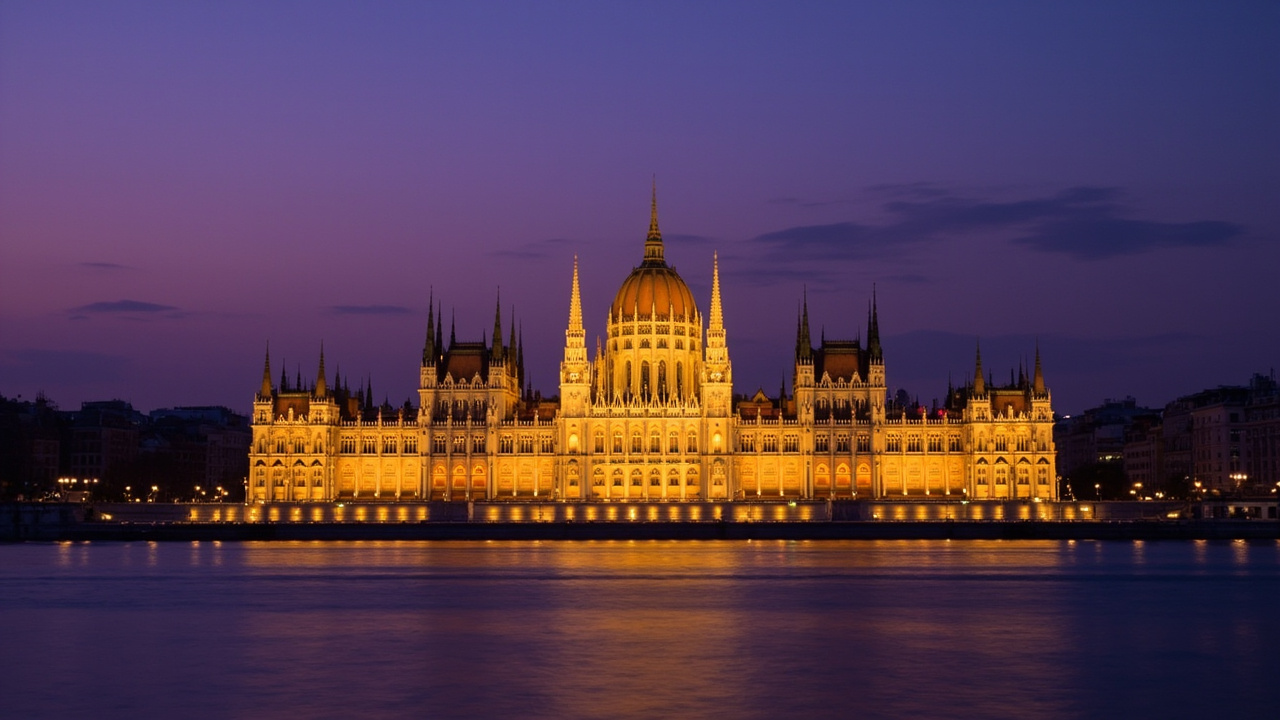
The arithmetic is so simple that it has acquired the quality of an incantation. One hundred and thirty-three seats. Two-thirds of Hungary's 199-seat parliament. The threshold at which a governing party can amend the constitution, restructure the courts, and rewrite the cardinal laws that Viktor Orbán spent sixteen years embedding into the foundations of the Hungarian state like rebar in concrete. The Idea Institute and Median polling consortium, in its final pre-election survey conducted April 7-9, projects Péter Magyar's Tisza party at 138 to 142 seats [1]. The supermajority is not a fantasy. It is a polling median.
Yesterday's account of how this is Europe's biggest democratic development explored the three-day horizon. Now it is two. And the numbers have not moved in Orbán's direction.
The Poll and Its Discontents
Among decided voters, Tisza leads Fidesz 50 to 37 percent [1]. This is not a margin that lends itself to dramatic reversals. It is a chasm — the kind of gap that, in a functioning democracy with independent media and impartial election administration, would produce the sort of subdued commentary about "transition planning" and "the incoming government's priorities." Hungary is not that democracy, which is precisely why the election matters.
The 21 percent of voters who remain undecided constitute the only uncertainty worth discussing [1]. Undecided voters in Hungarian elections have historically broken toward the incumbent, a phenomenon attributable less to late-blooming enthusiasm for Fidesz than to the machinery of state pressure — the local mayors who distribute public works contracts, the village notaries who know which families depend on government housing, the quiet calculus of citizens who have spent sixteen years learning that political dissent has professional consequences. Whether that machinery functions as designed on Sunday, or whether its gears have finally seized, is the question the polls cannot answer.
Government-friendly pollsters — Századvég, Nézőpont, the institutes whose funding flows through channels that terminate in the prime minister's office — still show Fidesz ahead [1]. This is expected. Their function is not measurement but morale. They exist to provide Fidesz voters with the psychological comfort of inevitability and to give state media a number to cite when dismissing independent polls as opposition propaganda. In 2022, these same institutes projected a comfortable Fidesz majority. They were correct that time. They may not be this time.
What a Supermajority Means
The distinction between winning an election and winning a supermajority is the distinction between governing a country and remaking it. A simple majority lets Tisza form a government, appoint ministers, pass ordinary legislation. A two-thirds majority lets it do what Orbán did in 2010: rewrite the constitutional order [1][3].
This means, concretely, that a Tisza supermajority could reverse the cardinal laws — legislation that Orbán deliberately enshrined at two-thirds thresholds to make them repeal-proof against any ordinary successor government. The media authority. The election commission's composition. The structure of the constitutional court. The central bank's governance framework. The rules governing the prosecution service. All of these were designed to outlast Orbán himself, to make Orbánism a permanent feature of Hungarian governance regardless of who held the prime minister's office. A supermajority dissolves that permanence in a single parliamentary term [3].
It would also unlock approximately €20 to 22 billion in frozen European Union funds — cohesion payments, recovery plan disbursements, and agricultural subsidies that Brussels has withheld since 2022 over rule-of-law concerns [3]. For a country whose GDP is roughly €180 billion, this is not a rounding error. It is an economic event. The prospect of these funds flowing again has already influenced the forint, which has strengthened modestly against the euro in recent weeks as Tisza's polling lead has stabilized.
The Prediction Markets
Polymarket and Kalshi, the prediction platforms that have become a parallel polling infrastructure for elections that traditional pollsters struggle to model, place the probability of a Tisza victory at 79 percent [2]. This is a high number, though not an unprecedented one — prediction markets assigned similar probabilities to outcomes that subsequently did not occur. What the markets capture, however, is the aggregated judgment of people willing to risk money on their assessment, which tends to impose a certain discipline that opinion surveys do not.
The 79 percent figure notably prices in the possibility that Hungary's election infrastructure may not perform neutrally. Orbán's government controls the election commission, the state media that dominates rural information environments, and the postal voting system that serves the Hungarian diaspora. A clean Tisza victory requires not just votes but a margin large enough to overwhelm the structural advantages that sixteen years of institutional capture have provided to Fidesz.
The Turnout Question
The most striking number in the pre-election data is not a vote share but a participation rate. Eighty-nine percent of registered voters say they intend to vote on Sunday [3]. In 2022, actual turnout was approximately 70 percent. If anything close to 89 percent materializes, it would represent the highest participation rate in Hungarian democratic history — a number more commonly associated with founding elections in newly independent states than with the sixth consecutive ballot in a consolidated, if deteriorating, democracy.
High turnout in Hungary has historically favored the opposition, for the straightforward reason that Fidesz's base is disciplined and votes reliably while disaffected Hungarians are more likely to stay home. An 89 percent turnout, if real, suggests that the disaffected have become the engaged — that the quiet, apolitical middle of Hungarian society has decided, after sixteen years, that this particular election is not one to sit out.
The Threshold Party
One additional variable warrants attention. Our Homeland, the far-right party that occupies the space to Fidesz's right, is polling near the 5 percent parliamentary threshold [1]. If it clears that barrier, it would likely win 5 to 6 seats — seats subtracted from the proportional pool in a way that marginally reduces Tisza's total. If it falls below 5 percent, those votes are wasted and the seat distribution shifts slightly in Tisza's favor. The difference between Our Homeland at 4.9 percent and 5.1 percent could, in a close supermajority scenario, determine whether Magyar gets 133 seats or 131.
Election day is Sunday, April 12 [4]. Polls open at six in the morning. The first reliable exit polls are expected by early evening. By midnight in Budapest, the question will likely have an answer: whether the arithmetic that has been recited like a prayer — 133, 133, 133 — translated into constitutional power, or whether it remained, as so many projections before it, a number on a page.
Two days is not a long time. It is also, for Orbánism, potentially all the time that remains.