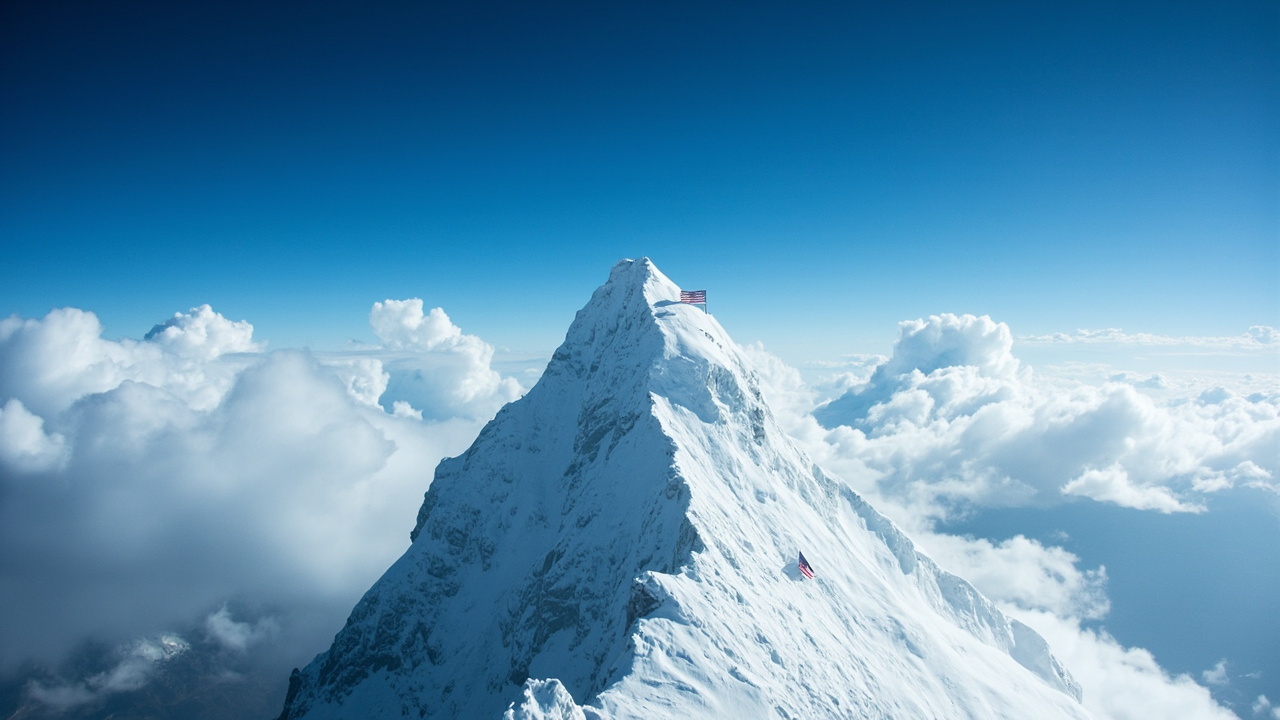
It is always the same story with Americans and their mountains. They climb them not merely to stand at the top but to prove something about themselves — some proposition about will, or freedom, or the national character — that the mountain itself has no interest in confirming. Jim Whittaker, who died Tuesday at his home in Port Townsend, Washington, at the age of 97, understood this better than most [1]. He had been the first American to reach the summit of Mount Everest, and he had spent the remaining sixty-three years of his life trying to explain what that meant, or whether it meant anything at all.
The facts of the ascent are simple enough. On May 1, 1963, Whittaker and the Sherpa climber Nawang Gombu reached the summit of Everest — 29,032 feet above sea level, the highest point on Earth — ten years after Sir Edmund Hillary and Tenzing Norgay had become the first humans to do so [2]. Whittaker hammered an American flag into the ice. He took a photograph. He came down. And then the country that had sent him up there did what countries do: it turned him into a symbol.
There were magazine covers and speaking tours and a parade in Seattle. President Kennedy awarded him the Hubbard Medal. He became, in the parlance of the era, a national hero — one of those figures the Cold War produced with reliable frequency, men whose achievements on remote mountaintops or in orbital capsules were understood as evidence that the American system worked, that its citizens were capable of feats that rivaled or surpassed anything the Soviets could manage [3]. This was the context in which Whittaker's climb was received: not as a personal accomplishment but as a geopolitical statement.
What is interesting about Whittaker — what distinguished him from many of the era's manufactured heroes — is that he seems to have been genuinely uninterested in the symbolic apparatus that was constructed around his achievement. He went back to work. He had been REI's first full-time employee, hired in 1955 by the co-op's co-founder Lloyd Anderson, and he continued to work there after Everest. He became president and CEO in 1971 and served until 1979, a period during which the company's membership grew from roughly 250,000 to more than 900,000 [4]. He was, in other words, a businessman who climbed mountains, or a mountaineer who ran a business — the distinction, in Whittaker's case, was never entirely clear.
But there was another life that ran parallel to the commercial one, and it was shaped by proximity to tragedy. Whittaker became a close friend of Robert F. Kennedy — a friendship rooted in shared convictions about public service and the outdoors [3]. He served as Washington state chairman for Kennedy's 1968 presidential campaign. He climbed a 14,000-foot peak in the Canadian Yukon with Kennedy — the mountain was later renamed Mount Kennedy after the senator's assassination. And Whittaker was at Robert Kennedy's bedside at the Ambassador Hotel in Los Angeles when he died, a detail that appears in every account of his life because it is the kind of detail that reorganizes everything around it. After that night, the mountains must have looked different.
He kept climbing. In 1981, he led ten disabled climbers up Mount Rainier — all 14,410 feet of it — an expedition he would later call one of his proudest achievements [4]. In 1990, he organized the Mount Everest International Peace Climb, which brought together climbers from the United States, the Soviet Union, and China at a moment when the Cold War was ending and such gestures still felt like they might matter [2]. The symbolism of the Peace Climb was as heavy-handed as the symbolism of his 1963 ascent, but Whittaker seems to have believed in it sincerely, which is either admirable or naive, depending on your disposition toward sincerity.
His twin brother, Lou Whittaker, was also a world-class climber — the two had started together as Boy Scouts in Seattle, summiting 7,965-foot Mount Olympus at sixteen [1]. Lou famously declined to join the 1963 Everest expedition, choosing instead to stay home and guide on Rainier. "Only our families and closest friends ever knew the difference," Lou wrote in his memoir, a line that captures the particular strangeness of being an identical twin whose brother became the most famous mountaineer in America. Lou died in 2024 at the age of 95 [3].
There is a line from Whittaker that has been circulating on social media since his death was announced, shared and reshared by people who have never been above tree line: "When you live on the edge, you can see a little farther" [4]. It is the kind of aphorism that sounds better on a poster than in practice, but Whittaker seems to have meant it literally. He spent his life at the edges — of mountains, of grief, of commercial enterprise, of the American century — and what he saw from those edges was, apparently, worth the risk.
He once told an interviewer that he hoped to "die in my sleep with the television on" — a wish that, after decades of risking death on the world's most dangerous peaks, has a quality of deliberate bathos that feels very American [1]. Whether he got his wish, the family's statement does not say. It says only that he died at home in Port Townsend, surrounded by family, including his wife of 52 years, Dianne Roberts, and their sons Joss and Leif. A third son, Bob, also survives him.
The mountain is still there. It does not know his name.