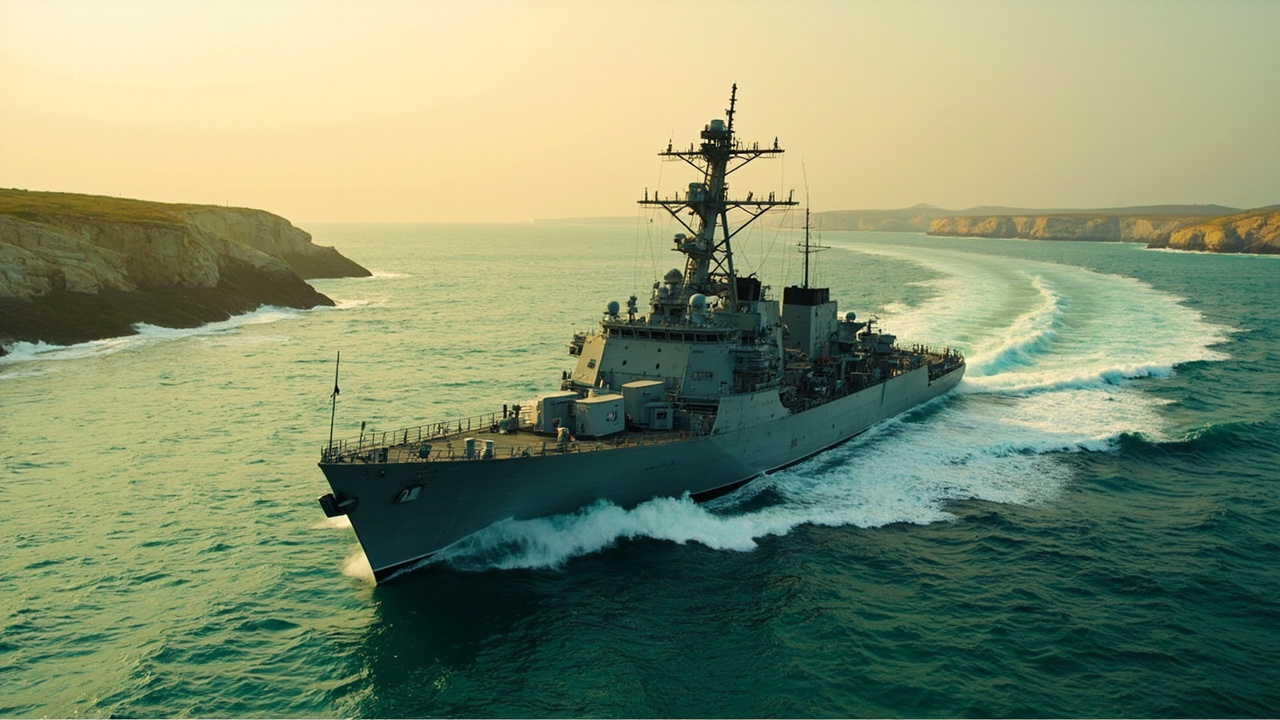
JERUSALEM — The USS Frank E. Petersen Jr. and the USS Michael Murphy transited the Strait of Hormuz on Saturday, becoming the first American warships to pass through the waterway since hostilities with Iran began. [1] The Navy confirmed both Arleigh Burke-class destroyers completed the crossing without incident and immediately commenced mine-countermeasure operations in the strait's shipping lanes.
The transit is operationally significant. Hormuz is twenty-one nautical miles wide at its narrowest point, with navigable shipping lanes compressed into corridors roughly two miles across. Iran mined portions of these corridors in the early weeks of the conflict. Commercial shipping has rerouted around the Cape of Good Hope at enormous cost. The two destroyers carry MH-60S helicopters equipped with mine-hunting sonar and AN/AQS-20 towed detection systems — the Navy's primary tools for locating and neutralizing sea mines in shallow, confined waters. [2]
Iran denied the transit occurred. Tehran's defense ministry issued a statement Saturday evening claiming no American vessels had entered Iranian-controlled waters and that the strait remained "under the full sovereignty of the Islamic Republic." [3] The denial contradicts commercial ship-tracking data, satellite imagery published by open-source intelligence accounts, and the U.S. Navy's own photographs of both destroyers in the strait. Iran's position appears to be that acknowledging the transit would concede a failure of its maritime interdiction posture.
The mine-clearing mission carries risks that extend beyond the ordnance itself. The Petersen Jr. and the Murphy are operating in waters where Iranian fast-attack craft, shore-based anti-ship missiles, and submarine-launched torpedoes remain within range. Fortune reported that the destroyers are operating under combat conditions with full defensive systems active, including the Aegis radar suite and close-in weapons systems. [3] The Navy has not disclosed whether additional assets — submarines, carrier-based aviation, or electronic warfare aircraft — are providing cover, but the deployment profile of two destroyers without a carrier strike group is unusually lean for a strait-transit operation in contested waters.
President Trump claimed credit for the crossing, posting that U.S. forces were "clearing the Strait of Hormuz" as part of the broader war effort. [1] The statement was accurate in its broadest outlines but obscured the operational reality: mine clearing in Hormuz will take weeks, not days. The Navy's own estimates for similar operations in the Persian Gulf during the 1991 and 2003 conflicts ran to months. The density and sophistication of Iranian mines — a combination of moored contact mines, bottom-influence mines, and more advanced acoustic-magnetic variants — will determine the timeline.
For commercial shipping, the transit changes the calculation. If the Navy can establish and maintain a cleared corridor, tanker traffic could resume within weeks, easing the oil price pressure that has pushed Brent crude above $130 per barrel. If a mine strikes a destroyer or a tanker in the corridor, the price goes the other direction.
Two ships in a narrow strait. The math is simple. The consequences are not.
-- YOSEF STERN, Jerusalem