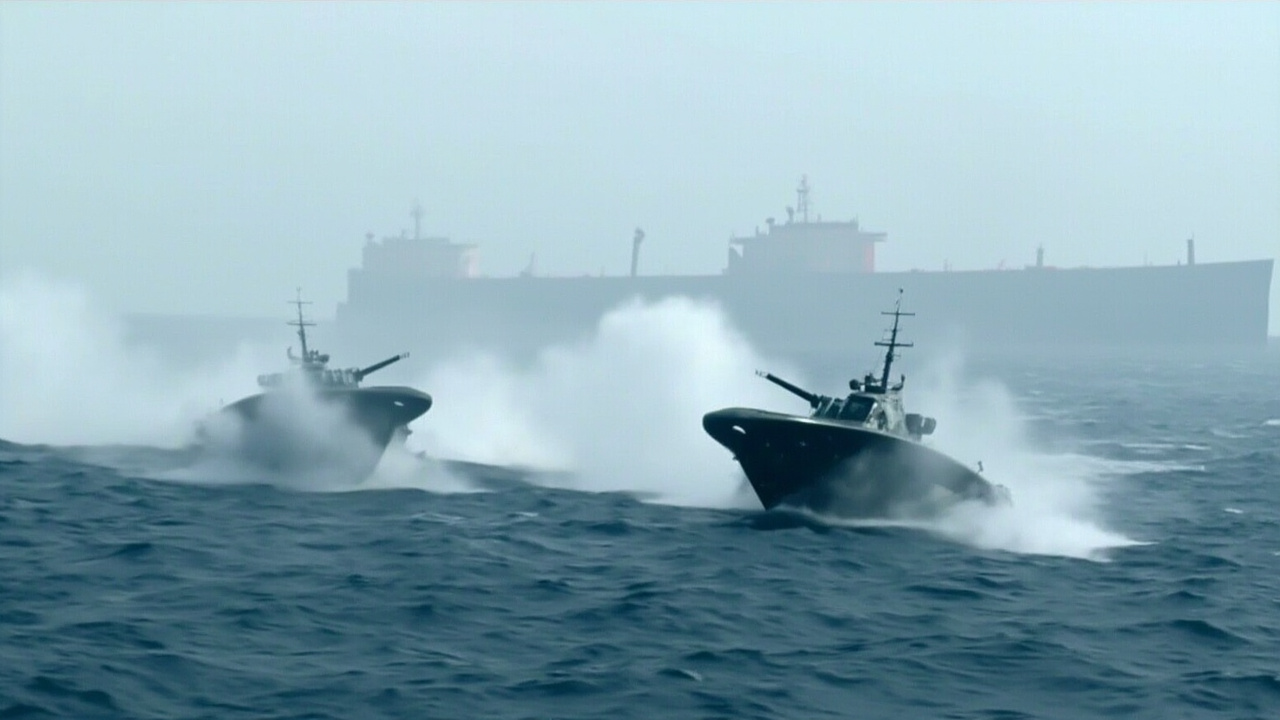
The Islamic Revolutionary Guard Corps Naval Command responded to Trump's blockade order within hours on Sunday, posting on X in Persian: "All traffic is under the full control of the armed forces." [1] The statement continued with a phrase that has since circulated across every Middle Eastern and South Asian news outlet: "The enemy will become trapped in a deadly vortex in the Strait if it makes the wrong move." [1] The post was accompanied by video footage showing crosshairs targeting vessels in the waterway. [2]
A separate statement from the IRGC's public relations office made the ceasefire claim explicit: "Any military vessels that intend to approach the Strait of Hormuz under any pretext will be considered in violation of the ceasefire and will be dealt with severely." [3] The framing is deliberate. The IRGC is not merely objecting to the blockade. It is declaring that the blockade constitutes a breach of the two-week ceasefire that began around April 8 and is set to expire April 22 — a ceasefire that the United States has not formally abandoned.
The logic, from Tehran's perspective, is not unreasonable. A ceasefire implies a halt to hostile military action. A naval blockade, even one limited to Iranian ports, involves warships positioning to interdict commercial vessels by force. The USS Frank E. Peterson and the USS Michael Murphy transited the Strait on April 11-12 for what CENTCOM described as mine-clearing operations. [3] Iran state media denied the destroyers entered the Strait and released footage claiming to show Iranian naval forces warning off a US vessel. [4] The IRGC claims it issued a warning that the ships would be "attacked within thirty minutes" if they crossed. [4]
The "full control" assertion is the IRGC's most consistent rhetorical position since the war began on February 28. IRGC Navy official Mohammad Akbarzadeh stated in March that "the Strait of Hormuz is under the complete control of the Islamic Republic's Navy." [5] The toll regime established at Larak Island in late March — where ships were required to pay up to two million dollars and submit details to IRGC-approved intermediaries — was the operational expression of that claim. [6] Traffic through the Strait dropped approximately ninety-five percent, from 130-140 ships per day to 5-20. [6]
But the IRGC's operational capacity to enforce its threats is unclear. Rear Admiral Alireza Tangsiri, the IRGC Navy commander and architect of the blockade and toll regime, was killed on March 26. [7] No successor has been publicly named. The IRGC's "mosaic defense" doctrine — a decentralized command structure designed to continue operations even after senior leadership losses — is meant for exactly this scenario. Whether it functions as designed with the command structure degraded is a question the IRGC has not had to answer under this level of pressure.
Iran's arsenal in the Strait is substantial: an estimated five thousand naval mines, fast-attack craft, antiship missiles, drones, and explosive unmanned surface vessels. [5] At least twenty-three ships have been hit since the war began, and at least seven crew members have been killed. [7] The IRGC's capability is not hypothetical. Its willingness to use it against US Navy vessels — risking an escalation that the ceasefire was supposed to prevent — is the open question.
Korea's Chosun Ilbo, citing IRGC media outlet Sepa News, reported a more vivid version of the threat: "If enemies make even a single miscalculation, the strait will become a deadly vortex that swallows them." [2] The imagery is consistent with IRGC communications doctrine — maximalist language paired with video of military capability — but the stakes have changed. This is no longer rhetoric aimed at commercial shipping or regional rivals. It is aimed at the United States Navy, which has a carrier strike group within range.
The ceasefire, such as it is, now depends on both sides agreeing that what the other is doing does not constitute a violation. The IRGC says warships in the Strait break it. CENTCOM says the blockade is limited to Iranian ports. Somewhere in between, the distinction between a ceasefire and a confrontation has become a matter of nautical miles and interpretation — and neither side has much interest in being precise.
-- YOSEF STERN, Jerusalem