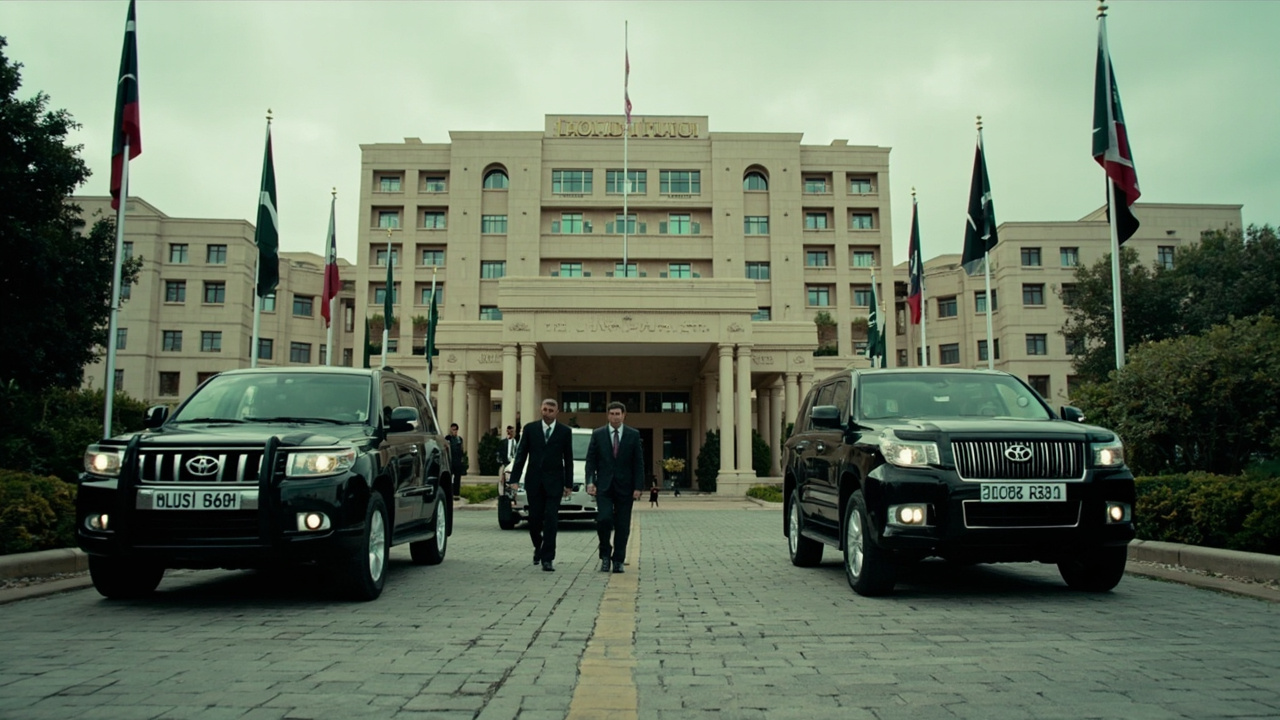
Twelve hours of negotiations between American and Iranian delegations ended without agreement in Islamabad on Sunday — and both sides credited Pakistan for getting them in the same room. [1] The marathon session at the Serena Hotel was the highest-level direct engagement between Washington and Tehran since the 1979 Islamic Revolution, a fact that matters as much for Pakistan's trajectory as for the war itself.
Foreign Minister Ishaq Dar stood before cameras afterward and used the language of institutional diplomacy rather than failure. Pakistan would continue facilitating. The door remained open. All parties must adhere to ceasefire commitments. [2] NPR described the talks as ending "in a deadlock," but the framing misses what Pakistan actually achieved: it moved the crisis from bilateral escalation to structured engagement, which is precisely what mediators are supposed to do. [1]
The Diplomat offered the sharpest analysis of why the talks deadlocked, identifying six unresolved points — enrichment, missile infrastructure, Hormuz transit, sanctions relief, security guarantees, and verification mechanisms. [3] Iran's foreign minister Abbas Araghchi posted on X that his delegation encountered "maximalism, shifting goalposts, and blockade" when they were "just inches away from an Islamabad MoU." [2] The reference to a memorandum of understanding was the clearest public signal that the two sides came closer to a framework agreement than either government has acknowledged.
For Pakistan, the strategic calculation extends well beyond this particular war. Islamabad has spent years on the margins of great-power diplomacy — managing its border conflict with Afghanistan, navigating the perpetual friction with India, absorbing the economic consequences of a Chinese partnership that delivers infrastructure but not political leverage on the world stage. The mediation role represents something qualitatively different. DW reported that Pakistan was "uniquely placed, if somewhat coincidentally," because it maintained simultaneous relationships with Washington, Tehran, Beijing, and the Gulf states — a diplomatic Venn diagram that no other country could replicate. [4]
The personal diplomacy mattered. Prime Minister Shehbaz Sharif and Army Chief Asim Munir cultivated their relationship with Trump during a May 2025 visit that predated the war by months. That relationship gave Pakistan a direct line to the single most important decision-maker, and it gave Trump a face-saving channel to explore ceasefire options without appearing to negotiate from weakness. Reuters noted that Islamabad outmaneuvered Oman and Qatar for the hosting role — two countries with deeper financial resources but less trust capital with both sides. [2]
Iran's ambassador to Pakistan, Reza Amiri Moghadam, offered the most telling post-mortem. "The Islamabad Talks is not an event but a process," he wrote on X. [2] The distinction is diplomatic code for: we intend to come back. The five-point initiative that Dar developed with China, Egypt, Turkey, and Saudi Arabia during a March 30 ministerial in Islamabad remains the only multilateral framework on the table. [4]
The risk for Pakistan is that the blockade, which began the same day the talks ended, undermines the ceasefire that made the talks possible. If the ceasefire collapses before April 22, the diplomatic architecture collapses with it, and Pakistan returns to being a regional power managing its own problems rather than a global mediator managing everyone else's. Dar's insistence on ceasefire compliance is not altruism. It is self-preservation.
The domestic politics of the mediation role are equally consequential. Pakistan is simultaneously fighting a war with Afghanistan — Operation Ghazab lil-Haq launched in late February against militant sanctuaries along the northwestern border — while asking the world to see it as a peacemaker. [2] Chinese officials had quietly pressed Islamabad to resolve the Afghanistan conflict before taking on the Iran portfolio, but the timeline collapsed when Trump's escalation made mediation urgent. Pakistan chose the bigger stage, gambling that success in Islamabad would earn it space on the Afghan front as well.
The gamble has paid dividends already. Both Trump and Iranian officials publicly praised Prime Minister Sharif and Army Chief Munir for their facilitation. [4] Michael Kugelman, a South Asia expert, called it "one of Pakistan's biggest diplomatic wins in years," though he cautioned that "what matters the most is it helped avert a potential catastrophe." [1] The praise is real. Whether it converts to durable geopolitical leverage depends entirely on what happens in the next nine days.
What distinguishes Pakistan's moment from previous mediation attempts by other countries is that Islamabad succeeded at the hardest part — creating the initial meeting — and now faces the second-hardest part, which is sustaining a channel when both parties have reasons to walk away. The Diplomat's assessment was blunt: "Why the U.S.-Iran talks in Pakistan ended in a deadlock." [3] The better headline might be: why they happened at all.
-- PRIYA SHARMA, Delhi