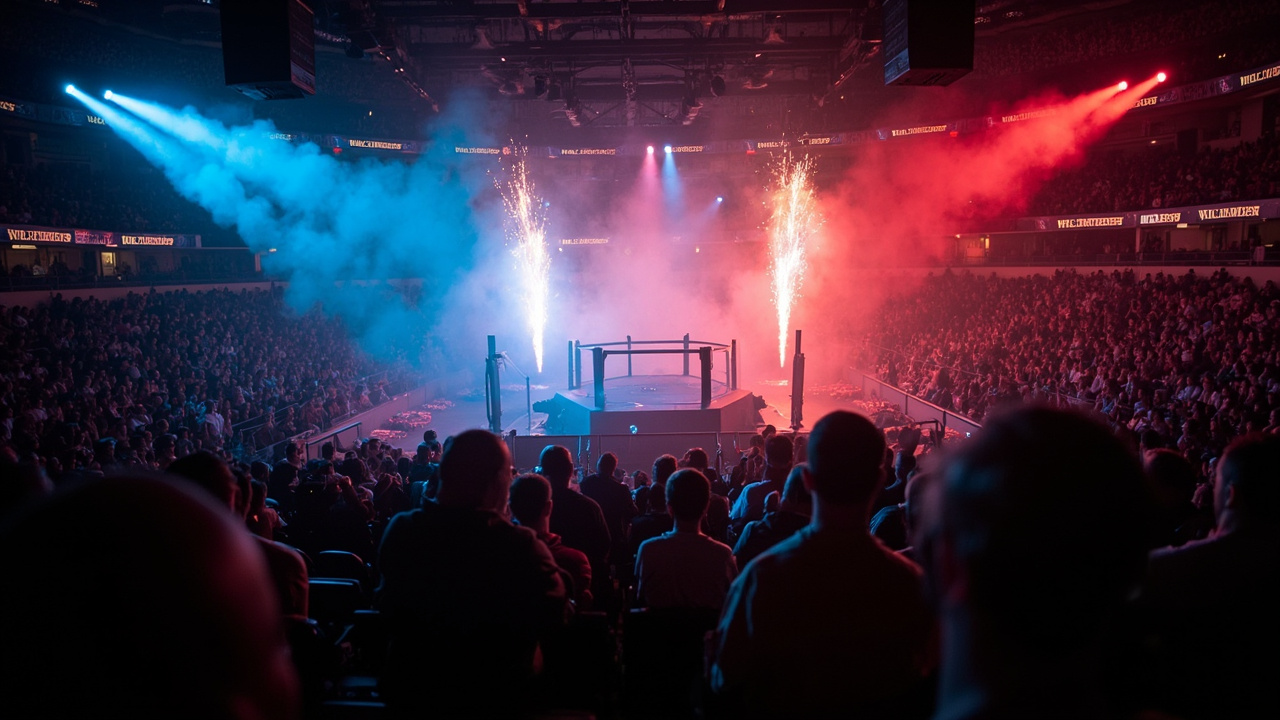
NEW YORK — The split screen arrived Saturday night with the subtlety of a pay-per-view undercard. On one half: Vice President JD Vance in Islamabad, sleepless, grinding through hour fourteen of ceasefire negotiations in a fluorescent-lit conference room. On the other: President Donald Trump walking into the Kaseya Center in Miami to a standing ovation, taking his cageside seat at UFC 327 with Secretary of State Marco Rubio beside him. [1]
The juxtaposition was not accidental. Nothing in this administration is.
Trump arrived at the arena at approximately 10 p.m. Eastern, according to the Guardian's pooled press report, flanked by Secret Service and accompanied by Rubio, who had been in Islamabad himself earlier in the week before flying back for the event. [1] The president received the crowd reaction he always receives at UFC events — a roar that registers somewhere between worship and spectacle, the kind of noise that turns a political figure into an arena attraction. He sat. He watched men fight. Eight thousand miles away, his vice president was trying to stop a war.
The Daily Beast captured what the mainstream networks danced around: the visual of a wartime president at a cage match while his negotiator failed to secure peace was, at minimum, a communications disaster. [2] At maximum, it was a statement of priorities so transparent that no press secretary could reframe it. The article noted that Trump did not call into the negotiations, did not issue a public statement about the talks while at the arena, and did not leave early when reports emerged that the talks were stalling.
Rubio's presence at the fight added a layer that the optics-conscious might call reckless. The Secretary of State had participated in preliminary talks in Islamabad days earlier. His decision to attend UFC 327 rather than remain in the region or return to Washington signaled either supreme confidence in Vance's mandate or something less flattering — that the talks were never expected to produce an agreement, and everyone except the public knew it.
On X, the reaction split along lines that have become as predictable as the fight card itself. Trump allies framed the evening as a "division of labor" — the president delegating while maintaining visibility, the vice president handling the detail work. [1] Critics, including Representative Gabe Amo, called it "Trump's B team" letting peace collapse while the principal attended entertainment. [2] Both readings assume the talks mattered to the president. The UFC appearance suggests a third possibility: that the Islamabad round was always Vance's show, designed to test whether the vice president could carry a diplomatic portfolio that might matter in a 2028 primary.
The Anadolu Agency reported the scene with characteristic directness — Trump at UFC, talks ending without agreement, no connection drawn because the connection draws itself. [3] The wire service did what wire services do: it placed two facts next to each other and let the reader feel the voltage between them.
What the split screen revealed is not hypocrisy. Hypocrisy requires pretending to care. Trump has never pretended that diplomacy interests him more than dominance, and a UFC arena is where dominance lives in its purest, most American form. The cage is honest. Someone wins, someone loses, and the crowd goes home satisfied. Islamabad offered no such clarity. Vance flew home with nothing. Trump flew home with the crowd's roar still ringing.
Both men got exactly what they came for.
-- MAYA CALLOWAY, New York