The 32-hour Orthodox Easter ceasefire between Russia and Ukraine expired at midnight Sunday with both sides accusing each other of thousands of violations, no extension forthcoming, and a war in its fifth year no closer to ending than when the truce began. [1]
Ukraine's General Staff reported 7,696 total ceasefire violations by Russian forces over the course of the truce, including 28 assault actions, 479 shellings, 747 attack drone strikes, and 1,045 FPV drone launches by early Sunday morning alone. [2] Russia's Defense Ministry counted 1,971 violations by Ukrainian forces, claiming Kyiv had fired 258 times with artillery or tanks and carried out 1,329 FPV drone strikes. [1] As yesterday's paper reported, the first hours of the truce had already produced 469 alleged Russian violations — a number that nearly quadrupled by dawn.
Russian President Vladimir Putin had declared the ceasefire on Thursday, ordering a halt to hostilities from 4:00 p.m. Moscow time on Saturday through the end of Sunday. Ukrainian President Volodymyr Zelenskyy accepted, describing the truce as an opportunity to demonstrate that diplomacy could work. [3] "Easter should be a time of silence and safety," he said. "A ceasefire at Easter could also become the beginning of real steps." [2]
Neither side's soldiers experienced much silence. Serhii Kolesnychenko, a communications officer for Ukraine's 148th Separate Artillery Brigade, told the Associated Press on Saturday that while artillery fire had paused in his sector at the junction of the Donetsk, Dnipropetrovsk, and Zaporizhzhia regions, Russian drones continued to strike Ukrainian positions throughout the truce. [2] Ukrainian forces responded in kind, operating under Zelenskyy's directive to mirror Russian actions: "silence to silence and fire to fire."
The Kremlin rejected any extension before the truce even expired. Spokesman Dmitry Peskov called the ceasefire a "humanitarian gesture" but said sustainable peace required Ukraine to accept Russian territorial demands. [1] "Until Zelenskyy musters the courage to assume this responsibility, the special military operation will continue," the Kremlin added — recycling the bureaucratic euphemism for a war that has killed hundreds of thousands and displaced millions.
There was one notable absence from the violations. Ukraine's military confirmed that no long-range drones, cruise missiles, or guided bombs were used during the truce period. [2] This distinction matters. The ceasefire's most tangible effect was not the cessation of small-arms fire or drone harassment — both continued — but the pause in the strategic-range bombardment that has devastated Ukrainian cities and energy infrastructure for four years. For 32 hours, there were no air-raid alerts. For a population that has spent years sleeping in subway stations and basements, even that brief respite carried weight.
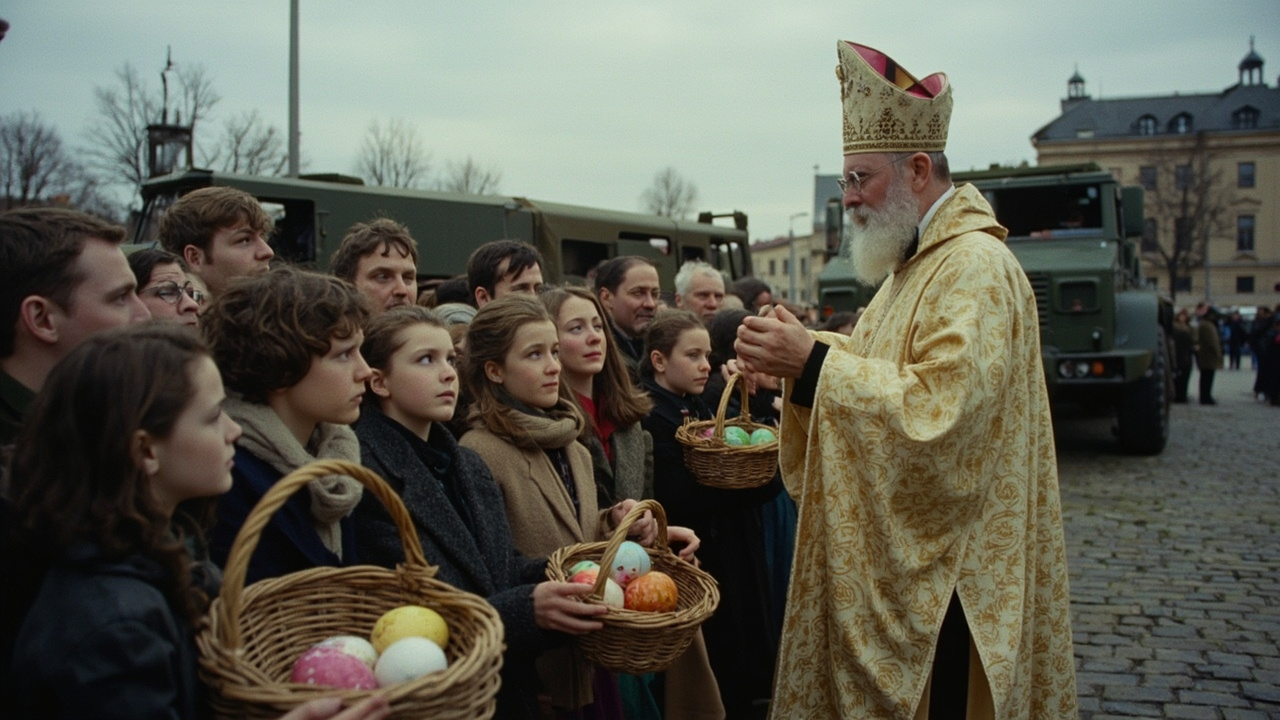
Outside Kyiv on Sunday, thousands gathered at an open-air heritage park for the annual blessing of Easter baskets. Worshippers clustered around wooden churches while priests in gold vestments sprinkled holy water on decorated eggs, bread, and bottles of wine. In central Kyiv, believers carried their baskets past a display of destroyed Russian military equipment on Mykhailivska Square — a scene that has become ordinary enough to serve as backdrop rather than spectacle. [2]
Irena Bulhakova, a worshipper at the heritage park, captured the national mood with practiced skepticism. "Every time a ceasefire is announced for a holiday, the shelling continues," she told the Associated Press. But she still reflected on the holiday's meaning: "Good triumphs over darkness, and we hope for that very much." [2]
The Easter truce is now the second such exercise in consecutive years. Last April, Putin declared a 30-hour ceasefire for Orthodox Easter. Both sides accused each other of hundreds of violations, though the Ukrainian air force reported a lull in Russian air raids. [3] Days later, Putin declared another truce for Russia's May 9 Victory Day holiday. Zelenskyy called that proposal "cynicism of the highest order" and refused to participate.
The pattern is established. Moscow proposes short truces around holidays. Kyiv accepts, warily. Both sides accuse each other of violations. The Kremlin rejects any extension. The war continues.
What makes this Easter different is not the ritual of the truce but the context surrounding it. The United States, which has brokered multiple rounds of negotiations between Moscow and Kyiv, has shifted its attention decisively toward the Iran-Hormuz crisis. American warships are enforcing a blockade in the Persian Gulf. American bombers are striking Iranian nuclear facilities. The diplomatic bandwidth that once flowed toward Kyiv has been redirected, and Ukrainians feel it.
Zelenskyy spent Easter Sunday visiting children who had lost parents in the war, writing in an online post that he wanted them to know "those who made the ultimate sacrifice for Ukraine never lose faith in the world." [2] The visit carried the quiet desperation of a leader who understands that his country's conflict is being eclipsed by a larger one.
The ceasefire produced one concrete result unrelated to its stated purpose. Hours before the truce began, Russia and Ukraine completed their 72nd prisoner exchange of the war, with 175 soldiers returning to each side. Twenty-seven Ukrainian officers were among those released. [3] These exchanges, brokered through intermediaries, remain one of the few functional channels between Moscow and Kyiv — small mercies in a war that has ground to a stalemate along a 1,200-kilometer front.
The battlefield itself has barely moved. According to an analysis by the Institute for the Study of War, Russia recorded almost no territorial gains in Ukraine last month for the first time in two and a half years. [3] Moscow occupies just over 19 percent of Ukrainian territory, most of it seized in the chaotic opening weeks of the 2022 invasion. The front lines are frozen. The dying is not.
Father Roman, a Ukrainian army chaplain who led Easter blessings outside Kyiv, framed the holiday in terms his congregation understood. "We are defending our borders. We are defending our identity," he said. "We are a free people who live on this land." [2]
The ceasefire is over. The war, forgotten by much of the world, is not.
-- KATYA VOLKOV, Moscow