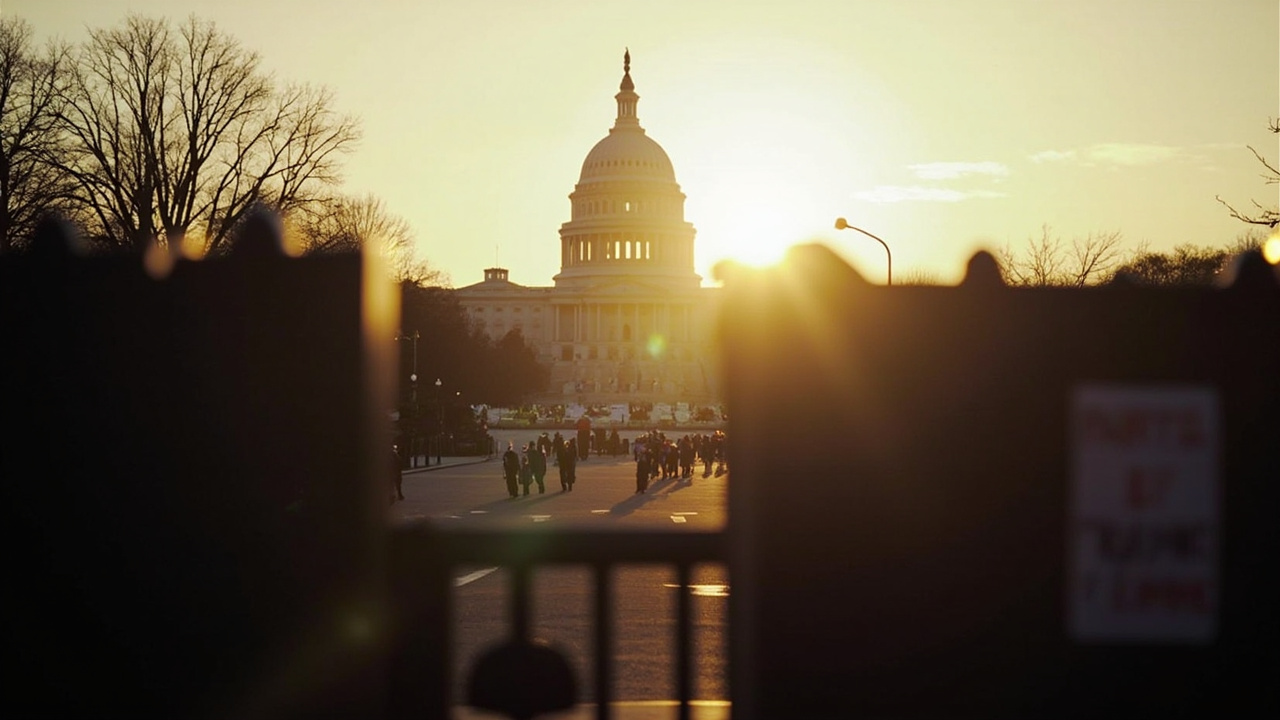
The 119th Congress gavels back into session on Tuesday after a two-week Easter recess. When members left Washington on March 28, the United States was conducting an air campaign against Iranian nuclear and military facilities. [1] They return on Day 44 of an unauthorized war to find that the president has added a naval blockade to the operation, that the Islamabad ceasefire negotiations have collapsed, that FISA Section 702 surveillance authority expires in six days, and that the Democrats intend to force War Powers votes before the week is out. [2]
The scope expansion is the constitutional problem. This paper's Sunday analysis of four converging deadlines in the April calendar argued that each off-ramp had become an on-ramp to escalation. That argument has been overtaken by the blockade itself. An air campaign, however aggressive, fits within the kinds of force presidents have historically deployed under Article II authority and the 2001 Authorization for Use of Military Force. A naval blockade does not. A blockade is an act of war under the UN Charter and the San Remo Manual. [1] It requires sustained force projection, explicit rules of engagement against neutral shipping, and an indefinite commitment of naval assets. No American president since John F. Kennedy has imposed one, and Kennedy sought and received a resolution from the Organization of American States before deploying the Navy off Cuba.
What Congress left behind and what Congress returns to are two different wars. The March 28 war was an air campaign with discrete targets, limited ground exposure, and a plausible legal theory rooted in self-defense after the IRGC's attacks on American bases. The April 14 war includes a blockade of all Iranian ports, 800 stranded commercial vessels in the Gulf, a ceasefire that Iran says the blockade violates, and classified briefings scheduled for Tuesday morning that most members have not yet seen. [1] [2]
The Democratic strategy is direct and procedural. Senate Minority Leader Chuck Schumer plans to invoke the War Powers Resolution's expedited procedures, which require only a simple majority to force a floor vote. [1] The resolution demands the president withdraw forces from hostilities not authorized by Congress within thirty days. House Democrats attempted to force a similar vote before recess and were blocked by the Republican majority. [3] Representative Gabe Amo called the Islamabad delegation "Trump's B team" and tied the diplomatic failure to the military escalation — a messaging frame that Democrats intend to sharpen now that the blockade has made the unauthorized scope harder to defend.
The Republican calculus has shifted in ways that matter. Before recess, the handful of Republican war skeptics — Rand Paul, Thomas Massie, Susan Collins, John Curtis — were isolated voices questioning the air campaign's legal basis. [2] The blockade gives them material. Collins told NPR in March that she would not support ongoing military action "beyond a 60-day window without congressional authorization." [2] The sixty-day window closes on April 29. The blockade accelerates the timeline because it is not an extension of existing operations — it is a new category of force. Republican leaders will have to decide whether the president's unilateral authority covers blockade operations, and several of their own members have already said it does not.
The cost dimension has arrived alongside the constitutional one. ABC News reported that the war's estimated cost has approached $30 billion, with a supplemental funding request in the $80 to $100 billion range under discussion. [1] Punchbowl News reported that Republican leadership is considering attaching war funding to the reconciliation process, which would bypass Democratic opposition but requires near-total party unity — unity that Paul and Massie have already demonstrated they will not provide on this issue. [2]
FISA Section 702 adds a second clock. Craig Caplan of C-SPAN noted that both chambers face an April 20 deadline on extending Section 702 warrantless surveillance authority. [4] The House Rules Committee met last week to prepare a clean eighteen-month extension for floor debate. [4] But the Iran war has politicized the surveillance question in ways that complicate a routine reauthorization. Progressive Democrats who opposed 702 on civil liberties grounds now have an additional argument: the administration is conducting an unauthorized war while simultaneously requesting expanded surveillance powers. Conservative libertarians like Massie oppose both the war and warrantless surveillance. The coalition against reauthorization may be larger than leadership expects.
The classified briefings on Tuesday are the pivot point. Most members of Congress have not seen the full intelligence picture since the blockade began. PBS reported that the briefings are scheduled for Tuesday morning, before the Senate gavels in at 2 p.m. [2] Several Democratic senators who previously voted against the War Powers Resolution — Fetterman, Gallego, and Kelly — have signaled they are reconsidering. Fetterman's office described the Islamabad collapse as "deeply concerning." Whether concern converts to votes depends on what the briefings reveal about the blockade's rules of engagement, its expected duration, and whether CENTCOM's narrower operational scope was authorized by the president or imposed over his objections.
The constitutional abdication is now forty-four days old. Congress has not voted on this war. It has not authorized the air campaign. It has not authorized the blockade. It has not held a single open hearing on the rules of engagement. The last time members voted on anything related to Iran war powers was a procedural motion before recess that failed along party lines. [3] In that time, the war expanded from airstrikes to a naval blockade, the ceasefire talks collapsed, and the administration imposed the most significant maritime enforcement action since the Cuban Missile Crisis — all without a single vote of the people's representatives.
The question this week is whether the blockade is the escalation that breaks the pattern. Every prior expansion — the initial strikes, the ground positioning at Diego Garcia, the Strait enforcement — happened incrementally enough for congressional leaders to defer. The blockade is not incremental. It is a named act of war, visible on every ship-tracking website in the world, with 800 commercial vessels frozen as physical evidence of its scope. If Congress cannot find a majority to vote on this, the War Powers Resolution is not dormant. It is dead.
The Senate gavels in at 2 p.m. Tuesday. The April 20 FISA deadline is six days away. The April 22 ceasefire expiration is eight days away. The April 29 War Powers clock is fifteen days away. And the blockade — the one Congress did not authorize, did not debate, and did not know about when it left for Easter — is operational now.
-- SAMUEL CRANE, Washington