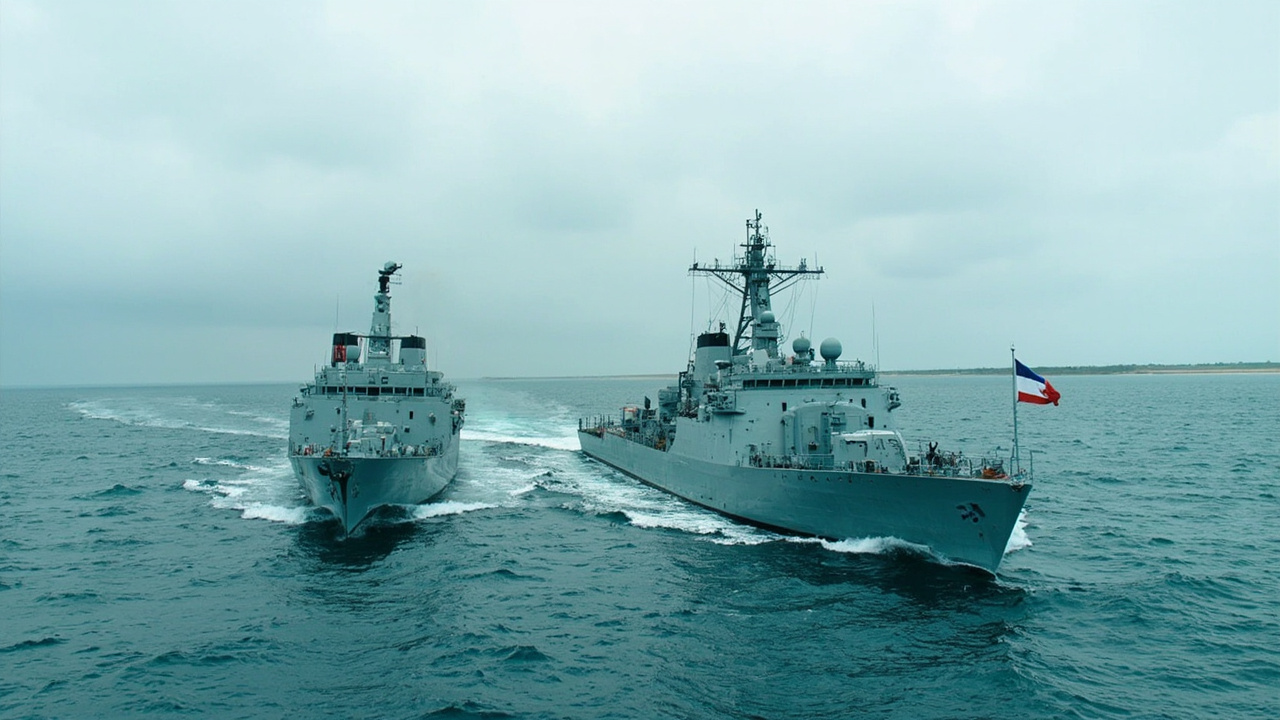
President Emmanuel Macron announced on Monday that France would co-host a conference with Britain "in the coming days" to organize a multinational naval mission aimed at restoring freedom of navigation in the Strait of Hormuz. [1] The mission would be, Macron specified, "strictly defensive" — the adjective doing all the work of distinguishing it from the American blockade that began enforcement the same morning. [2]
This is the first independent European military initiative in the Persian Gulf since the 2019 European Maritime Awareness in the Strait of Hormuz mission, known as EMASOH, which France led after Washington's maximum-pressure campaign made European governments uncomfortable sailing under American command. [1] EMASOH was an observation mission with a single frigate. What Macron described on Monday is something larger, more operationally ambitious, and more politically significant: a European escort mission operating in the same waters as an American blockade while explicitly not being part of it.
The distinction between American and European operations in the Gulf has been a subtext of this paper's coverage since CENTCOM narrowed Trump's blockade language. The narrowing created a gap — the American force is blockading Iranian ports, but the Strait itself remains nominally open to non-Iranian traffic. The European mission would occupy that gap: escorting European-flagged and allied commercial vessels through the Strait under European naval protection, asserting freedom of navigation without participating in the American enforcement action against Iran.
Bloomberg reported that British Foreign Secretary David Lammy had been in discussions with Macron's office since late last week, before the blockade's first day of enforcement. [1] The timing suggests the European initiative was not a reaction to Monday's events but a parallel planning track that the blockade accelerated. Anadolu Agency reported that more than forty nations had been approached about participation, and that the conference would focus on rules of engagement, force composition, and the legal framework under which escort operations would proceed. [2]
The legal framework is where the ambition meets the difficulty. A European escort mission operating alongside an American blockade raises questions that international maritime law does not cleanly answer. Under the law of blockade, neutral vessels approaching a blockaded port may be stopped and diverted by the blockading power. If a French frigate is escorting a Greek tanker to a Saudi port through the Strait, and the American Navy challenges the tanker because it previously loaded Iranian crude, does the French frigate intervene? The answer is almost certainly no — Paris is not going to fire on an American destroyer — but the scenario illustrates the operational complexity of running two missions with different objectives in the same thirty-four-mile-wide waterway.
Macron framed the mission in the language of European strategic autonomy, a project he has championed since his 2017 Sorbonne speech. "Europe cannot outsource the security of its energy supplies to a single ally, however powerful," he said, according to the Tribune India report. [3] The "however powerful" was diplomatic understatement. The ally in question is currently conducting a blockade that has stranded 800 commercial vessels, sent insurance premiums to historic levels, and pushed European natural gas futures up eighteen percent in a single day. European strategic autonomy has been an abstract concept for nearly a decade. The Strait of Hormuz is making it concrete.
Britain's participation is the more surprising element. London has historically aligned its Gulf naval posture with Washington, maintaining a permanent naval support facility in Bahrain and contributing ships to Combined Maritime Forces under American command. The decision to co-host a conference on an independent mission — one defined by its separation from American operations — represents a meaningful shift in the UK's post-Brexit foreign policy positioning. Lammy's Labour government has been critical of the Iran war's expansion but has carefully avoided direct confrontation with Washington. The Hormuz conference lets Britain distance itself from the blockade without opposing it.
The practical question is whether a European force can credibly escort commercial shipping through a contested waterway. France has one carrier group, the Charles de Gaulle, currently deployed in the Eastern Mediterranean. Britain has no carriers immediately available; HMS Queen Elizabeth completed a refit in March but has not deployed. [1] A European escort mission would likely consist of frigates and destroyers — enough to provide a visible presence but not enough to deter an IRGC attack if Tehran decided to challenge European vessels directly. The mission's credibility depends on the assumption that Iran would not fire on European ships, an assumption that rests on Iran's interest in splitting the Western coalition rather than unifying it.
Iran International, the London-based Persian-language news outlet, reported the conference announcement without editorial comment, a noteworthy restraint from a channel that typically frames European diplomatic initiatives as insufficient. [4] The restraint suggests recognition that the Franco-British mission, however modest in scale, represents the first time European powers have proposed independent military operations in the Gulf that are explicitly not subordinate to American command. The precedent matters more than the frigates.
If the conference produces an operational mission within days — the timeline Macron implied — European warships could be in the Strait of Hormuz before the April 22 ceasefire expires. That would create a three-way maritime dynamic: American forces blockading Iranian ports, European forces escorting non-Iranian traffic, and Iranian forces asserting control over the waterway. The Strait is thirty-four miles wide. That is a great deal of ambition for a very narrow body of water.
-- CHARLES ASHFORD, London