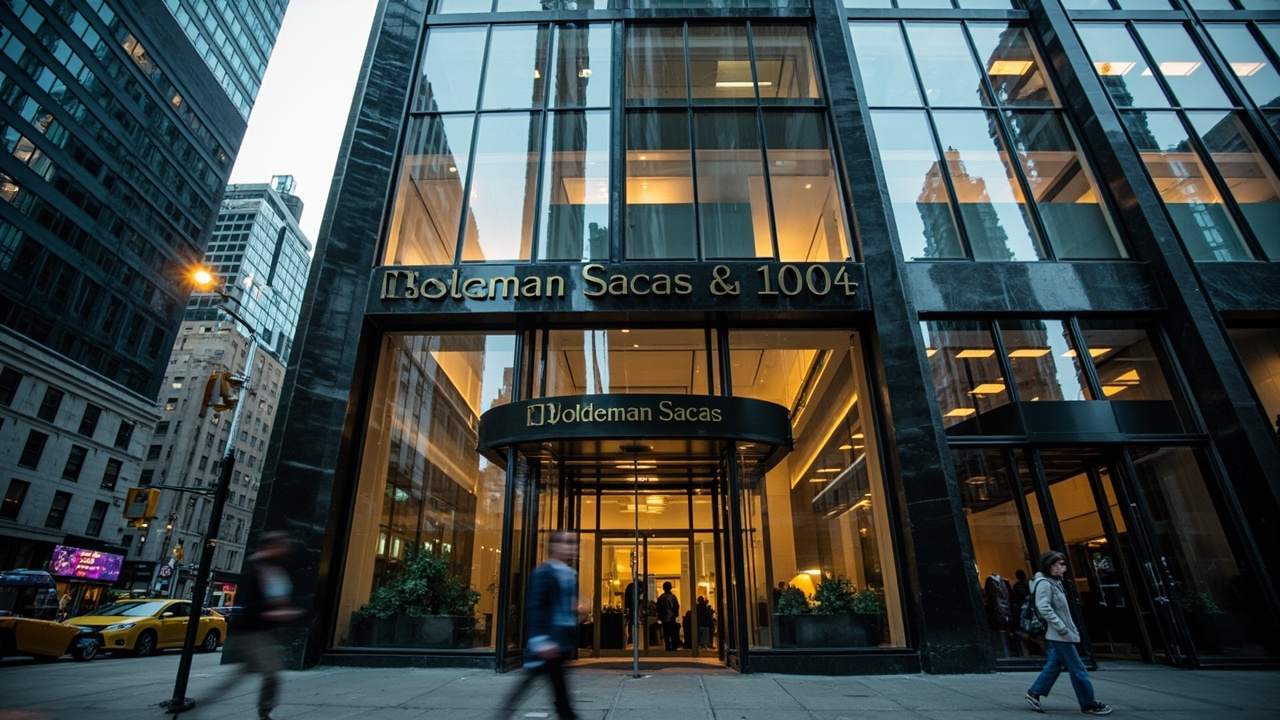
Goldman Sachs reported first-quarter 2026 earnings on Monday that beat Wall Street estimates on nearly every headline metric. Earnings per share came in at $17.55, above the consensus estimate of $16.49. Revenue reached $17.23 billion, above the $16.97 billion expected. Net income hit $5.63 billion, up from $4.74 billion a year ago. [1] The equities trading desk posted a record $5.33 billion in revenue, the highest quarterly figure in the division's history. [1] Revenue was up 14 percent year-over-year. [2]
The stock fell.
Goldman shares dropped as much as 4.2 percent in morning trading before recovering slightly, closing down approximately 1.9 percent on a day when the broader market was also under pressure. [3] The disconnect between a headline earnings beat and a declining stock price is not unusual on Wall Street, but the specific cause in this case illustrates a distinction that matters: the difference between the number that earns the press release and the number that moves the stock.
The number that moved the stock was FICC trading revenue — fixed income, currencies, and commodities. Goldman's FICC desk generated $4.01 billion in the quarter. The consensus estimate was $4.87 billion. [4] That is a miss of approximately 18 percent in a division that Wall Street considers the bellwether for Goldman's risk-taking franchise. Equities hit a record. Investment banking revenue rebounded sharply. Asset and wealth management grew. But FICC missed, and FICC is the business that the trading desks, the prime brokerage clients, and the institutional investors who own Goldman's stock watch most closely.
The reason is structural. FICC trading at Goldman is where the firm's balance sheet meets the global macro environment. When interest rates are volatile, commodities are swinging, and currencies are repricing geopolitical risk — conditions that describe the first quarter of 2026 with precision — FICC revenue is supposed to surge. It is the division that profits from chaos. Oil above $100, a naval blockade in the Strait of Hormuz, rate uncertainty from the Federal Reserve, and a global tariff regime in flux should have produced a FICC quarter for the ages. Instead, it produced $4.01 billion — a number that suggests Goldman either misjudged its positioning or pulled back from risk at exactly the moment the opportunity was largest. [1]
CEO David Solomon, on the earnings call, attributed the FICC result to "a more challenging trading environment in rates and credit" while noting that commodities revenue was "significantly higher" year-over-year. [1] The explanation is plausible but incomplete. JPMorgan, which reports later this week, will provide a comparison point. If JPMorgan's FICC desk beat estimates in the same environment, the problem is Goldman-specific. If both banks missed, the problem is market-wide.
The equities record deserves attention independent of the FICC miss. The $5.33 billion in equities trading revenue reflects a quarter in which stock market volatility — driven by tariff announcements, AI sector repricing, and geopolitical escalation — created the conditions for active trading desks to outperform. Goldman's equities franchise, rebuilt over the past several years under the leadership of Ashok Varadhan and Jim Esposito, has become the firm's most consistent revenue engine. [1] The record quarter confirms a structural shift: Goldman's trading floor increasingly leans toward equities and away from the fixed-income business that defined the firm for decades.
Investment banking revenue also exceeded expectations, rising to $2.36 billion from $1.91 billion a year ago. [1] The rebound reflects a recovery in mergers and acquisitions advisory fees and equity underwriting, though the total remains well below the peaks of 2021. The pipeline, according to Solomon, is "robust" — a word CEOs use when they want to signal optimism without committing to specific numbers. [2]
Asset and wealth management, the division Goldman has identified as its growth engine for the next decade, generated $3.68 billion in revenue with assets under supervision reaching $3.17 trillion. [1] The growth is steady and predictable, which is the point. Goldman has spent the past three years repositioning itself as a firm that generates more of its revenue from recurring fee income and less from volatile trading results. The FICC miss is an argument for that strategy. The equities record is an argument against it, or at least a reminder that trading revenue in favorable conditions can dwarf management fees.
The stock's reaction tells a simple story: Goldman's investors have priced in headline beats. They expect earnings above consensus. What they do not expect — and what they punish — is a miss in the specific division that serves as the firm's risk-taking barometer. A headline beat with a FICC miss reads, to institutional holders, as a warning sign. The macro environment should have favored Goldman's trading franchise more than it did. Either the firm left money on the table, or the environment is less favorable for risk-taking than the surface volatility suggests.
The broader context matters. Goldman reports in the same week that the United States has begun enforcing a naval blockade of Iranian ports, oil is trading above $100, and the administration has signaled no clear timeline for de-escalation. Those conditions will intensify in the second quarter. If Goldman's FICC desk missed in Q1, the question for Q2 is whether the miss was a timing issue — positions that will pay off later — or a strategic retreat from risk that will persist. Solomon did not answer that question on the call. The stock market, in its blunt way, suggested it does not like either option.
-- THEO KAPLAN, San Francisco