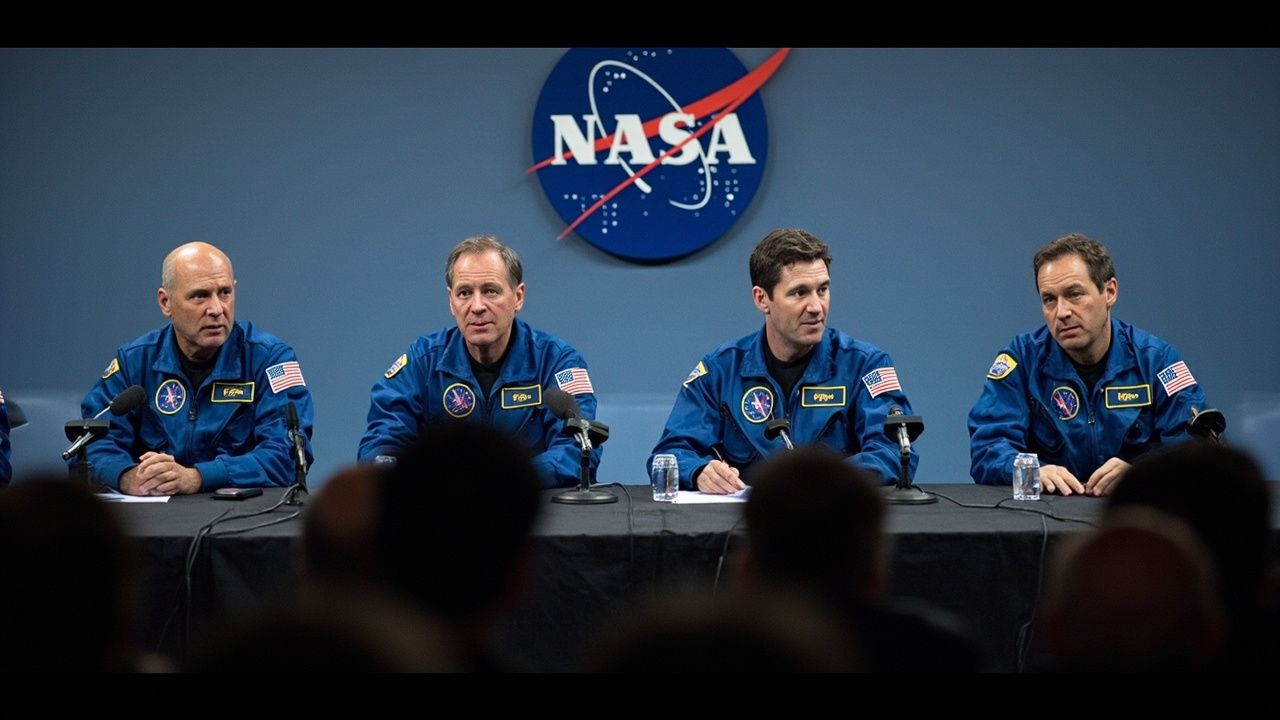
Reid Wiseman, Victor Glover, Christina Koch, and Jeremy Hansen sat at a table in Houston on Thursday afternoon and described what it was like to orbit the Moon. The press conference — their first formal public appearance since splashing down in the Pacific on April 11 — lasted ninety minutes and covered mission operations, crew dynamics, and the particular quality of lunar light as seen from 60 miles above the surface. [1]
It was a remarkable event staged inside an unremarkable moment. On the same day, CENTCOM reported turning back 13 vessels in the Strait of Hormuz. The House failed to bring FISA reauthorization to a vote. Oil prices reversed their two-day decline. And four people who had just completed the first crewed lunar orbit since Apollo 17 in 1972 answered questions about trajectory corrections and sleep schedules.
The juxtaposition was not lost on the crew. Wiseman, the mission commander, was asked whether the view from lunar orbit changed his perspective on the conflicts below. His answer was careful: "When you see the whole thing — the whole planet — the borders disappear. You can't see them. What you see is weather and water and land. It's not a political statement. It's a geometric fact." [2]
Glover, the first Black astronaut to fly beyond low Earth orbit, was more direct. He noted that the mission launched on April 1, the same day the US Navy began enforcing the Hormuz blockade. "We were aware of what was happening. You don't lose awareness of your country when you leave it. You gain perspective on it." [2]
Koch described the mission's most technically demanding phase — the trans-lunar injection burn that sent Orion beyond Earth's gravitational influence — as "the quietest loud thing I've ever experienced." The engine fired for roughly 20 minutes. Inside the capsule, the acceleration was gentle. Outside, the velocity change was sufficient to leave Earth orbit entirely. [1]
Hansen, the Canadian Space Agency astronaut and the first non-American to fly a lunar mission, spoke about the international dimension. The Artemis program includes contributions from the European Space Agency, the Japanese space agency JAXA, and the CSA. "This was not an American mission that happened to include a Canadian," he said. "This was a human mission that happened to launch from American soil." [2]
The mission itself was a success by every technical metric NASA has disclosed. Orion performed nominally throughout the 10-day flight. The heat shield withstood re-entry at approximately 25,000 miles per hour — the fastest any crewed vehicle has traveled since Apollo. Life support systems maintained cabin conditions throughout. The crew conducted over 200 hours of data collection on radiation exposure, a critical dataset for the planned Artemis III lunar landing. [1]
What the presser could not address — because NASA press conferences do not address such things — is the broader dissonance of the achievement. The United States in April 2026 is simultaneously the only nation sending humans beyond low Earth orbit and a nation enforcing a naval blockade of a sovereign country's ports. It is expanding the boundaries of human exploration while its legislature cannot agree on the legal framework for surveilling its own citizens.
These contradictions are not new. Apollo flew during Vietnam. The Space Shuttle program overlapped with the Gulf War. American spaceflight has always coexisted with American military operations. But the coexistence has rarely been this compressed in time — the blockade and the splashdown separated by ten days, the presser and the FISA collapse happening on the same afternoon.
C-SPAN carried both events live, side by side on its split-screen coverage. On the left, four astronauts describing the far side of the Moon. On the right, congressional reporters explaining why a surveillance bill could not reach the floor. The network did not editorialize on the pairing. It did not need to. [3]
The next Artemis mission — Artemis III, which will attempt the first crewed lunar landing since 1972 — is currently scheduled for late 2027. It will use a SpaceX Starship variant as its lunar lander. Whether the political and budgetary conditions for that mission will exist in a year and a half is unknown. What is known is that four people went around the Moon and came back, and on the day they talked about it, the country that sent them was otherwise occupied.
Wiseman closed the presser with a line that may have been rehearsed but did not sound it: "We went to the Moon because we could. We came back because we had to. What we do with what we learned is up to everybody in this room and everybody who isn't."
-- KENJI NAKAMURA, Tokyo