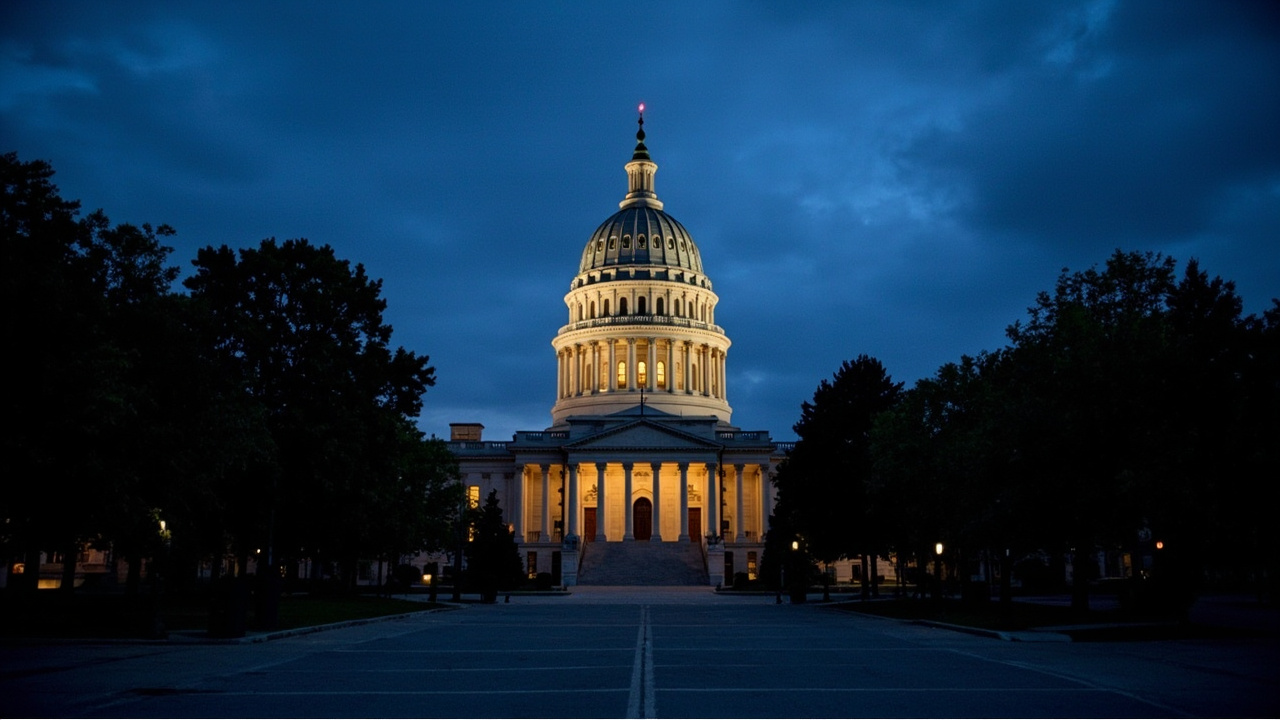
Anthropic filed formal written opposition to Illinois Senate Bill 3444 Thursday, becoming the first frontier AI company to publicly break with OpenAI's position on the bill that would shield developers from civil liability for "critical harms" provided they published a safety framework. WIRED's Max Zeff broke the news Thursday evening. The filing places on the legislative record what the two companies' diverging lobbying positions have signaled privately since February. [1]
The paper wrote April 15 that OpenAI and Anthropic were opposites on Illinois liability — the "open" company demanding immunity, the "safety" company opposing it. Wednesday's coverage noted the bill's status as it cleared committee, and Thursday's feature on Anthropic's $800 billion valuation and the safety-company paradox argued that the paradox — a safety-branded company nearly as valuable as its capability-branded rival — was itself the market's answer to which positioning enterprise customers preferred. Friday's development converts the positioning into a governance split on the legislative record.
What makes Thursday's filing consequential is not what Anthropic said. The company's public policy posture since 2023 has been consistent — AI developers should face accountability for foreseeable harms, liability is a design incentive, and immunity shields reduce the pressure to build safer systems. What is consequential is that Anthropic said it in Springfield, against a bill that OpenAI has spent months lobbying to pass, in a forum where the two companies' opposing interests can no longer be smoothed over by the trade associations that typically represent "AI industry consensus." [1]
The bill itself is worth understanding precisely because the split over it is structural. SB 3444 defines a "critical harm" as any AI-caused event producing more than 100 deaths, more than $500 million in property damage, or the compromise of "critical infrastructure." Developers who have published a documented safety framework — the specific threshold is vaguely defined in the bill's current draft — would be shielded from civil liability for any such harm unless a plaintiff could prove the framework was knowingly inadequate. The legal effect, as Quartz's reporting made clear, would be to raise the bar for liability litigation from standard negligence to a heightened pleading standard that functionally bars most cases before discovery. [2]
OpenAI's support for the bill is unsurprising when its revenue model is considered. The company operates at a scale where even a small percentage of deployments producing adverse outcomes could generate liability exposure into the tens of billions annually. Immunity in a major state — Illinois is the fifth-largest by economic output — creates a template other states can adopt. Lobbying for Illinois now is efficient because it establishes the legal architecture elsewhere later.
Anthropic's opposition is less obviously self-interested, which is why the split matters. A safety-branded company that opposes liability shields is either signaling to enterprise customers that it is willing to accept accountability as a product feature, or it has concluded that liability shields create a competitive advantage for capability-maximizing rivals. Both readings are plausible. The second reading would suggest Anthropic sees accountability as a moat — something a well-capitalized incumbent with compliance infrastructure can absorb more easily than a nimble startup or a capability-chasing rival. The $800 billion valuation the company has been turning down lends weight to the second reading. A moat is worth paying for.
The Transparency Coalition's neutral policy brief on the stack of Illinois AI bills makes clear that SB 3444 is one of six measures the state is considering, and not the most comprehensive. But it is the one the frontier companies have chosen to fight over publicly. That choice, rather than the bill's specific text, is what the filing Thursday makes visible. The fight is about whether the industry's regulatory posture will be set by the company demanding immunity or by the company accepting accountability. Until Thursday, both companies allowed the fight to take place in the footnotes of trade-association comment letters and in private meetings with state attorneys general. Thursday, Anthropic made the fight public. [3]
The immediate effect on SB 3444 is limited. The bill's sponsors have expressed confidence in committee passage next week. Anthropic's opposition is unlikely to kill the bill in a Democratic-controlled legislature where technology-friendly moderates have the majority. What Anthropic's opposition does is establish a testimony record that plaintiffs' lawyers will cite, that federal regulators will reference in their own rule-making, and that other state legislatures considering similar legislation will find in their research files.
The longer-term effect is structural. The frontier-AI companies' ability to present a unified industry voice — which held through the 2023 Senate AI Insight Forums, the 2024 executive-order drafting process, and the 2025 AI Action Plan — has ended. The ending was not dramatic. It happened in a legislative filing in Springfield. But it happened. Future regulatory fights will feature two voices from the frontier-AI sector, not one, and the voices will disagree. The governance implications of that disagreement are just starting to be written.
The brand inversion the paper named two days ago is now a governance fracture. At $800 billion and climbing, Anthropic's positioning has the financial weight to sustain the split. OpenAI's lobbying budget has the weight to fight it. The next chapter will be written somewhere other than Springfield — in Sacramento, in Austin, in Boston, or in Washington itself.
-- THEO KAPLAN, San Francisco