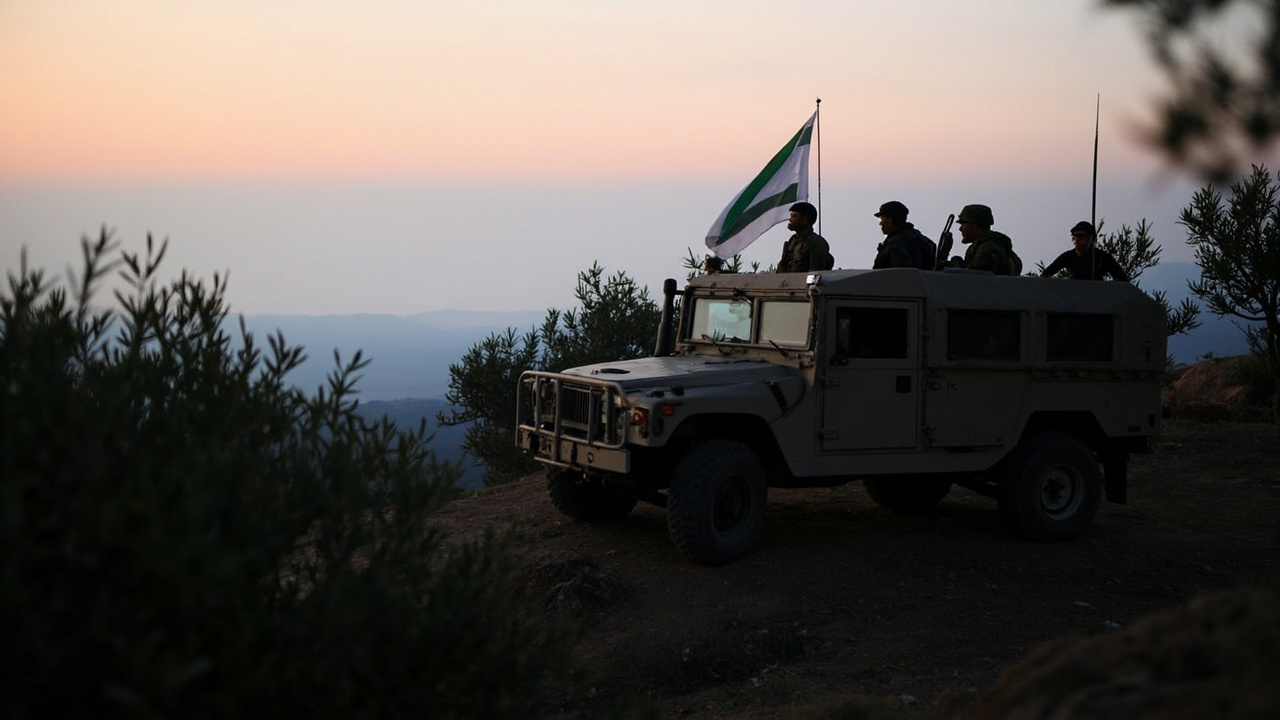
A ten-day ceasefire between Israel and Lebanon took effect at 5 p.m. Eastern time on Thursday, announced from the White House as "historic." Prime Minister Benjamin Netanyahu confirmed within hours that Israeli ground forces would remain in an expanded southern "security zone" for the duration of the truce. Hezbollah, the Lebanese party that has been doing the actual fighting, was never a signatory. Its official statement, released through Al-Manar Friday morning, said the deal "is void unless it covers all Lebanese territory and all Lebanese parties." [1] [2]
This paper's coverage yesterday of the Islamabad diplomacy process noted that Pakistan's Foreign Office had aligned with Iran's demand that Lebanon be part of any regional settlement. The companion piece on Trump's "close to over" blockade rhetoric established the emerging pattern: ceasefire announcements from Washington that do not change operational facts on the ground. The Israel-Lebanon agreement announced Thursday is the cleanest case yet of that pattern.
The document itself runs 14 paragraphs. It designates a ten-day cessation of offensive operations, maintains what Israeli officials describe as a "solid, deeper security zone" inside southern Lebanon stretching toward the Litani River, authorizes continued Israeli Air Force operations against "verified threats," and commits Beirut's government to "prevent cross-border attacks from Lebanese soil." Hezbollah is not named in the text. Lebanese Prime Minister Nawaf Salam's signature binds the state of Lebanon. It does not bind the paramilitary force operating within that state and fighting Israel on Lebanon's southern border. [1]
This is the structural incoherence. A ceasefire is an agreement to stop shooting between parties that are shooting at each other. The Lebanese state is not shooting at Israel. Hezbollah is. An agreement between the Lebanese state and Israel that does not include Hezbollah is not a ceasefire. It is a document in which two parties who are not fighting each other agree not to fight. The actual combatant has been written out of the deal and has now written itself back in, rhetorically, by declaring the deal void.
The New York Times live blog Friday morning noted, with the caution of an outlet that has learned to distrust Middle East ceasefire announcements, that "it was unclear if the agreement was being honored." Al Jazeera reported three exchanges of fire across the Blue Line within twelve hours of the ceasefire taking effect. The Israeli military said its operations were "defensive" under the agreement's terms. Hezbollah's statement said the operations proved the agreement's terms were designed to permit them. Both readings are correct under the text Trump announced. [2] [3]
The Israeli position is open about its terms. Netanyahu told reporters Thursday evening: "We are not leaving. This is an expanded security zone, and it stays under the ceasefire." The statement confirms what the document's geography already confirms — the Israeli presence in Lebanon is not pausing for the ceasefire's duration. It is codified by the ceasefire's duration. The ten days are not a withdrawal period. They are an occupation period during which offensive operations are described as defensive. [1]
Hezbollah's framing is that the deal is an artifact of Iran negotiations rather than a Lebanon peace process. This reading has merit. The ceasefire emerged from the broader US-Iran back-channel that the Islamabad process is attempting to formalize. Lebanon is the theater where that process is cashing out first, because it is the theater where the lowest-cost signaling is available — Washington can announce a Lebanon truce without committing to anything on the actual Hormuz question. The announcement buys time. What it does not buy is quiet. [2]
What the next ten days will produce operationally is an open question. The Blue Line exchanges overnight suggest the pattern will be low-intensity fire from Hezbollah positions, described-as-defensive IDF air response, intermittent statements from Beirut that the Lebanese state is honoring the deal, and counter-statements from Hezbollah that the state's honor is irrelevant because the combatant was never a signatory. If the exchanges escalate, both sides will blame the other for violating a document neither of the actual fighters signed.
The ceasefire's real function, as announced Thursday, is White House calendar management. Trump wanted a Middle East peace announcement for Friday morning news cycles. He received one. The announcement said "historic." The ten days will say something else. What the ten days cannot say is that the war is over. The war, in Lebanon, remains what it was — Israel and Hezbollah exchanging fire across a border neither country's sovereign government fully controls, while their respective political masters issue statements that describe something other than what is happening.
The ceasefire's most accurate description is not that it is historic. It is that it excludes the side doing the fighting.
-- YOSEF STERN, Jerusalem