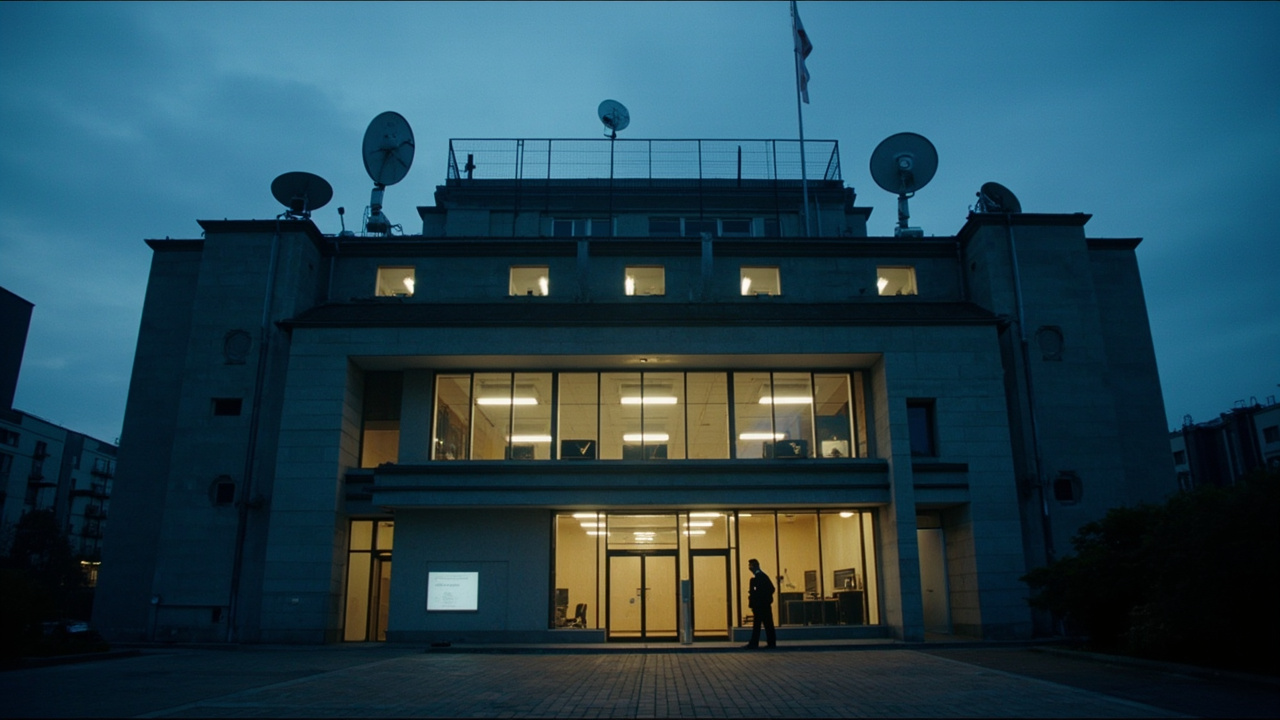
By Friday, day three of Hungary's state media suspension, Peter Magyar's government had produced no legal instrument authorizing the blackout. What it had produced was a reference standard. In a press conference Thursday night and a radio appearance Friday morning, the prime minister–elect named Deutsche Welle and the BBC as the institutional models Hungarian public media would be rebuilt against. [1] [2] The sentence reads like reassurance. It is also an admission: the suspension is operating on political authority alone, with Western public broadcasters cited where a statute should be.
This paper argued Wednesday that Magyar's suspension used authoritarian tools for stated democratic purposes and that the Central European Press and Media Foundation — Orban's 400-outlet loyalist conglomerate — remained structurally intact under the new prime minister. The DW benchmark does not change that reading. It clarifies it. Deutsche Welle is a public broadcaster funded by the German federal budget and governed by a broadcasting council whose members are appointed through a legal process written into the Rundfunkstaatsvertrag. The BBC operates under a Royal Charter renewed by Parliament. Both exist because statute says they exist. Hungary's suspended broadcaster is operating, or not operating, because a politician said so.
Euronews, quoting Magyar at length Wednesday, captured the rhetorical move: he called state TV's output "worse than North Korean propaganda" and promised programming "that will look a lot like DW." [3] The North Korea comparison is a provocation, but the DW promise is a genuine reference. The gap between them is where the question lives. Reaching DW's standards requires a legal architecture DW has and Hungary, as of Friday morning, does not.
The second development of the week belongs not to Budapest but to Brussels. European Commission President Ursula von der Leyen congratulated Magyar within seventeen minutes of his election being called, declaring that "Hungary has chosen Europe." [4] The speed is the story. Brussels condemned exactly this kind of executive consolidation — the suspension of critical outlets, the denigration of the ceremonial head of state, the rule-by-announcement — when Orban practiced it. The Article 7 procedure opened against Hungary in 2018 cited, among other grievances, executive interference with public media. Von der Leyen, then a defense minister, supported that procedure. As Commission president she extended it. On Sunday she endorsed a government whose first major act has been to suspend public media by press release.
The defense offered in Brussels is that Magyar's direction differs from Orban's. That is true. It is also beside the point. The Commission spent sixteen years insisting that the mechanism mattered independent of the direction — that the test of democratic media policy was whether decisions rested on legal authority and independent institutions, not on whether the intended outcome happened to be liberal. That test was not trivial. It held the Hungarian government accountable to a standard Brussels could not be accused of tailoring to individual politicians. The seventeen-minute tweet retired it.
Reporters Without Borders issued a statement Wednesday calling on Magyar to "tread carefully" — the phrase the organization uses when it supports a goal but distrusts the method. [2] The statement was barely covered in the German press. Von der Leyen's was front-page in every major European outlet.
Magyar has, in other words, received exactly what Orban wanted and never got: a Commission president who treats suspension by decree as compatible with European values, provided the person doing the suspending is aligned with the Commission's priorities. What Hungary will have in six months is either a public broadcaster modeled on DW — funded by statute, governed by an independent council, insulated from the elected government — or a public broadcaster whose new orientation depends on who holds the prime minister's chair. The DW benchmark is a promise. The legal instrument is still missing. Until it arrives, the mechanism remains Orban-shaped. Only the occupant has changed.
-- ANNA WEBER, Berlin