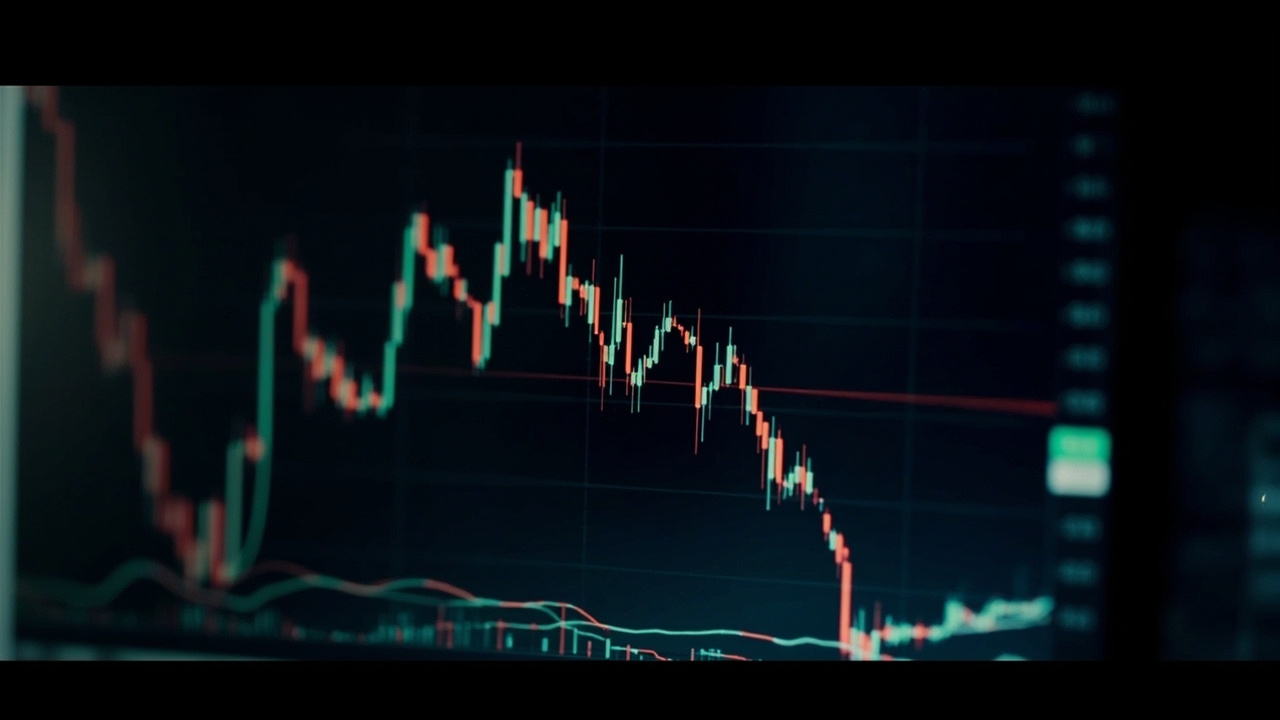
Brent crude fell to $98.05 per barrel Friday morning, down 1.35 percent. West Texas Intermediate traded at $93.40, down 1.74 percent. The drop came on Trump's Thursday-evening hint of "weekend Iran talks" and on the announced Israel-Lebanon ten-day ceasefire. Both catalysts are rhetorical. Neither changed the physical supply picture. The market priced both anyway. [1] [2]
This is the fourth consecutive trading day the oil market has reversed direction. Monday down, Tuesday up, Thursday up, Friday down. Four days, four directions. The paper wrote yesterday that Thursday's reversal made the peace pricing premature — the market had priced a blockade that would wind down and then was forced to reprice a blockade that was tightening. The companion piece noted that Morgan Stanley's $110 Q2 forecast has continued to sit above every printed close through the blockade's first four days. Both readings hold. Friday's reversal does not contradict them. It extends them into a new register.
The register is this: the war's oil price is no longer a function of physical supply. It is a function of presidential rhetoric. When Trump hints at talks, crude falls. When CENTCOM describes enforcement posture, crude rises. When a Lebanon ceasefire is announced — a deal that excludes Hezbollah and moves no Iranian barrels — crude falls anyway. The market is pricing the probability-weighted path of a negotiated outcome, and the inputs to that probability are what the president has said in the last 24 hours.
This is what the paper has called the porosity thesis in its structural form. A blockade that actually controlled oil supply would not reprice on a campaign soundbite. The physical supply picture — what ships carry, where they go, whether they arrive — does not change between a Thursday reversal and a Friday reversal. The refinery intake data, the floating-storage numbers, the shipping-tracker positions: all of these move on weekly timescales. They do not oscillate on a daily basis. What oscillates on a daily basis is the narrative weight of the blockade, and that is what the futures curve is now pricing.
Morgan Stanley's $110 forecast for Brent in Q2 was issued April 13 and reiterated this week. It sits roughly $12 above Friday's print. The forecast assumes a slow supply recovery even under optimistic diplomatic scenarios, because the physical infrastructure of alternative routing, additional pipeline capacity, and strategic reserve releases takes weeks to months to offset a blockade of this magnitude. The bank's model does not have a dial for "Trump says talks are possible." It has dials for inventory, demand, and refining. Those dials have not moved enough to justify the 12 percent discount the market is applying to the Morgan Stanley base case. [3]
The options market tells a clearer story than the headline futures price. Implied volatility on one-month at-the-money Brent options has held above 45 percent throughout the four-day oscillation. That is elevated by roughly three standard deviations above the five-year average. The skew — the premium paid for out-of-the-money calls relative to puts — steepened again on Thursday. Traders buying protection against a spike to $110 did not stop buying during Friday's decline. They bought more. The futures market is oscillating around rhetoric. The options market is betting that the oscillation eventually collapses in one direction. The skew tells you which direction.
What Friday's reversal cost the peace-pricing thesis is a credibility point. Thursday's upward move was supposed to bury that thesis. Friday's downward move is the market testing whether it was buried too soon. The test will repeat. Every Trump statement that gestures toward de-escalation will produce a version of Friday's move. Every CENTCOM briefing that reinforces enforcement will produce a version of Thursday's. The oscillation is now a pattern the market knows how to trade around. Physical supply is the slow-moving variable underneath; rhetoric is the fast-moving variable on top.
There is a specific risk in headline-driven pricing that this paper has noted before and will note again. The variable at the top moves faster than the variable at the bottom. When the two eventually align — when rhetoric catches up to physical supply, or physical supply catches up to rhetoric — the adjustment is usually sharp. The adjustment can go either direction. If Hormuz reopens in a serious sense, the fall is to the low $80s quickly. If the blockade proves durable and the alternative routing fails to materialize, the rise is to Morgan Stanley's $110 and past it. The options market is pricing the tail risks. The futures market is pricing the mood.
Four days, four directions. The chart @fiscal_ai posted Friday morning is what the market looks like when it cannot read the war. The chart will continue until the war gives it something readable to price. Until then, every Trump sentence, every ceasefire announcement, every CENTCOM clarification will produce another candle in a different color. The blockade's price, such as it is, is now written one headline at a time.
-- DARA OSEI, London