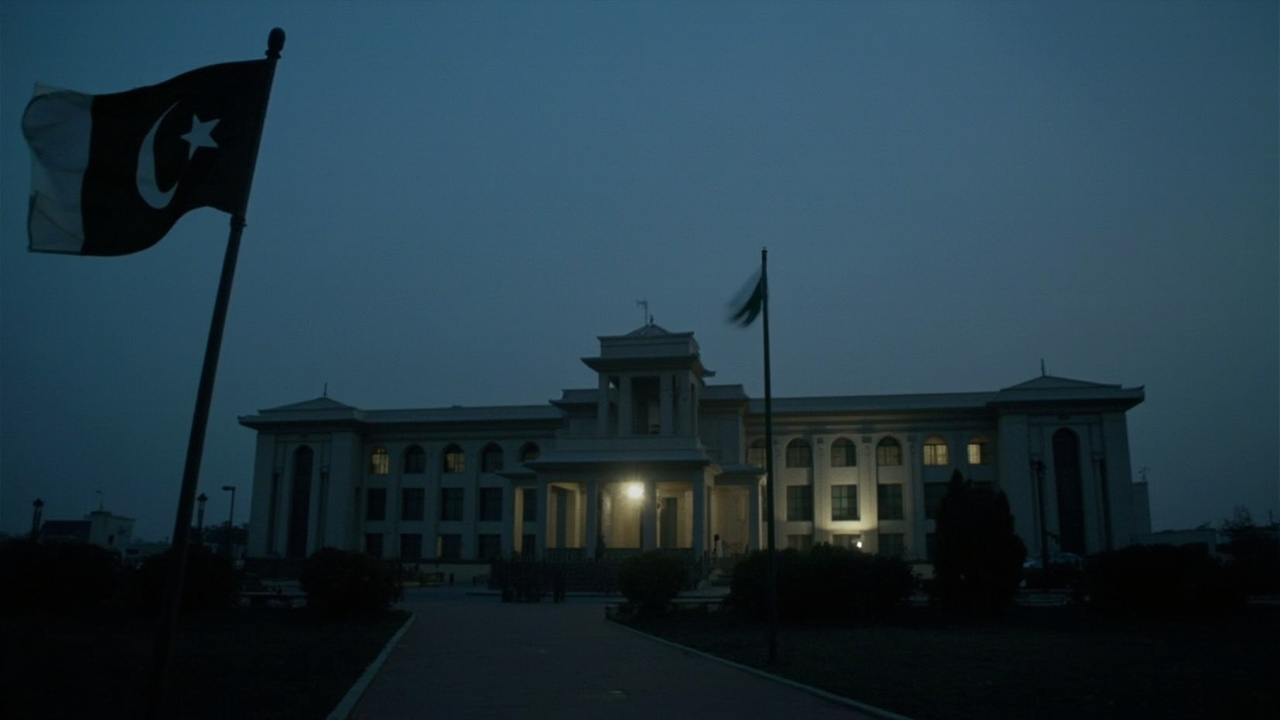
Four days before the April 22 expiry of the two-week ceasefire that halted the US-Iran war, Pakistan's Foreign Ministry spokesperson Tahir Andrabi walked to the podium in Islamabad on Thursday and confirmed what diplomatic cables across three continents already suspected: there is no date for a second round of negotiations. "There are no dates yet," Andrabi told reporters, in a formulation so stripped of diplomatic padding it landed like a confession [1]. Yesterday's account of the undecided Round 2 schedule reported that timing and venue remained unresolved. Pakistan's own 45-day ceasefire extension proposal, floated the same day, had drawn no public response from Washington or Tehran.
The diplomatic geometry has since decomposed. What Islamabad calls the "Islamabad Process" now runs through four separate capitals on three continents, with no coordinator and no convergence point. The civilian-military split at the heart of Pakistan's mediation effort is no longer subtext — it is operational architecture.
The Tehran Track
Pakistan's Chief of Defence Forces, Field Marshal Asim Munir, arrived in Tehran on April 15 with a delegation that included Interior Minister Mohsin Naqvi. Iranian Foreign Minister Abbas Araghchi received him at the airport with what Iranian state media described as a "warm embrace," telling reporters he was "delighted" to welcome the field marshal and expressed gratitude for Pakistan's "gracious hosting of dialogue" [2]. The optics were deliberate: Araghchi, Iran's chief diplomat and a veteran of nuclear negotiations, chose to greet Munir personally rather than delegate the task to protocol officers.
On Thursday, Munir met Iranian Parliamentary Speaker Mohammad Bagher Ghalibaf, who led Tehran's delegation at the April 11-12 Islamabad talks — 21 hours of negotiation across three rounds that produced, in Andrabi's careful phrasing, "neither a breakthrough nor a breakdown" [3]. Iran's ambassador to Pakistan, Reza Amiri Moghadam, stated publicly that Tehran would not consider any venue other than Pakistan for future talks. "We will do talks in Pakistan and nowhere else, because we trust Pakistan," he said at an event in Islamabad [2]. The declaration locked Islamabad into Tehran's venue preference while foreclosing alternatives — Geneva, Muscat, Doha — that Washington might have preferred.
The Sharif Circuit
While Munir worked Tehran, Prime Minister Shehbaz Sharif embarked on a four-day regional tour that began in Jeddah on April 15, moved to Doha on April 16, and will conclude at the Antalya Diplomacy Forum on April 17. In Jeddah, Sharif met Crown Prince Mohammed bin Salman and expressed "full solidarity and support" for the kingdom following regional escalation [2]. Riyadh praised what it called the "constructive role" played by both Sharif and Munir. In Doha, Sharif met Emir Sheikh Tamim bin Hamad Al Thani to discuss "the regional situation, particularly in the Gulf region," according to the prime minister's office.
From Antalya, Sharif — accompanied by Deputy Prime Minister and Foreign Minister Ishaq Dar — is expected to meet counterparts from Saudi Arabia, Turkiye and potentially Egypt on the sidelines of the forum. Turkish Foreign Minister Hakan Fidan confirmed that discussions were underway for a regional security platform involving Pakistan, Saudi Arabia and possibly Egypt, describing it as a mechanism so "countries can be assured of one another" [2]. It would be the third such meeting in a month, following earlier rounds in Riyadh and Islamabad.
The Lebanon Alignment
The most significant diplomatic shift came not from Munir's Tehran meetings or Sharif's Gulf tour, but from Andrabi's briefing room in Islamabad. When asked about Iran's insistence that any deal must include Lebanon — where Israeli strikes have killed more than 2,000 people and displaced 1.2 million — Andrabi did not demur. "Peace in Lebanon is essential for US-Iran peace talks," he said, adding that "signs of improvement on the Israel-Lebanon front over the past two days are encouraging" [1][4].
The statement aligned Islamabad explicitly with Tehran's position against Washington's. The United States has maintained that any Lebanon deal must remain separate from US-Iran negotiations. On April 14, Secretary of State Marco Rubio convened a trilateral meeting in Washington with the ambassadors of Israel and Lebanon — the first direct engagement between the two sides since 1993 — but no ceasefire or follow-up meeting was agreed [2]. By endorsing Tehran's linkage argument, Pakistan surrendered its posture as a neutral mediator. Islamabad is now a partisan in the framing dispute, whether it acknowledges this or not.
Entropy as Strategy
Muhammad Faisal, a Pakistani security analyst at the University of Technology Sydney, described the parallel outreach as "dual-tracked," with Sharif reassuring Gulf allies while Munir engaged in "hard negotiations" to narrow gaps between Iran and the US [2]. The charitable reading is division of labour. The uncharitable one is that Pakistan's civilian government and military leadership are running separate diplomatic operations with no unified chain of command, and that four capitals — Washington, Tehran, Islamabad and now Antalya — are receiving different signals from different Pakistani interlocutors.
The ceasefire itself is holding, but under increasing strain. A US naval blockade on Iranian ports remains in place, with US Central Command reporting its forces had turned away nine ships as of April 16 [2]. The Strait of Hormuz, through which roughly a fifth of the world's oil passed during peacetime, remains effectively closed by Iran except for vessels from countries that have struck individual deals with Tehran. Iran's effort to monetise the closure — charging tankers roughly $2 million for transit permits — has produced only about 60 permits issued, payment requests sent for eight shipments, and no funds collected, according to sources cited by Iran International [3].
White House press secretary Karoline Leavitt said further talks would "very likely" take place in Islamabad, adding: "We feel good about the prospects of a deal" [2]. President Trump said on Tuesday that talks could resume within two days. But two days have passed. The calendar is now merciless: April 22 arrives on Tuesday, and with it the formal expiry of the ceasefire that Pakistan spent enormous diplomatic capital to broker.
Kamran Yousuf, an Islamabad-based diplomatic affairs journalist, told Al Jazeera he expected the ceasefire to be extended, noting there was "little appetite on both sides to go back to war" [2]. Perhaps. But extending a ceasefire is not the same as building a peace, and running four parallel diplomatic channels through four capitals with no date for the next round is not a process. It is entropy with a press briefing.
-- YOSEF STERN, Jerusalem