Five days after Peru went to the polls, the count is still being challenged, and the two candidates apparently advancing to the June 7 runoff sit on opposite ends of the country's political axis. Right-wing Keiko Fujimori of Popular Force leads with 17.07 percent. Leftist Roberto Sánchez Palomino of Juntos por el Perú — founder of that party, former foreign-trade minister in Pedro Castillo's leftist cabinet — sits second with 11.97 percent, narrowly ahead of the far-right Lima mayor Rafael López Aliaga at 11.93 percent. [1] [2] With 93 percent of ballots reported, Sánchez's lead over López Aliaga is roughly 5,600 votes. The choice García Márquez would have recognized — between orderings of the same problem — is not the one Peruvians will face in June. They will face the older choice. Fujimori or the left.
The first round also produced a structural fact that will shape the campaign before the ideological one does. Voting on April 12 was extended to April 13 after a contractor failed to deliver electoral materials. Authorities said roughly 63,000 people in Lima alone could not cast ballots when they first tried; thirteen polling stations in the capital reopened on the second day. [3] Organization of American States observers called the failures "substantive." Frustrated candidates — including Fujimori — alleged fraud without producing evidence. By Thursday evening the National Jury of Elections was still issuing partial results.
The paper's democracy-erosion thread — extended yesterday through the Magyar state-media suspension in Hungary — has tracked how democracies decay without collapsing. Peru adds a different vector: election administration itself. The infrastructure of casting ballots was under the direction of an interim government whose legitimacy the election was supposed to restore. José María Balcázar, the current president, is Peru's fourth head of state since Castillo's 2022 removal. Congress stripped judicial oversight in 2023 and has since accumulated near-absolute institutional power. Whichever candidate wins the June runoff inherits an executive branch already hollowed out.
A runoff pitting Fujimori against a Castillo-cabinet leftist is not a new situation. It is the same situation. Fujimori has reached the second round in 2011, 2016, 2021 — and now 2026. She lost all three, twice narrowly, the 2021 vote to Castillo by 44,000 ballots. The anti-Fujimori coalition has been the organizing principle of Peruvian presidential politics for fifteen years. Its durability is a form of political memory; its weakness is that it is reactive.
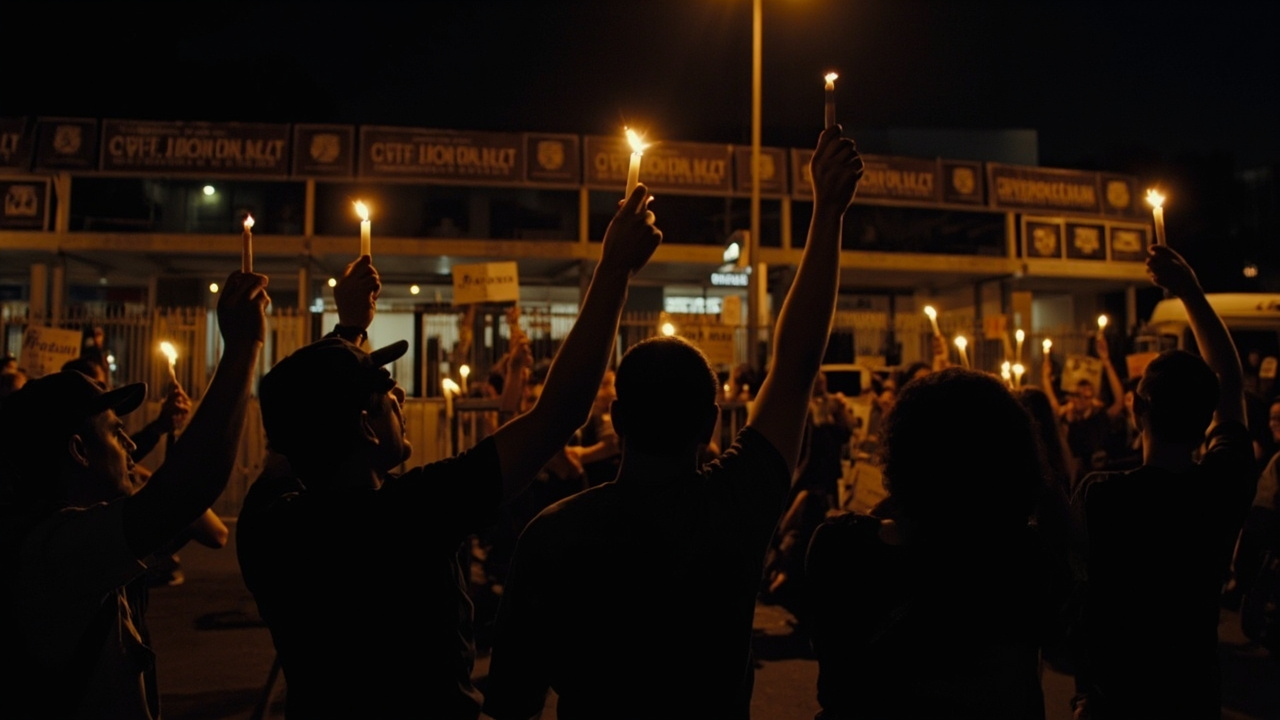
Outside the JNE in Lima, protesters have returned each evening since the election. Their grievance is not primarily about which candidates advanced. It is about the voters who did not cast ballots — the 63,000 in Lima plus an undetermined number across nineteen provinces where biometric verification machines failed. Signs read "they stole the count without stealing the vote." The ballot boxes were not tampered with. The count appears accurate. What failed was the infrastructure of casting, which the interim government was responsible for delivering. A democracy that cannot count the people who tried to vote has not failed. It has arrived at the condition that precedes failure.
-- LUCIA VEGA, São Paulo