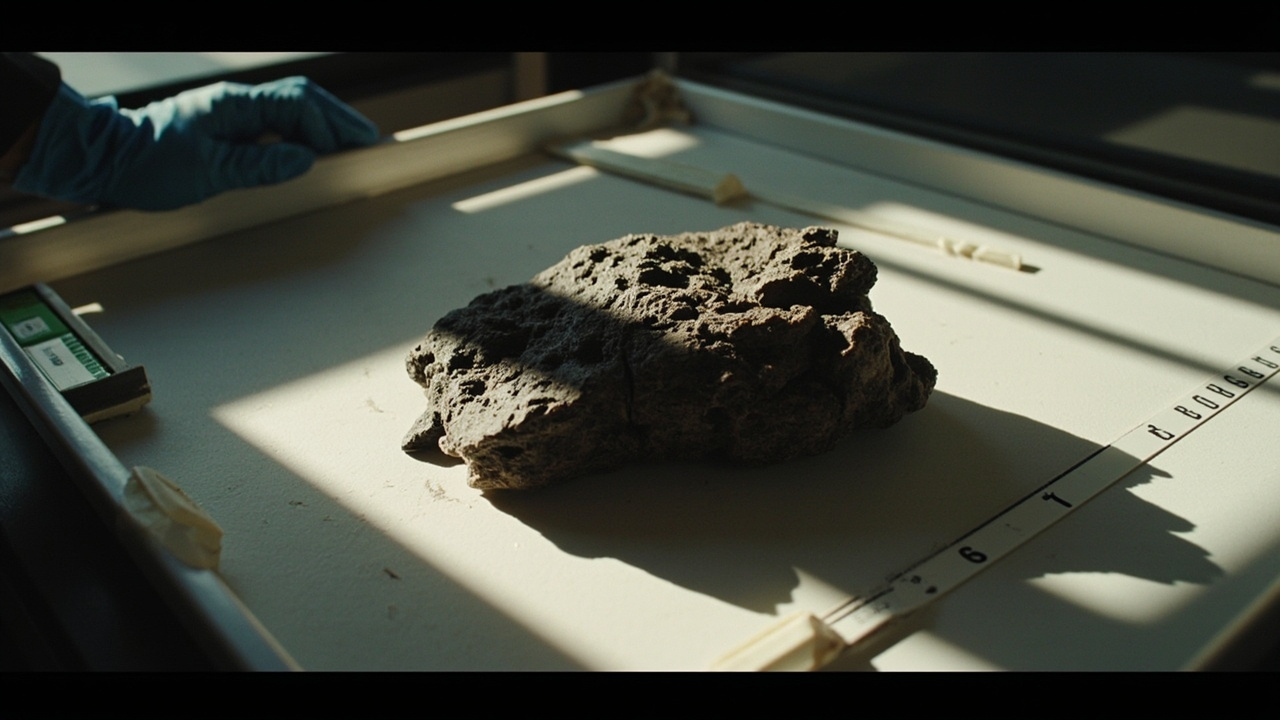
A paper published this week in Papers in Palaeontology describes a crushed skull from Ghost Ranch, New Mexico, that its authors name Ptychotherates bucculentus — "folded hunter with full cheeks" — and assign to Herrerasauria, one of the earliest carnivorous dinosaur lineages. [1] The specimen, collected by a Carnegie Museum team in 1982 and long dismissed as too mangled to classify, was rediscovered in a museum drawer by Virginia Tech's Sterling Nesbitt and handed to an undergraduate, Simba Srivastava, who spent two years digitally separating the bones with CT tomography and producing a 3D reconstruction. [2]
The standard textbook line has herrerasaurians vanishing well before the end of the Triassic — early casualties in the long rise of the theropods. The Ghost Ranch specimen sits in rock layers that may date to just before the end-Triassic mass extinction 201 million years ago. No other herrerasaurians have been found after this time. The paper's implication is the opposite of the usual framing: the extinction event that is conventionally understood to have cleared dinosaurs' rivals appears to have cleared some early dinosaur lineages too. "This forces us to reconsider the impact of the end-Triassic extinction," Srivastava said, "as something that wiped out not just the competitors to dinosaurs, but some long-standing dinosaur lineages themselves." [2]
The specimen is the only known evidence that herrerasaurians persisted this late and at these latitudes. The American Southwest, the paper suggests, may have been their final refuge. One crushed skull, one drawer, one lost lineage. [1]
-- KENJI NAKAMURA, Tokyo