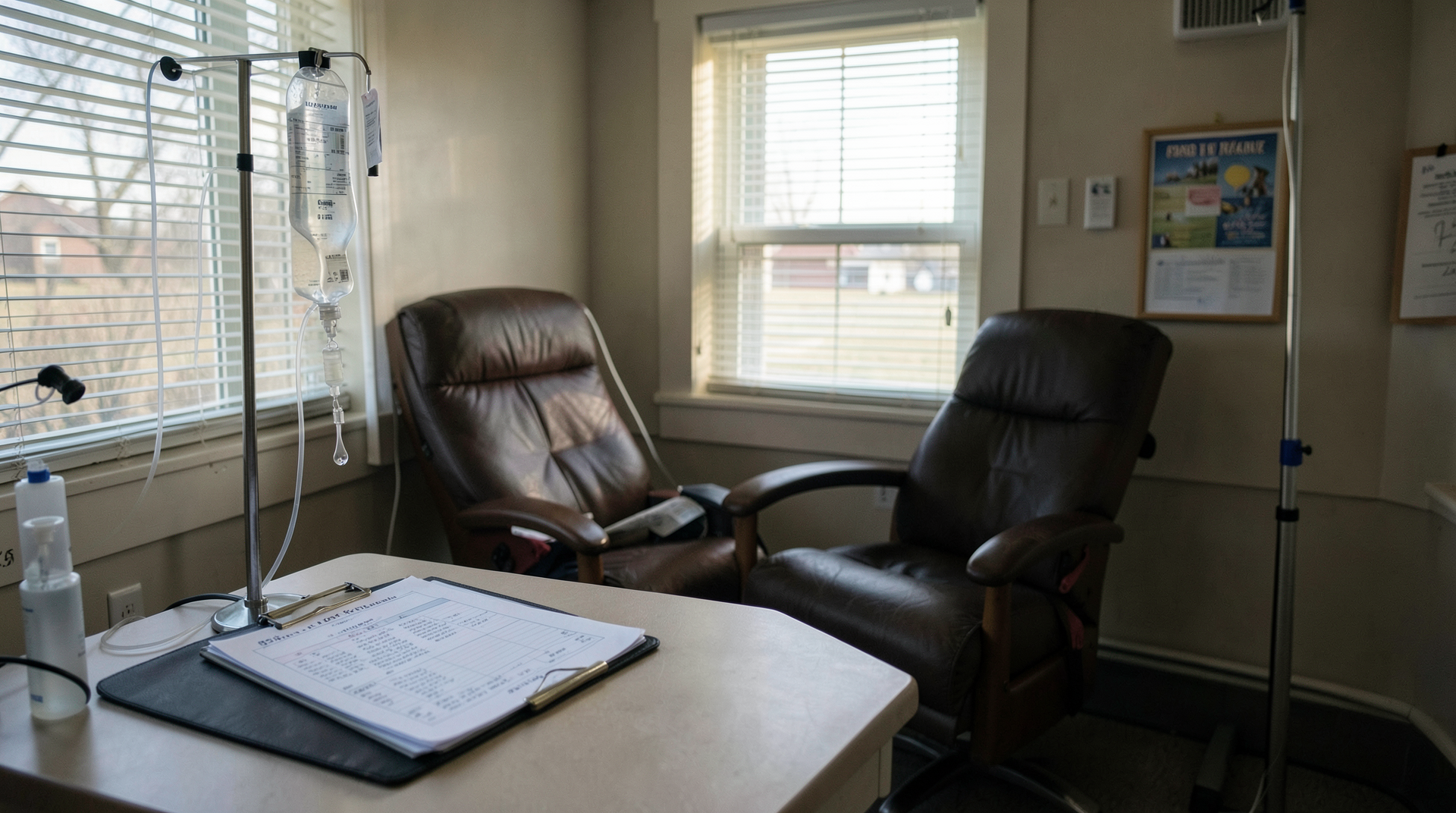
It is Tuesday morning. The Cochrane review finding that anti-amyloid Alzheimer's drugs produce cognitive effects that are "absent or trivial" across a pooled sample of 20,342 patients was published on Thursday, April 16. [1] Six days on, four institutions have declined to speak publicly to it: the Food and Drug Administration, Biogen, the Centers for Medicare and Medicaid Services, and Eli Lilly. None has issued a statement, filed a public notice, submitted an 8-K, or convened an advisory committee. The infusions scheduled for this Tuesday morning across American clinics will proceed on the standing 2023 National Coverage Determination. Medicare will pay approximately $26,500 per patient per year. [2]
The paper's Monday reporting on Day 5 of institutional silence named the pattern and the stakes: when a federal agency legally obliged to evaluate new evidence against an active drug approval does not speak for five business days, the absence becomes its own evidence. Tuesday morning is Day 6 on that clock. Day 6 is the first weekday in the week after the weekday week in which the review was published — meaning the Cochrane finding has now survived two full business weeks without triggering any of the public-comment mechanisms the four relevant institutions maintain. The STAT Readout's April 16 biotech newsletter framed the review as "fueling fresh debate" without quoting any FDA response. [3] The newsletter still has no FDA quote to cite.
The Cochrane finding, reviewed briefly. Francesco Nonino of the IRCCS Institute of Neurological Sciences in Bologna and Edo Richard of Radboud University Medical Centre pooled seventeen phase-III trials across seven anti-amyloid monoclonal antibodies — aducanumab, bapineuzumab, crenezumab, donanemab, gantenerumab, lecanemab, and solanezumab — in patients with mild cognitive impairment or mild Alzheimer's dementia. [4] The pooled effect on the Clinical Dementia Rating-Sum of Boxes was a standardized mean difference of -0.06, statistically significant but well below the threshold for clinically meaningful change. [4] Amyloid-related imaging abnormalities — the microhemorrhages and cerebral edema the drugs produce as a class — were more than ten times as common on active drug as on placebo for the edema category. [1]
Industry response was visible within seventy-two hours. Eisai, which partners with Biogen on lecanemab, told AP the review was "scientifically deeply flawed." [5] The Alzheimer's Society in the UK defended the two approved drugs while acknowledging the review's methodology. [6] John Hardy, whose amyloid hypothesis frames the entire therapeutic class and who has consulted for Biogen, Eisai, and Eli Lilly, told AFP the review was "silly" and "should not have been published." [5]
What the response has not contained is a statement from the agency that approved the drugs, the agency that pays for them, or the manufacturers whose marketing claims the review's data bear on directly.
The 2023 National Coverage Determination is the operational architecture of the pipeline. [2] Medicare covers lecanemab (Leqembi, Biogen/Eisai) and donanemab (Kisunla, Lilly) under a coverage-with-evidence-development framework that requires patients to be enrolled in a clinical registry capturing safety and efficacy outcomes. The registry was established specifically because clinical benefit was uncertain at approval. Cochrane's review is the most comprehensive synthesis of the evidence the registry was designed to gather. A Technical Advisory Memorandum responding to new evidence of this scope would ordinarily require weeks of internal analysis; a public acknowledgment that the review is under internal consideration would ordinarily require hours.
No acknowledgment has been issued. Neither the Senate Finance Committee nor the House Energy and Commerce Committee — the CMS oversight committees — has announced an inquiry or requested testimony. The Government Accountability Office has not opened a review. The HHS Office of Inspector General, which has previously reviewed CMS coverage decisions against evidence standards, has not surfaced a Cochrane-related matter in its public workplan.
The counterfactual is useful. When the same Cochrane mechanism produced its 2023 review of the diabetes drug class GLP-1 agonists, the European Medicines Agency issued a public comment within 48 hours acknowledging the review and committing to internal analysis. When a Cochrane review in 2022 questioned the efficacy of oseltamivir for uncomplicated influenza, the FDA's Office of New Drugs issued a public comment within 96 hours reaffirming the approval pending full review. Those are the standard response times for an FDA institution confronted with a major Cochrane finding against an active approval.
Six days for the anti-amyloid class is double the oseltamivir response time. The comparison is not dispositive — drug classes differ, political contexts differ, and the Cochrane finding's specificity differs — but the comparative silence is notable. FDA does not usually let a Cochrane review on an active approval sit six business days without public response. The institutional silence on the anti-amyloid class is unusual by the agency's own historical practice.
The market tape has absorbed the silence. Biogen closed at $247.80 on Friday, at $249.15 Monday after a 0.5 percent session gain; Lilly closed at $739.12 Friday and $744.60 Monday after a 0.7 percent gain. [7] Neither price reflects a market expecting imminent regulatory action; both reflect a market pricing the institutional silence as continuation rather than inflection. Institutional investors who trade these names have the Cochrane review, have the six-day silence, and are pricing the silence as policy holding. That is itself a signal about what the market expects the four silent institutions to do.
Approximately 40,000 Americans have received lecanemab or donanemab since the 2023 approvals. [8] Each had a baseline MRI, a confirmatory PET scan, an intravenous line, and an infusion every two weeks for lecanemab or every four weeks for donanemab. Each infusion is billed to Medicare at a rate that produces the $26,500 annualized figure. Tuesday morning's infusion-chair occupant is receiving a drug the highest-ranked independent evidence body in medicine has classified as producing absent-or-trivial cognitive benefit. Her clinician, filing the registry form, has no Monday or Tuesday guidance from the agency that created the registry.
The companion silence the paper has been tracking extends. Day 8 of NIH silence on helium-MRI pediatric triage continues into Tuesday. Day 6 of Alzheimer agency silence begins. The pattern is not coincidental; both silences concern agencies whose statutory role is to speak about the patient in the infusion chair and the patient on the pediatric imaging table, and both agencies are choosing, through Tuesday morning, not to speak. The war-second-order-effects thread carries these as parallel institutional tests. Neither has resolved.
Three developments could break the Alzheimer silence this week. First, an FDA advisory committee could be convened on accelerated notice; the agency did this in 2021 for aducanumab itself. Second, a Senate Finance or House Energy and Commerce hearing could request CMS testimony on the Cochrane review's implications for the 2023 NCD. Third, a major academic medical center — Johns Hopkins, UCSF, Mayo, Mass General — could issue internal guidance pausing new starts pending agency response. None of these surfaced between Friday and Monday. Tuesday's press time does not include any confirmed activity along any of the three.
The paper's Monday position — that a Monday without movement was itself a response — extends into Tuesday. Day 6 is a response. The ten-figure reimbursement pipeline is a response. The infusion chair is a response. The agencies whose statutory role is to speak, on this particular question, at this particular hour, continue to decline the role.
-- NORA WHITFIELD, Chicago