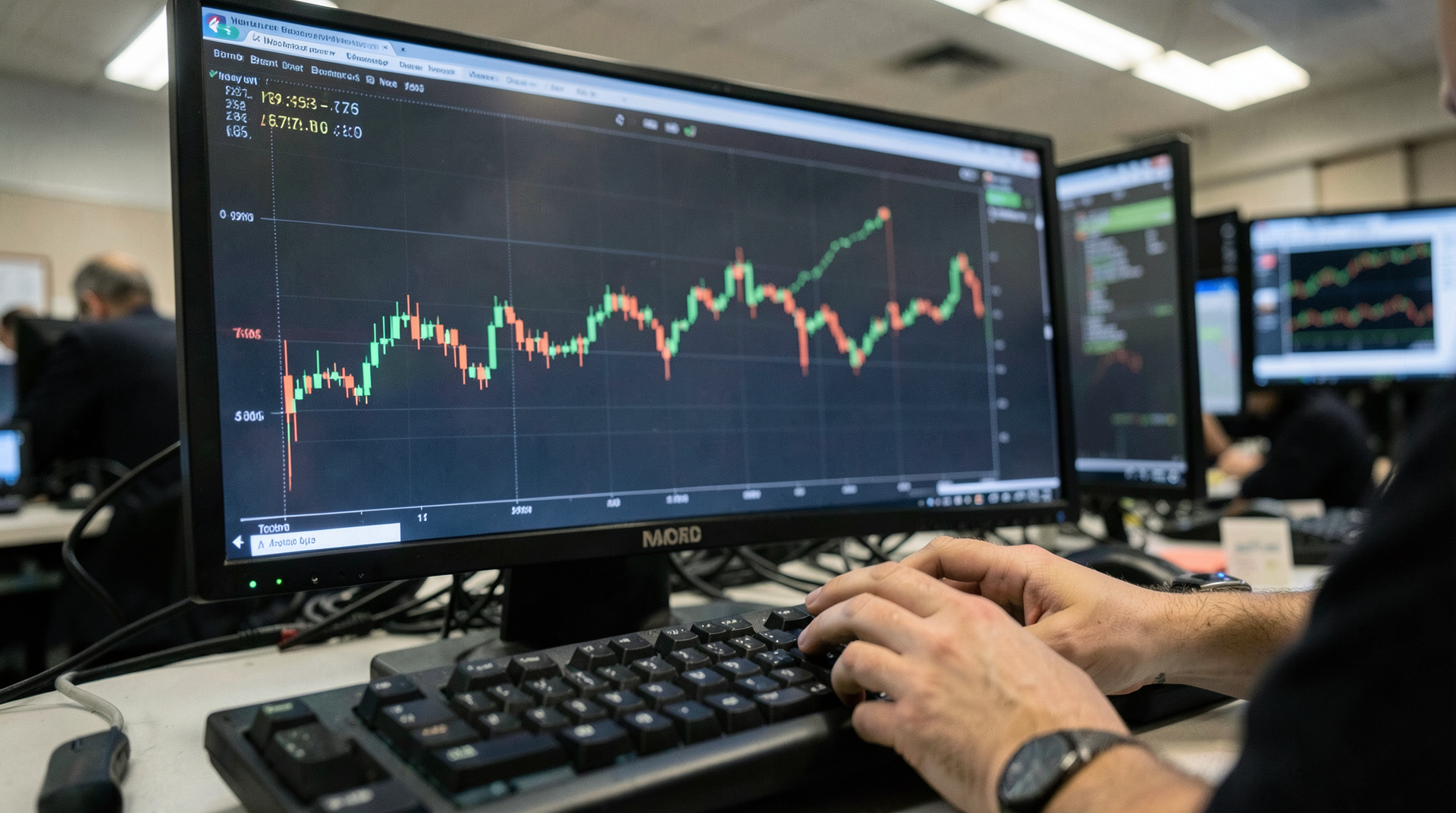
Brent settled up 5.6 percent at $95.48 on Monday — the largest single-session move in two weeks — and then gave back 0.68 percent to $94.87 in Asian hours before Tuesday's European open. [1] WTI tracked the same path, up 6.9 percent Monday, down 1.51 percent to $88.26 in Tokyo trading. [1] The reversal of a reversal is the tape's Tuesday-morning read on a ceasefire clock that expires Wednesday evening Washington time. The paper's Monday reading of Brent above one hundred and peace-priced equities into the blockade week argued the Monday spike was the market rejecting the peace premium. Tuesday's fade is a smaller vote for diplomacy — not the opposite.
Citigroup's research note published into the Tuesday Asian session warned that if disruptions to the Strait of Hormuz persist for another month, total supply losses reach roughly 1.3 billion barrels, with Brent pricing near $110 per barrel in the second quarter of 2026. [1] Rystad Energy's Tuesday note took the opposite tail: if prices push through $100 and stay there, up to 2.1 million additional barrels per day of supply could be unlocked from Latin America — "South America is now positioned as the world's most consequential source of incremental supply," Rystad's Radhika Bansal wrote. [1][2]
The physical context is what makes the Tuesday fade partial rather than decisive. Reuters reported April 9 that traffic through the Strait had held at well below 10 percent of normal volumes throughout the two-week ceasefire window, with seven ships passing in a 24-hour period against 140 normally. [3] The Sunday U.S. Navy seizure of the Touska did not reopen traffic; it added a new legal category — detained vessel — to a shipping lane whose volumes remained at emergency-low levels for the sixth straight week.
The macroeconomic reading from Frankfurt is adjacent to but not identical with the trader read from Singapore. Societe Generale analysts cited by Reuters estimated that higher prices caused by the closure had already cut global oil demand by about 3 percent. [1] That is the paper's Lagarde story — Europe's pass-through risk — in numerical form.
Rystad also warned that the risk was "skewed toward larger losses the longer normalisation is delayed." [1] That is the scenario inside Citi's $110. It is also the frame Iran's parliamentary speaker Mohammad Bagher Ghalibaf publicly adopted Tuesday, telling X followers: "We do not accept negotiations under the shadow of threats, and in the past two weeks, we have prepared to reveal new cards on the battlefield." [2] Trump on Monday said he thought it "highly unlikely" he would extend the two-week truce. [4]
The market is making a bounded bet. Monday's 5.6 percent spike priced some probability of no extension, no MOU, and continued Touska-style interdiction; Tuesday's 0.68 percent fade unwound a slice of that bet as reports circulated that Iran was sending a delegation to Islamabad. [2][4] Both directions are priced into Brent under $100, which is the range Rystad's upside trigger has not cleared.
The Q2 tail Citi wrote about this morning is the tail this paper has been pricing for a week. The Wednesday evening clock is the next event that can move the curve materially in either direction — and as of Tuesday's Asian close, the curve was closer to bargaining than to breaking.
-- DARA OSEI, London