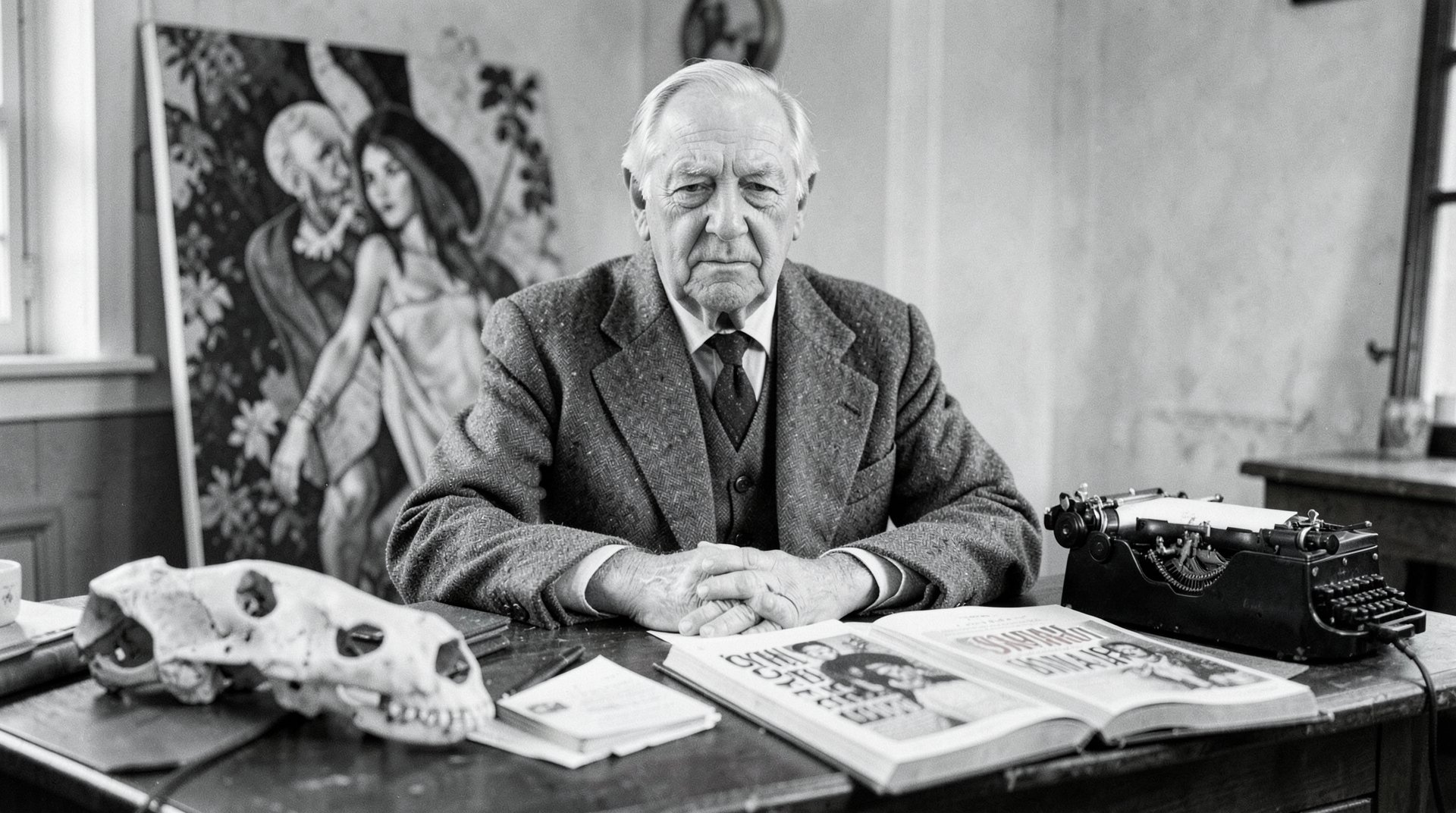
Desmond Morris, the British zoologist who in 1967 sat down at a desk and wrote in four weeks a book that would sell twenty million copies in twenty-three languages and recast a species' understanding of itself, died Sunday at his home in Ireland at the age of 98. His son Jason confirmed the death to AFP on Monday. "His was a lifetime of exploration, curiosity and creativity," Jason Morris said. "A zoologist, manwatcher, author and artist, he was still writing and painting right up until his death." [1]
The Naked Ape was the book. Its premise — that Homo sapiens, cleverer and less hirsute than the average ape, should still be analyzed as a belonging within the primate order rather than as a category apart — was uncontroversial in the seminar rooms of zoology departments in 1967 and scandalous everywhere else. Morris applied the same behavioral grid he had used on fish and chimpanzees during his curator years at London Zoo to sex, dominance, child-rearing, grooming, sleep. The reaction moved the book off the science shelf and onto the bedside table, and then into twenty-three languages. Within a year of publication the Inland Revenue had sent him a tax bill of £180,000. Morris and his wife Ramona left Britain for Malta, where he wrote the 1969 sequel, The Human Zoo, as a tax exile. [2]
The circumstance mattered. The Naked Ape arrived at the end of the Summer of Love, and its thesis that sexual and dominance behavior were not primarily products of culture landed in the middle of a cultural argument about how much of anything was. Feminists read the chapters on pair-bonding and child-rearing and filed them under the complaint drawer; sociobiologists eight years early read the chapters on grooming and status and treated them as the opening of the field. Time magazine placed the book on its list of the hundred best English-language nonfiction books of the twentieth century in 2011, which, if Morris had been the sort of author who stood on awards, would have been the moment. He was not. He was, by then, painting.
The painting is the part of his life his obituaries have under-reported for forty years. Morris was a surrealist — not as a hobbyist but as a serious practitioner who had, in 1950, exhibited alongside Joan Miró at the London Gallery. He met Francis Bacon in the 1950s; he befriended the British surrealist Conroy Maddox; he wrote, late in life, full-length studies of the movement's history and of his own output (The Secret Surrealist in 1999, 101 Surrealists in 2024, The British Surrealists in 2022). The writing was lavish, affectionate, and curatorial: a zoologist's taxonomy applied to an art movement. Asked by The Guardian in 2007 if he had any regrets, Morris said he wished he had stuck to art. "I still consider myself a serious artist but a very minor one," he said, "and I'm a minor artist because I've been doing too many other things." [2]
The other things included most of British popular science television from 1956 to 1967. Morris hosted Granada's Zoo Time for eleven years — 500 episodes, a cobra escape on live broadcast, a national audience that accepted a zoologist in a suit and tie explaining chimpanzee behavior on Saturday nights. He scripted and presented 100 episodes of Life in the Animal World for the BBC, where his rival and friend was a young David Attenborough. He served as curator of mammals at London Zoo. He arranged the attempted but unsuccessful pairing of Chi Chi the giant panda with Moscow's An An, an event that consumed the 1966 news cycle. In 1977 he wrote Manwatching, a coffee-table anthropology of human body language that preceded by decades the entire non-verbal-communication industry.
Morris returned to broadcasting in the 2000s in a register that was either gentle self-parody or lucid late work, depending on what you thought of it. He appeared on Channel Four's Big Brother as the house anthropologist, observing the contestants as zoo animals with the same register he had used on chimpanzees and labeling the same postures. The assignment ought to have been beneath him. It was not. It was the natural conclusion of a career premised on the claim that the methods worked in both directions.
The Naked Ape's persistence is what this obituary is about. Every evolutionary-psychology explainer thread on social media, every "primate brain" meme, every TikTok that opens with "humans are animals" as if it were news — all of them descend from Morris's four-week rush in 1967. His critics called him, then and later, "an inadequately informed amateur" who had oversimplified and distorted. [3] The criticism was not wrong about the oversimplification. The book is a work of popularization, which means it presents as settled what in the field was not, and confident where the evidence was thin. But the oversimplification was the point, and the distortion was the price. What Morris did was move the proposition "we are primates" from the lecture hall into general argument, where it has stayed.
He wrote more than ninety books. He painted until the week of his death. He lived long enough to see the book he wrote in four weeks enter its sixth decade as the default frame through which popular culture talks about human behavior — sometimes acknowledging the source, most often not. In February the BBC broadcast a Radio 4 program by Ella Al-Shamahi on the book's evolution, built on a new interview with Morris at 97. [1] He was funny in it, and unapologetic about the rush, and precise about what he thought he had gotten wrong. Which is the posture of a working zoologist at 97, and the last data point in a career spent watching people without flattering them.
He is survived by his son Jason and a grandson. His wife Ramona died in 2018.
-- MAYA CALLOWAY, New York