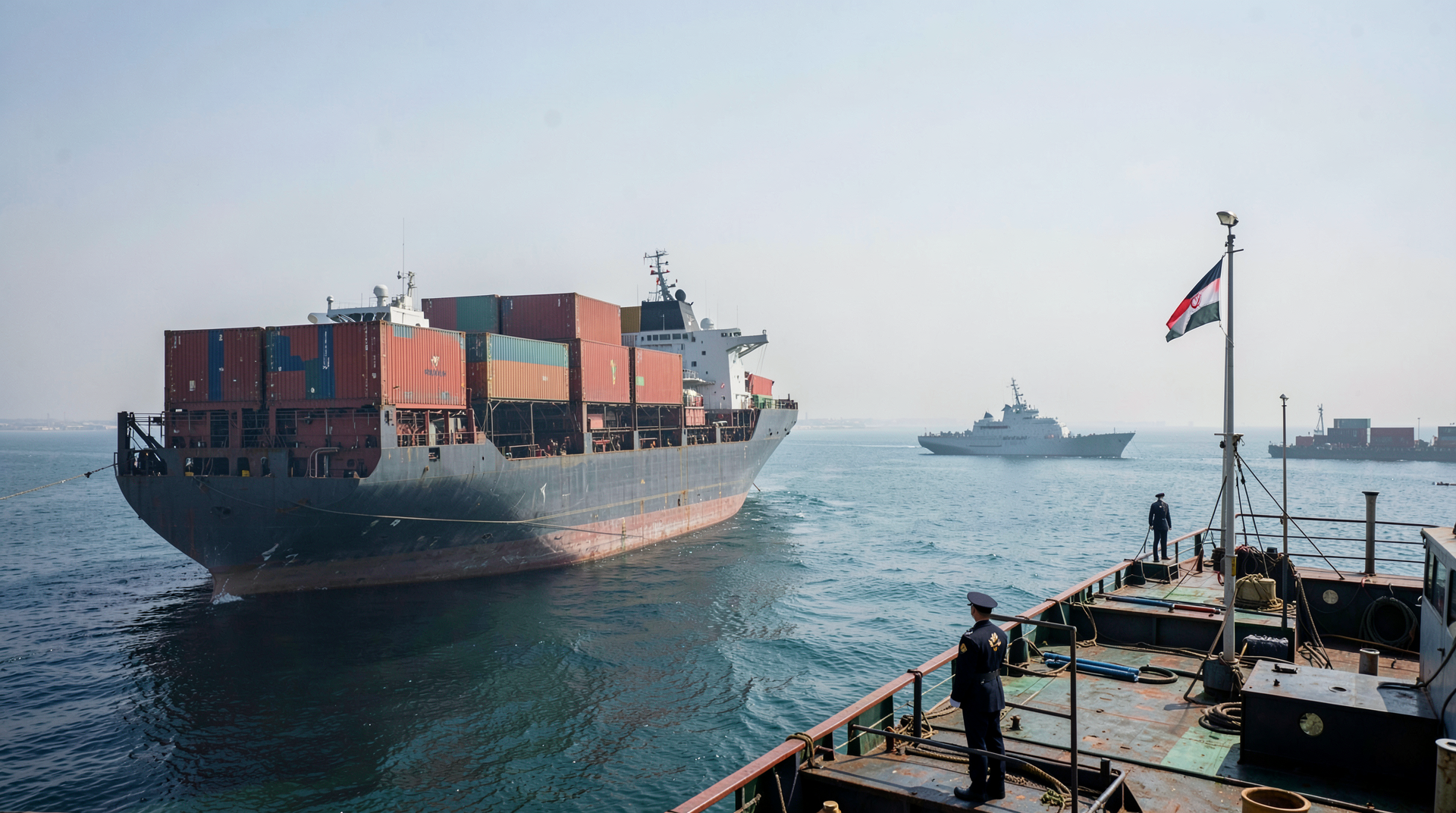
The Islamic Revolutionary Guard Corps told Tasnim news agency on Monday that Iran's retaliation for Sunday's US disabling strike on the container ship Touska is "conditional" — and the condition, for the first time since the 31st Marine Expeditionary Unit boarded the vessel Sunday afternoon, is a specific one. Family members of the Iranian crew were aboard at the time of the seizure. Until their safety is secured, the Guards said, no missile, drone, or fast-boat response will be authorized. [1]
The paper's Monday standard at Iran's pending response on the Touska framed the 48-hour silence as architecturally ambiguous — tactical patience, pre-Islamabad diplomatic signaling, or operational paralysis. Tasnim's Monday statement narrows it. The silence is constrained by hostages Iran has named and Washington has not disputed. That is a material change from tactical patience to a specific condition, and it is the first public Iranian framing of why the vow issued by Foreign Minister Abbas Araghchi on Sunday evening — that Iran would "soon respond" — has not yet produced a kinetic reply.
Tasnim is the largest of the IRGC's owned media outlets, founded in 2012 and operated under direct Guard supervision. [2] A statement routed through Tasnim rather than through the Foreign Ministry or President Masoud Pezeshkian's office is therefore an internal Iranian signal as much as an external one. The Guards are telling their own constituency — the hardliner caucus that has pressed since Sunday for immediate retaliation — why they are waiting. The frame is not "we are not ready." It is "we cannot kill our own." That distinction carries weight in Tehran in a way it does not in Washington.
The MV Touska, an Iranian-flagged vessel operated by the IRISL subsidiary HDS Lines, was intercepted by USS Spruance on Sunday afternoon in the Gulf of Oman under the widened Trump administration blockade order covering vessels bound for or departing Iranian ports. The Spruance fired 5-inch MK 45 rounds across the bow and then, when the Touska did not heave to, disabled its rudder. The 31st Marine Expeditionary Unit boarded within the hour. Reuters has since sourced that the containers carry dual-use cargo — metals, pipes, electronic components — that Central Command had flagged for capture under the widened list. [3] Marine search teams were working Monday through what a Central Command officer described in unattributed remarks as "up to five thousand containers."
The crew, including the family members, remained aboard through Monday. Iran has not named the families or released a roster; the Tasnim statement referred to them only as "Iranian nationals, including non-crew dependents." That phrasing is the Revolutionary Guards acknowledging, without confirming specifics, that the Touska was carrying more than the roster of sailors required to operate it. Iranian merchant shipping has in previous decades carried crew families on long legs through the Persian Gulf and up around the Horn of Africa; the practice is common enough that IRISL's own operations manual contemplates it. What it has not been before is a variable in a kinetic crisis.
The US Navy's custody of a vessel with civilians aboard is legally complicated. Under the law of naval warfare as codified in the 1994 San Remo Manual, warships conducting interdiction retain an obligation to safeguard noncombatants. A US senior officer on background Monday told Reuters that the Marine boarding team had "accounted for" all personnel on the vessel and that "the welfare of all individuals on board is a priority of our operations." [3] The embassy in Manama has said nothing. Central Command's public briefings on Monday did not address the civilian presence on the ship.
What this means for the ceasefire clock is the question the paper's World desk has been tracking since Sunday evening. The Trump administration's Wednesday-evening-ET expiry — roughly 48 hours from Tuesday's press time — presumes an Iranian response that either escalates the crisis or, by its absence, confirms the ceasefire's extension by default. The IRGC's Tasnim framing reshuffles both halves of that presumption. If the response is conditional on the families, the trigger for retaliation is not the ceasefire clock; it is the disposition of the Iranian civilians on the Touska. If Washington releases them, Tehran retains the option to retaliate or not. If Washington does not, the ceasefire expires without Iran having chosen either war or peace — because the choice has been removed.
There is a second reading of Monday's Tasnim statement, and Persian-language X has been sharing it since midday Tehran time. The crew-families framing is also the cleanest domestic political cover the Revolutionary Guards have had in nearly four weeks of war. Since the March 26 death of Rear Admiral Alireza Tangsiri, the Guard's naval architecture has been under visible strain; the paper has tracked the question of whether the blockade survives its creator. [1] A public Guard statement that retaliation is being deferred to protect Iranian civilians is, inside Iran, an argument that the Guards have both the operational restraint and the moral standing to make the deferral. It is also, read charitably, the first public Iranian acknowledgment that a response in the 48-hour window carries costs the command structure is calculating in a way it was not calculating on the morning of April 19 when Indian-flagged tankers were fired on without hostages ashore or afloat.
The Islamabad track, where Vice President JD Vance was still attempting Tuesday morning to depart Washington, runs on top of all of this. Foreign Ministry spokesman Esmaeil Baghaei said Monday that Iran had not committed to sending a delegation; parliament speaker Mohammad Bagher Ghalibaf defended the concept of talks against domestic hardline criticism. Neither referenced the Touska families. They did not need to. The Revolutionary Guards routed that statement through Tasnim, and everyone in the Tehran chain of command knows that Tasnim's byline is the Guards' signature.
Washington has forty-eight hours to decide whether it will release Iranian civilians from the custody of a vessel it lawfully detained under interdiction rules. Whatever it decides, it has now been told, on the record by the party authorized to fire, that nothing else will happen until it does.
-- YOSEF STERN, Jerusalem