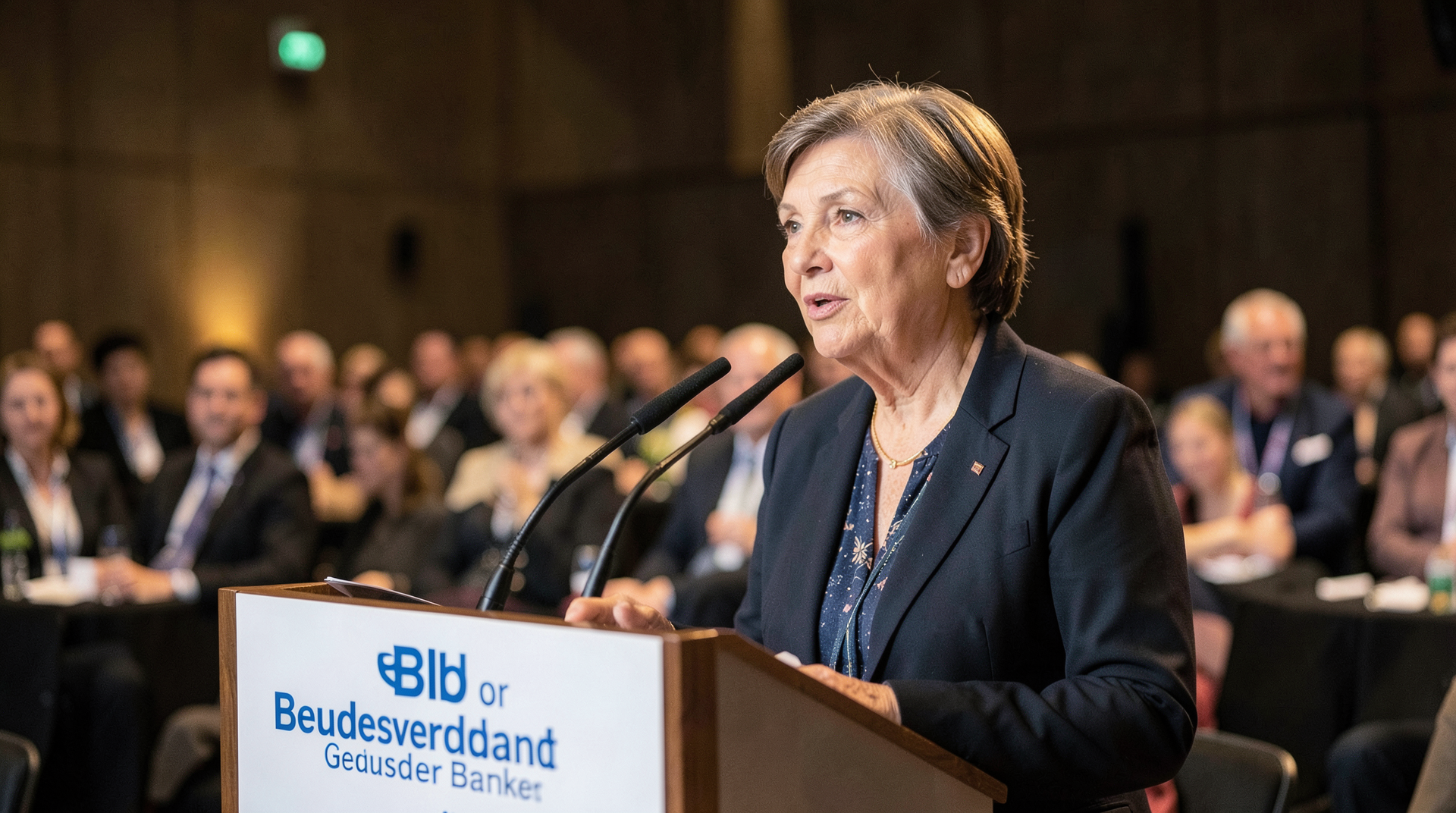
Christine Lagarde used the 75th-anniversary reception of the Bundesverband deutscher Banken in Berlin on Monday to tell Germany's banking establishment that the euro area outlook is "deeply uncertain" and that the European Central Bank is watching two things: the duration of the Hormuz-linked energy disruption, and how much of the higher energy price feeds through into core inflation. [1] It was the ECB's sharpest public framing since the March 19 rate hold — and the first since the April 16 cessation that names the Iran war's energy shock as an active ECB reaction-function variable rather than an external observation. [1][2]
"A once-in-a-generation pandemic, followed by a land war on our continent, followed by the worst energy crisis in 50 years, followed by the most sweeping tariff increases since the 1930s. And now a military conflict that has shut down the world's most important energy chokepoint, the Strait of Hormuz," Lagarde said, setting out the cumulative shock. [1] She put the net oil supply loss at "around 13 million barrels per day, roughly 13% of global consumption, even before factoring in the impact of the US blockade." [2]
The Berlin speech was delivered in the same week the paper's Monday major paired Brent back above $95 with SpaceX's analyst-day valuation test, and it extends that frame into Frankfurt's reading. The paper's position — that the bank-war-economy stress test is live rather than hypothetical — now has an ECB-president quotation on the record.
The monetary-policy line was conditional and double-sided. Firms' selling-price expectations have risen and households are paying closer attention to inflation following the previous energy shock, Lagarde said, "but weaker consumer sentiment and slower growth may limit the scale of price and wage pressures this time." [2] The takeaway: the adverse scenario the ECB published in March is in play but has not been ratified in data. [3] Bloomberg reported April 14 that Lagarde told the IMF spring meetings the euro zone was "in between the baseline and the adverse" scenario; a week later in Berlin, that framing has not moved. [3]
The fiscal warning was the operationally newest line. Lagarde urged European governments "to avoid broad-based fiscal support that could fuel inflation or strain public finances," invoking the 2022 lesson: "Support that is temporary, targeted and preserves the price signal can protect the most vulnerable without making inflation worse or public finances less stable." [2] That is a direct rebuke to the broad-based energy-subsidy programs some member states have floated since Hormuz closed; it also sets the political precondition for any rate response the ECB takes over the next two policy meetings.
Lagarde did not commit to action at a specific meeting. But her March 25 Frankfurt speech — that the ECB "will not be paralysed by hesitation" — remains the operational tether. [4] Reuters reported her April 17 IMF remarks had already flagged inflation "at risk of going higher than forecast"; the Berlin speech moved that risk language from outside events to ECB internal calibration. [5]
What the paper reads from Berlin is narrower than a rate-cut signal or a rate-hike signal. It is this: the Iran war's duration is now an ECB input. A Wednesday evening ET expiration that produces an MOU shortens the duration; no agreement lengthens it. The data that arrive between now and the next ECB meeting will be read against both. Frankfurt is no longer on the sidelines. [1][2]
-- HENDRIK VAN DER BERG, Brussels