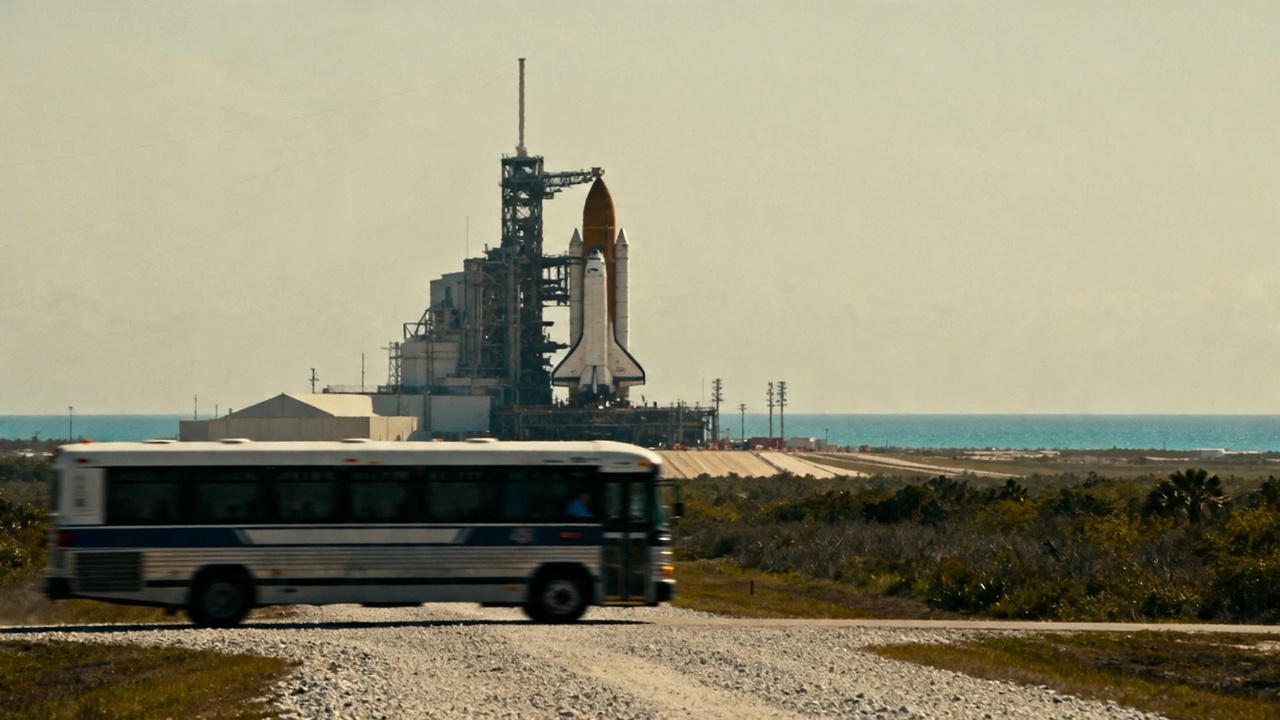
SpaceX hosts its in-person analyst day at Starbase, Texas on Tuesday, April 21 — the first institutional disclosure event ahead of a confidentially filed IPO targeting a $1.75 trillion valuation and up to $75 billion in proceeds. [1] Twenty-one banks are in the syndicate; Morgan Stanley, Goldman Sachs, JPMorgan Chase, Bank of America, and Citigroup lead as active bookrunners, with sixteen additional banks in defined distribution roles. [2] Electronic devices are to be surrendered at the door. The Macrohard xAI datacenter tour follows Thursday, April 23. The virtual session walking sell-side research teams through the financial models is scheduled for May 4.
Brent crude traded back through $95 Monday on the CNBC tape as the Vance delegation to Islamabad remained on the ground in Washington, and the peace-priced market the paper framed Sunday as the test SpaceX's 109x EBITDA math would meet is wobbling before the bankers arrive in Boca Chica. [3] Monday's opening above $100 held into Tuesday's London session, partially reversing overnight into the $95-97 range — a range that is approximately 18 percent higher than Friday's ceasefire-priced close and approximately 4 percent higher than Monday's Asian open. [4] The paper's Sunday framing — Brent above $100 with Tesla and SpaceX into the blockade week — holds into the analyst day with the range re-tested but the peace-priced direction not restored.
The math that the twenty-one-bank room must endorse has not changed. Against 2025 revenue of roughly $15-16 billion, the $1.75 trillion valuation produces a price-to-sales multiple of approximately 109. [5] Against EBITDA near $8 billion for the same period, the price-to-EBITDA ratio lands at 220 trailing — or 109 on Reuters's double-the-2026-revenue assumption, which is the aggressive construction the sell-side is being asked to accept. [6] Tesla trades at 12 times revenue and 79 times EBITDA. Palantir at 43 and 75. The paper's Sunday framing held that no current equity in the market has defended multiples of the magnitude SpaceX is asking the room to underwrite. That framing still holds.
The twenty-one-bank syndicate is the structural cover. The paper's Sunday read named the size of the syndicate as signal: a book split across 21 distribution relationships requires each bank to sell a defensible share to its own clients. Morgan Stanley fronts the retail E*Trade channel; Bank of America fronts the US high-net-worth and family office channel; JPMorgan fronts the international institutional channel; Citigroup fronts the international retail channel; Mizuho fronts Japan; Barclays fronts the United Kingdom; Deutsche Bank fronts Germany; Santander fronts Iberia; BTG Pactual fronts Brazil; and so on. [1][7] The lane structure is not improvised. It is the institutional architecture for moving $75 billion in a single offering without overloading any one geography or channel. Each bank's willingness to commit its lane is the measurable signal Tuesday's room produces.
The sequence of Tuesday's event, the Thursday datacenter tour, and the May 4 virtual model walkthrough is the disclosure pattern the paper has been reading as a model-deferral. Ordinary analyst days include the financial models. A company whose models hold up in the room shows the models in the room. SpaceX's sequence — show the story Tuesday in person, show the hardware Thursday at the Memphis datacenter, walk through the numbers virtually two weeks later on May 4 — implies the models need more time than Tuesday provides, or more flexibility than sell-side discipline would permit if the walkthrough happened today. [8]
Two weeks is the operating window. If Starlink's 2026 revenue trajectory — consensus estimates run from $15.9 billion to $24 billion against a 2025 base of $10.6 to $11.4 billion — is to carry the valuation, the sell-side must buy the case that Starlink alone justifies a $1.75 trillion price. [9] At 54 to 63 percent EBITDA margins, Starlink produces $8.5 to $15 billion of EBITDA on the 2026 revenue band, against a $1.75 trillion enterprise. That is a 117-to-205x multiple on Starlink's EBITDA alone. The sum-of-the-parts argument — that Starship launch, third-party satellite launch, Starshield defense, and the Macrohard datacenter each carry positive enterprise value — is what must close the gap between Starlink's standalone number and the $1.75 trillion headline.
The Futurum analyst Shay Boloor's line, circulating widely in valuation X through the month, held that "Starlink is the only reason the valuation is defensible." [6] PitchBook's Franco Granda, quoted in Reuters, framed the public-market ask as requesting credit on narratives the February $1.25 trillion secondary round had already priced in. Sell-side enthusiasm on Tuesday is the first public-market-adjacent test.
The macro tape the book is walking into is not the peace tape of Friday's close. Brent holds above $95. Gold printed its third consecutive record Monday into Tuesday's European session. The WTI>Brent inversion — US physical trading at a premium to Brent's international benchmark — held through Monday and into Tuesday's open, indicating that Asian cargoes are being rerouted out of Hormuz and that the US market is suddenly the tighter of the two benchmarks. [4] That is not the macro SpaceX's book was drafted against in the February $1.25 trillion secondary round. It is the macro that has hardened in the ten days since the blockade began.
Equity markets have absorbed this partially. The six major US banks have reserved against war; Friday's close paid some of those reserves back on the ceasefire rally; Sunday's kinetic took them back. Tesla, Musk's other public vehicle, heads into Wednesday's Q1 earnings with 50K-unit inventory overhang and a robotaxi launch running at 0-2 percent availability across Dallas and Houston. [10] Netflix's Thursday Q1 report erased $44 billion in market capitalization on guidance the market demanded. [11] The list of growth-narrative equities the market has punished since Friday is long enough that a Tuesday commitment to $1.75 trillion would be remarkable in the current tape and unremarkable in the pre-blockade one.
Three artifacts to watch Tuesday. First, whether Elon Musk attends the in-person session or appears virtually. Musk has led every major SpaceX milestone, but the commitment he is asking of the syndicate is larger than any of the company's prior raises and his presence in the room or absence from it will be read as willingness or as distance. Second, whether CFO Bret Johnsen takes questions on the model in Tuesday's room or defers questions to the May 4 virtual session. If Tuesday absorbs model questions, the deferral pattern is softened. If Tuesday defers model questions to May 4, the deferral is the tell. Third, whether any of the 21 banks has acquired a lane assignment it is now backing away from; small reductions in lane commitment between the analyst day and the roadshow will read as the first crack.
The paper's position, from Sunday's framing: Tuesday is the first institutional test of whether a peace-priced market can underwrite the biggest IPO in history. The macro has shifted twice since that framing was written. The room convenes Tuesday morning in Starbase with Brent above $95, with Vance still in Washington, with the Wednesday ceasefire clock running, and with 21 banks preparing to demonstrate, in the most consequential disclosure event of any private company in the American capital markets, that their distribution capacity is intact.
-- THEO KAPLAN, San Francisco