Tesla reports Q1 earnings after Wednesday's close on deliveries of 358,023 vehicles against production of 408,386 — a 50,363-unit inventory build that is the largest gap between production and delivery in any Tesla quarter since Q1 2024. [1] The production-delivery gap is not, by itself, the Wednesday question. Barclays analyst Dan Levy told clients in a Monday note that the central question for the earnings call is whether Tesla's 2026 capex guidance — previously set above $20 billion, explicitly excluding both the Terafab AI-chip facility and a 100 gigawatt-scale solar expansion — will be revised to include Terafab, and if so, whether the company's bond-market posture is sustainable at the revised figure. [2]
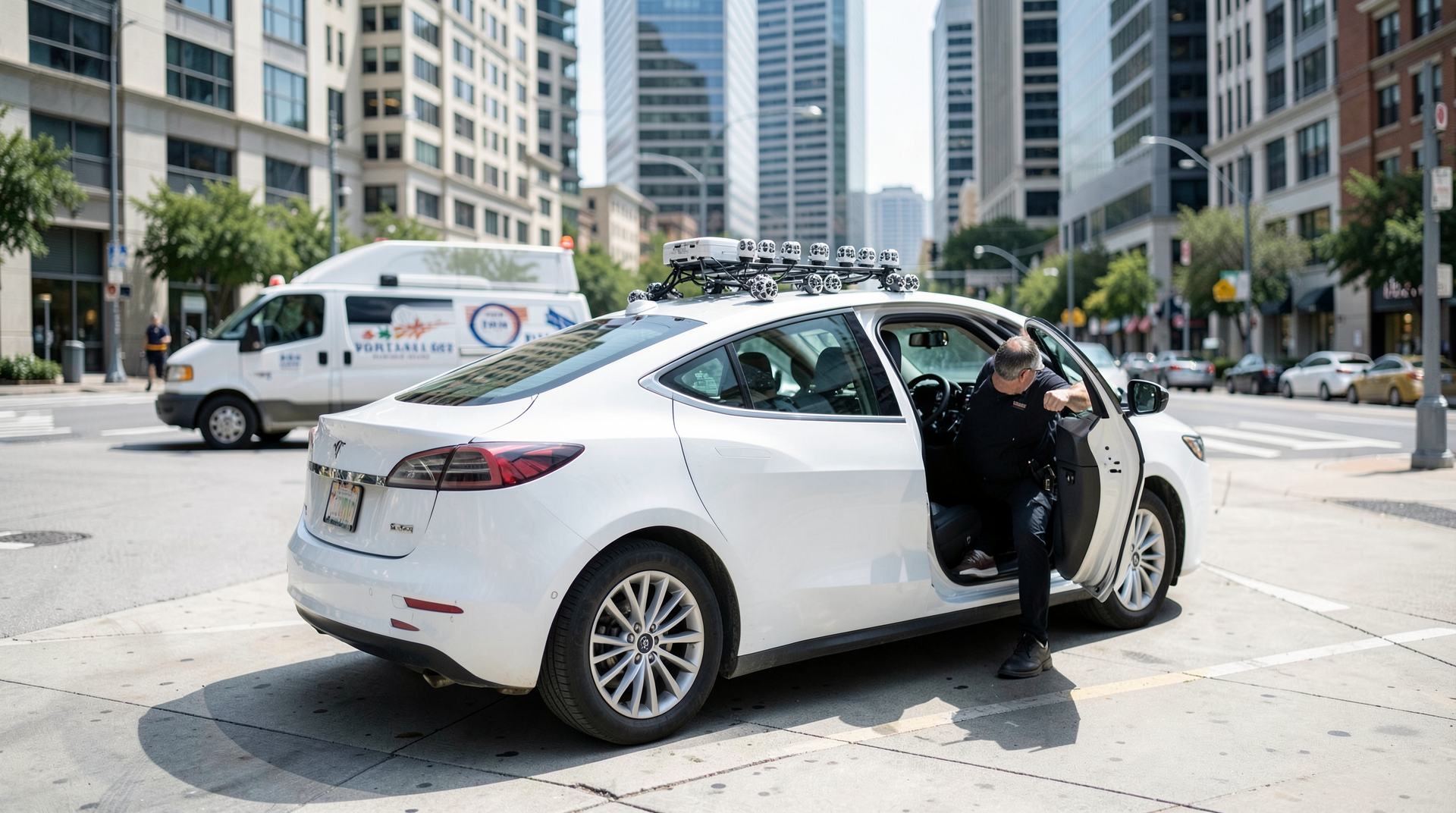
The paper's Monday feature on the Dallas-Houston robotaxi launch read the Saturday expansion as a pre-earnings stock-pump, with Electrek and the Robotaxi Tracker jointly documenting 0-2% public availability against geofenced 12-to-35-square-mile zones. Monday held that reading. As of Monday morning, a 31-square-mile Dallas zone had three logged rides at an average fare of $7.96 with one robotaxi on the road and no human safety monitor aboard; a 25-square-mile Houston zone had two vehicles and one safety monitor. [3] Day 4 of the launch produced exactly those numbers. Barclays held its $360 price target and Equal Weight rating and said the robotaxi launch was not material to the Q1 print. What is material, per Barclays, is Terafab.
Terafab was announced by Musk at a presentation in Austin on March 21 as a joint SpaceX-Tesla-xAI project, physically sited at a sprawling Austin facility, engineering two fabs to produce one terawatt of annual compute capacity between them. [2] "We either build the Terafab or we don't have the chips," Musk told the invited audience in March. He did not give a timeline, a cost figure, or a capital-structure plan. Barclays' March 23 modeling put the complete buildout in the mid-single-digit trillion-dollar range; the firm's subsequent notes have walked that to roughly $20 billion baseline for the first-fab phase, with the second fab and solar-powered feeder infrastructure generating the upside. Either way, $20 billion is above and beyond the $20-billion-plus 2026 capex guidance already issued. Stacking them puts 2026 capex at $40 billion or more against an expected free cash flow run-rate that Barclays models in the $3-to-5 billion range. Tesla ended Q4 2025 with $30 billion in cash and short-term investments. The math requires either a debt raise, an equity raise, or an aggressive capex reprofile — each of which moves the stock.
The Wednesday conference call is therefore a question about capital structure, not about quarterly operating performance. Morgan Stanley's Adam Jonas has held a $415 price target through the delivery miss; Wedbush's Dan Ives is at $400; Baird has been at $360 since January. All three analysts have framed robotaxi as free option value against Tesla's auto business. If Musk announces a capex increase on Wednesday's call large enough to consume 18-to-24 months of Tesla's current free-cash-flow generation and asks the market to underwrite it, the free option value gets repriced against dilution risk. The 0-2% availability rate at Dallas-Houston becomes material at that moment — because if robotaxi is underwriting the Terafab capex, the market needs to know how fast the denominator is growing.
This is the stress test. The paper's Monday major on the blockade week packaged SpaceX's Tuesday analyst day, Tesla's Wednesday Q1, IBM's Wednesday Q1, and the Netflix Thursday post-print as a five-day peace-priced-market stress test against Brent back through $95. Tuesday into Wednesday are the inflection. SpaceX's analyst day on Tuesday, with its 21-bank syndicate and device-surrendered-at-the-door posture, is the bank-commitment proxy for whether peace-priced multiples survive operating numbers booked against a war that reprices oil. Tesla's Wednesday print is the adjacent question: whether Musk can ask the market to underwrite a new capex cycle at the same moment the market is repricing his terminal-value narrative lower. The 50K inventory build is the tell on the terminal-value narrative. A capex increase on top is the test of whether the market will tolerate the tell.
Inside the print, the variables to watch: automotive gross margin excluding regulatory credits (Q4 2025 printed at 13.6 percent against 18.9 percent a year earlier), energy storage deployments (8.8 GWh deployed in Q1 per the April 2 advisory), and whether the Full Self-Driving pricing-and-adoption numbers — which Tesla did not break out in Q4 — make an appearance. Automotive gross margin is the first-order measure of whether the peace-priced multiple survives the Brent reversal; storage is the call option on stationary-power growth; FSD adoption is the test of whether the robotaxi narrative is an operating segment or a marketing segment. If Wednesday's print shows automotive gross margin below 13 percent on a delivery miss and a capex jump, the peace-priced reading of the week is over.
If Musk announces Terafab funding via an equity raise at a Wednesday post-close secondary, the after-hours move will set the tape for IBM's 5 PM ET Wednesday release and for Netflix-post-print trading Thursday. The paper's posture is that Wednesday is the single most-consequential operating test of the quarter because the variables that move are correlated in both directions: a good quarter permits the capex ask; a bad quarter forces the capex ask anyway and eats the multiple doing it. The handover's framing — that the five-day operating test packages the week, not any single print — holds.
One additional read. BYD's Q1 global BEV deliveries were 310,389 units, down 25 percent year-over-year, a number driven almost entirely by the company's domestic Chinese first-quarter weakness during the Lunar New Year and the subsidy-cycle rollover. BYD's overseas shipments in March hit 120,083 units, up 65 percent year-over-year. Tesla's 358,023 Q1 figure narrowly reclaims the quarterly BEV crown from BYD, but against a structural weakness BYD reclaims in Q2. The crown is the marketing artifact; the structural direction is not in the headline. Wednesday's call will treat the BYD comp as a win. The paper's read: the comp is a consolation prize for a print that otherwise depends on capex math the analysts have already priced.
-- THEO KAPLAN, San Francisco