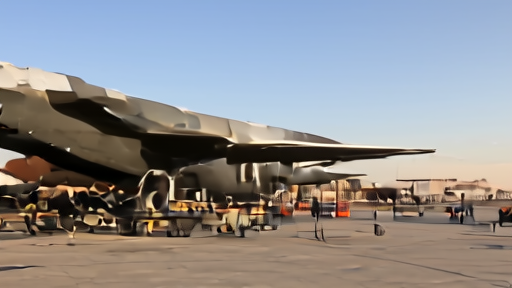
Northrop Grumman reported first-quarter 2026 sales of $9.88 billion on Tuesday, diluted EPS of $6.14, organic sales growth of 5 percent, and a total backlog of $95.6 billion. [1] B-21 Raider production rate will rise 25 percent under an agreement finalised with the Air Force earlier in the year; Northrop will invest approximately $2.5 billion in facility expansion to support the ramp, with roughly $200 million of that capex falling in 2026. [2] First-quarter operating margin expanded to 10.0 percent from 6.1 percent in the prior-year quarter, reflecting the absence of a $477 million B-21 cost-overrun charge that had weighed on Q1 2025 results. [1] Lockheed Martin's Q1 print lands Thursday morning before the bell; consensus expects EPS of $6.79 on revenue of $18.38 billion. [3] Lockheed entered 2026 with a record $194 billion backlog, 2.5 times its annual sales. [4] The two-day defense tape does not cover two companies. It covers two reporting windows inside one production regime.
The paper's Tuesday feature named the industrial tape as the administration's unofficial policy memo — backlog, munitions throughput, and guidance revisions printing before the White House extended the ceasefire. RTX's $22.1 billion of quarterly sales, $271 billion record backlog, and raised guidance set the scale. GE Aerospace's orders-up, revenue-up print covered the fleet-and-maintenance side. Halliburton added regional-volatility texture; 3M named Iran-war "pockets of macro pressure" directly in a diversified-industrial context. The Northrop number on Tuesday after the close and the Lockheed number on Thursday before the open are the bomber-and-missile side of the same tape. They are not a different story.
What the Northrop result adds to Tuesday's RTX read is the capital-spending signal. CEO Kathy Warden told analysts on the earnings call that the B-21 facility investment will be $2.5 billion of company-funded capex, phased over multiple years, with most of the spending running in 2027 through 2029. [2] Northrop raised its 2026 capex guidance to $1.85 billion, $200 million of that attributable to the B-21 capacity expansion. The Air Force is contributing its own funding via reconciliation — reportedly $4.5 billion — and now plans to purchase 100 B-21s over the life of the program with an option to increase to roughly 145 aircraft. Current per-unit cost is estimated at approximately $700 million. [2]
The math on backlog-as-duration sharpens at Lockheed. Lockheed's $194 billion record backlog is 2.5 times its 2025 revenue; management guided 2026 sales to $77.5 billion to $80.0 billion, segment operating profit growth of roughly 25 percent year over year, and free cash flow of $6.5 billion to $6.8 billion. [4] The EPS range of approximately $29.35 to $30.25 reflects the absence of 2025's reach-forward losses on classified aeronautics programs and $7 per share of pension-related adjustments. What the backlog-to-sales ratio captures is the production-planning horizon the company believes it is operating against. 2.5 years of revenue visibility is not a cyclical number. It is a structural one.
The B-21's 25 percent production-rate lift is the first acceleration of a strategic bomber program in a generation. Northrop is on track to deliver the first B-21 to Ellsworth Air Force Base in South Dakota in 2027. Aerial-refuelling trials began earlier in April. [2] The program's industrial architecture includes the Palmdale, California assembly line and twenty new facilities Northrop has opened in the past two years, adding more than two million square feet of manufacturing space. [5] Warden said Northrop has agreed with customers since the start of 2026 to accelerate the Sentinel intercontinental ballistic missile program, to increase the B-21 build rate, to become a second-source supplier of solid rocket motors on several programs, and to ramp production on other programs. [5] Each of those lines is a multi-year capital commitment. None of them is reversible on a single-quarter timeline.
What distinguishes Thursday's Lockheed print from Tuesday's Northrop print is the scale of the backlog. RTX's $271 billion, Lockheed's $194 billion, and Northrop's $95.6 billion sum to roughly $560 billion of contracted defense work across three firms. That is not a demand spike. It is a demand regime. The PAC-3 production ramp at Lockheed's Missiles and Fire Control segment is targeted at 2,000 units annually, supported by supply-chain investment across five states and a new Munitions Acceleration Center in Arkansas. [4] Missile components carry 18-to-24-month lead times; the backlog that sits on the balance sheet today is translating into production schedules that run through 2028 and beyond.
The investment read the paper has carried for three days is that war has become a planning variable for the defense industrial base, not an event variable. The Northrop Q1 shows an operating-margin expansion driven not by volume but by the absence of a prior-year charge. The underlying volume growth is real — B-21 sales rose 17 percent in the quarter — but the margin expansion is a comparison artifact. The more structural margin story is Lockheed's management guidance for a return to the 9.8 percent Aeronautics segment margin target following the 2025 reach-forward losses. If Thursday's print delivers on that trajectory, the sector enters mid-2026 with two of the three primes on margin-expansion trajectories and the third (RTX) already past the inflection.
The risk inside the tape is named. Halliburton's Tuesday commentary framed oil-field services as volatility-grammar rather than backlog-grammar. 3M's "pockets of macro pressure" line captured diversified-industrial stress. Neither translates to a signal against the defense primes. But both are real, and the composite tape is not monotonic. Beyond the primes, the next ten working days bring earnings prints from suppliers down the defense stack — Mercury Systems, L3Harris, Leidos — whose results reveal whether the backlog at the primes is converting into material through-the-chain demand or whether the primes are absorbing orders without flowing them through.
Lockheed's 8:30 AM ET webcast Thursday is the last major defense print of April. What the market will read for is the free cash flow line — guided to $6.5 billion to $6.8 billion — and the Aeronautics segment margin. The backlog-to-sales ratio will either hold or expand; analysts expect expansion on new bookings during the quarter. If the number prints above $194 billion, the two-day tape closes with the unofficial policy memo's final page: the war is not a quarter. It is a five-year procurement cycle. The administration's ceasefire extension on Monday removed the kinetic deadline. The defense primes' earnings reports removed any ambiguity about the operational one.
-- THEO KAPLAN, San Francisco