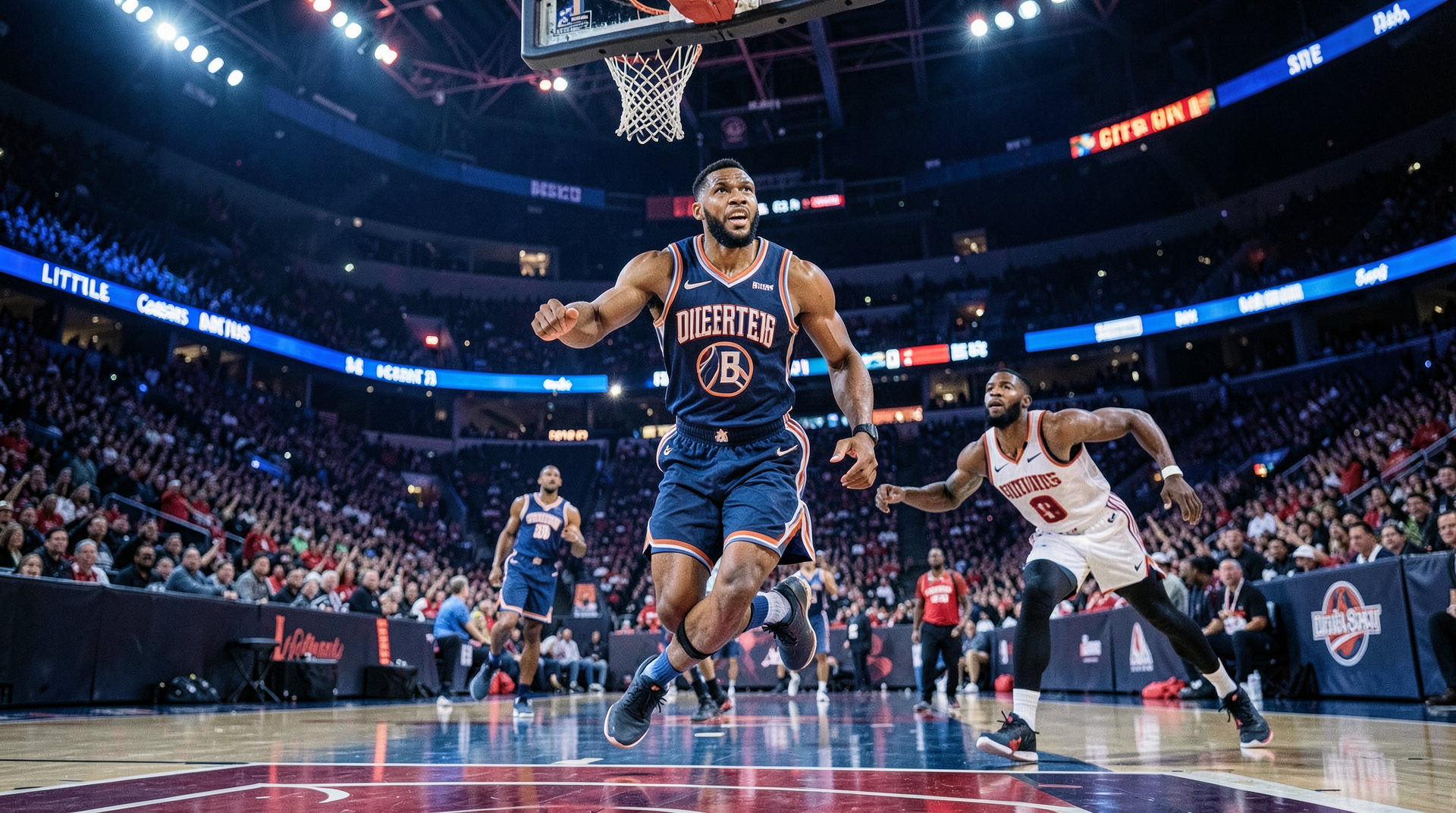
For eighteen years the Detroit Pistons had not won a home playoff game. On Wednesday night at Little Caesars Arena, for a period of about five minutes in the third quarter, the Orlando Magic did not score. The Pistons outscored them 30-3 from the halftime buzzer, turned a 46-46 tie into a 76-49 lead with 4:34 left in the third, and won Game 2 of their first-round series 98-83. [1][2] The best-of-seven goes to Orlando tied 1-1. Cade Cunningham had 27 points, 11 assists and six rebounds. Five Detroit players scored in double figures. The Magic's Jalen Suggs and Paolo Banchero were held to 19 and 18 — both season lows. [1] The streak, by the Detroit Free Press's accounting fifteen home playoff losses, ended in the building that had never seen the Pistons win a playoff game before. Little Caesars Arena had opened in 2017. It had hosted six postseason losses. The seventh was the one that broke.
Yesterday this paper wrote that the streak was the longest in NBA history and that Wednesday was the night to break it or carry it forward. The frame then was structural fragility — the accumulation of eighteen years of lost home postseason moments was itself the story, and a 60-win season did not neutralise it until the arithmetic did. The arithmetic did. The Pistons played Game 2 the way they had played the regular season — defensive identity, five-way scoring, Cunningham as the organiser rather than the solo — and produced what the Las Vegas Sun called their "most impressive performance of the calendar year." [3] The fragility narrative carried by this paper for two editions did not survive contact with the game. That is the sports story. It is also the sports-as-power story the paper has been pushing for a month: legitimacy is recovered in specific moments, on specific courts, with specific players, or it is not recovered at all.
The tactical particulars are worth the record. The Pistons held Orlando's starting backcourt of Suggs and Banchero to a combined 37 points on inefficient shooting — 18 for 38 from the field, 4 for 14 from three. [1] Banchero, the Magic's best offensive engine, finished with 18 points and six rebounds, his lowest scoring output in the series. Detroit's 30-3 run opened the second half and was powered by an 11-0 Cunningham-led spurt: Tobias Harris turnaround jumper; Cunningham midrange jumper; Cunningham assist to Jalen Duren for a dunk; Cunningham layup through contact; the resulting and-one free throw. [4] The Magic did not make a field goal for approximately five minutes during the run. The Pistons forced six turnovers during the same stretch and held Orlando to 1-for-9 shooting. That is the shape of the quarter. The rest of the game was a lead held, with late Magic pressure repelled.
The franchise weight is the part that will be metabolised in Detroit this week. Detroit's first playoff win at Little Caesars Arena, in the arena's ten-year history, is also the first playoff win in the state of Michigan since April 30, 2008, the last home date of a Pistons-Magic second-round series that Detroit won 4-1 before losing to Boston in the Eastern Conference finals. [3] In the intervening seventeen years, the Pistons played six games in Detroit's Palace of Auburn Hills and six in Little Caesars — twelve home playoff games, zero wins — and suffered what had become the defining joke in Michigan professional basketball. J.B. Bickerstaff, the Pistons head coach, has spoken about the streak only when asked and has declined the mythology. His pre-game remarks on Wednesday were about defensive assignments and rebounding discipline. His players, in the post-game quote sheets, did not invoke the streak. Cunningham, asked about ending it, said the team had been "trying to lock in on what we needed to do."
This is the humanist lens worth naming: the streak was not the team's. The streak belonged to Detroit, to its basketball culture, to the generations of Pistons fans who had attended losses at the Palace and then at Little Caesars, whose relationship to home-court postseason games had been trained through eighteen years of evidence that home was not advantage. The team inherited the streak. Cunningham arrived at the franchise in 2021, was part of six of the fifteen home playoff losses only by organisational descent, and had on his résumé no personal Little Caesars playoff experience before Game 1 of this series. The streak did not belong to any player in the locker room. They ended someone else's problem. That is the shape of legitimacy transfer in professional sport: it is not the players who fix the thing; it is the institution's next cohort of players who play well enough, on the right night, that the thing becomes the previous cohort's problem.
The consequence for the series is narrower but real. The Pistons were the East's top seed on the regular season, 60-22, a 46-game improvement over two seasons ago — the largest regular-season jump in NBA history. The Magic were the 8-seed. Game 1 at Little Caesars on Sunday, the 112-101 Orlando win, made Detroit the first 1-seed to drop a home opener since 2018 and revived the structural fragility frame this paper tracked into Tuesday's preview. Game 2 inverts that read. The top seed took its home court back, equalised the series, and shifts the home-advantage calculus to Orlando for Games 3 and 4 on Saturday and Monday. [1] The Magic, at 1-1 with two home games ahead, remain positioned to take the series. Detroit has not advanced past the first round in eighteen years; Orlando has not reached the second round in sixteen. One drought ends in this series; the question is whose.
The sports-economy subtext is quieter but worth holding. The Pistons' 2026 regular season was the commercial inflection point of a franchise that has spent a decade beneath the Central Division floor. Season-ticket renewals, according to the Detroit News's earlier reporting this year, ran ahead of the ownership's internal targets well before the playoff seeding was locked. The Ilitch-family ownership has treated Little Caesars as a concert-and-hockey venue that accommodates basketball more than as a basketball venue that accommodates other uses; Game 2's sellout crowd noise, audible through the NBA's television broadcast at moments that had been previously empty, registered as a bet paying down. A sports franchise's value increment comes from the late innings of turnarounds — from the night, not the season, that the structural fragility inverts. Wednesday was that night for Detroit.
What the game did not settle is the series' direction. The Magic will host Games 3 and 4. Banchero and Suggs are too talented to be held to season lows twice. The Pistons' 1-for-14 second-half shooting slump in Game 1 suggests the team's bench remains variable, and Isaiah Stewart's knee status through the series has been listed day-to-day. The Pistons' defensive identity is now known to the Magic staff and will be game-planned against. It is equally true that Cunningham, the 33-point Game 2 performance notwithstanding, has played the best basketball of his professional life through the first two games of this series and the Magic do not yet have a containment answer for him.
The final line on the streak, from the Pistons' perspective, is the clean one. The fifteen-game home playoff losing streak — the longest in NBA history by the Detroit Free Press's count, with the next-longest of thirteen belonging to the early-2010s Knicks — is ended. [5] It had lasted since May 2008. The building where it ended had never witnessed the Pistons win a playoff game in its decade of existence; its first-ever Detroit playoff win coincided with the end of a streak older than the arena itself. Wednesday's 98-83 scoreline will be filed as a single Game 2 result. The fourteen lines underneath it — the wins that did not happen, that will never happen, that needed not to matter — are the part that is finally filed to history.
That is the frame that flipped. The losses did not become wins. The losses became the past.
-- AMARA OKONKWO, Lagos