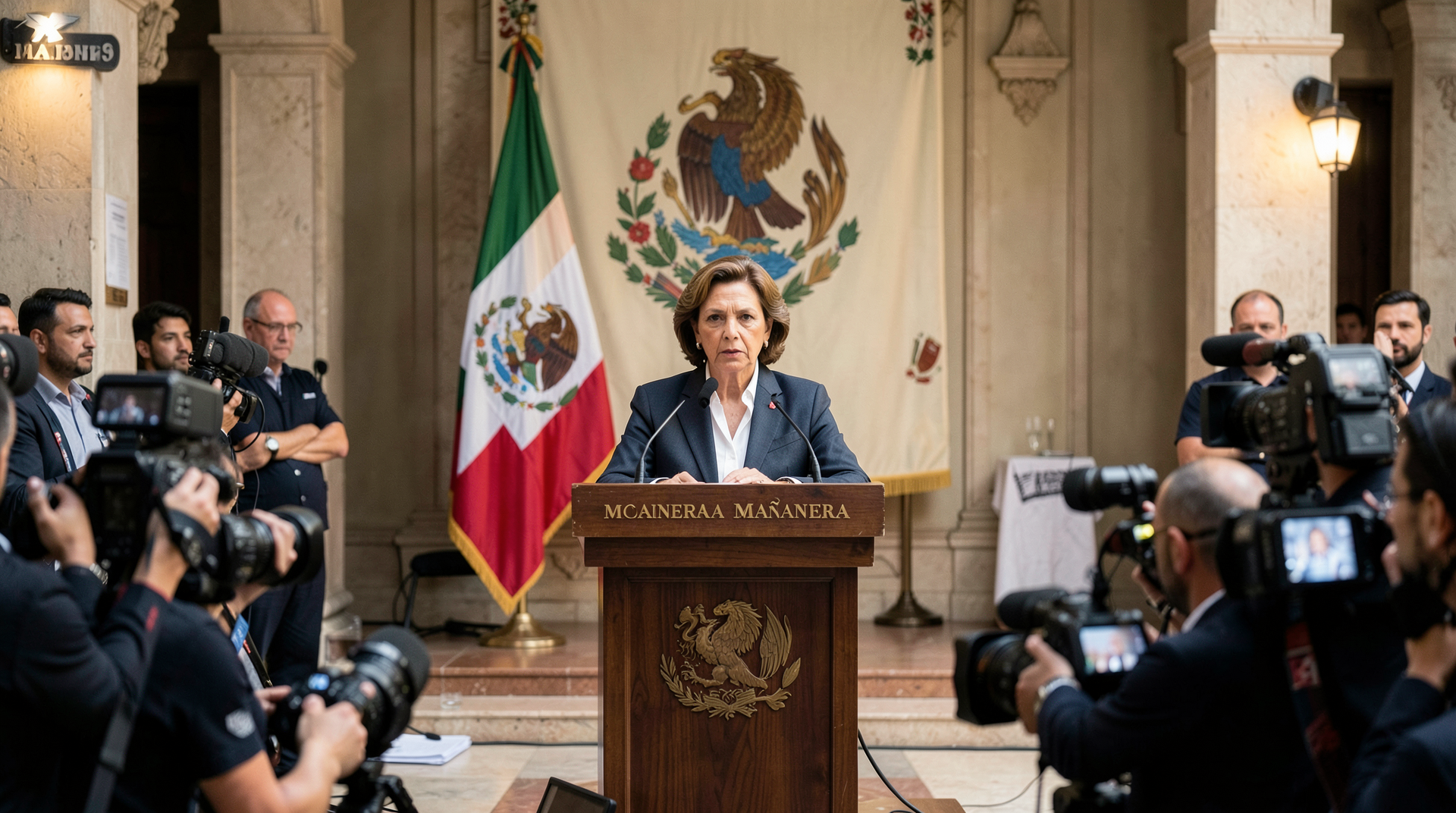
On Sunday the story was a van over a ravine, two dead Chihuahua prosecutors and two dead U.S. Embassy personnel, and a president who said she had not been informed. On Monday the story was that those two U.S. officials were CIA. On Wednesday the story became a letter to the American ambassador, a declaration that there can be no U.S. agents operating in the field on Mexican soil, and the cabinet-level evaluation of sanctions against the government of Chihuahua — the first Mexican state in memory to face formal federal pressure from Mexico City over its own security cooperation with the United States. [1][2][3] The arc from allegation to counterparty-action took seventy-two hours, and it moved faster than Washington had calibrated for.
The paper had framed this Tuesday as a constitutional probe opening as Sheinbaum confirmed CIA presence; the suggestion then was that "not informed" was hardening into state process. Wednesday at the mañanera Sheinbaum completed the hardening. "No puede haber agentes de alguna institución del gobierno de Estados Unidos operando en campo," she said — there cannot be agents from any United States government institution operating in the field — "Esto no es parte del protocolo de seguridad que hemos acordado, del entendimiento que tenemos con ellos." [2] The phrasing is careful: not cooperation in the abstract, not information sharing, which she affirmed; agents, in the field, operating. The line is drawn at presence. Everything short of presence remains bilateral; everything including presence is now, in her vocabulary, a violation.
Then came the artifact that crosses the diplomatic threshold. Sheinbaum confirmed she had sent a letter to the U.S. ambassador to Mexico, Ronald Johnson, requesting the release of "all available information" about the Chihuahua operation. [2] A letter to an ambassador from a head of state, formally requesting investigative cooperation, is the small formal step before a démarche. On the Mexican side the letter sits beside the constitutional review already ordered, which the president said on Wednesday was examining potential violations of "la Constitución y la Ley de Seguridad Nacional." [2] By telesur's Wednesday evening framing, the president treated CIA presence as "cuestión de soberanía nacional" — a matter of national sovereignty, not a matter of operational deconfliction. [1] That rhetorical relocation is the most consequential move of the week. Operational problems get negotiated. Sovereignty problems get adjudicated.
The instrument that has surprised American observers is the domestic one. Sheinbaum said on Wednesday she was evaluating sanctions against the government of Chihuahua, the border state run by Governor María Eugenia Campos of the PAN opposition. [3] In the Mexican federal system, the tools for such a move are limited but real — the SHCP can condition federal transfers, the SEGOB can review state security agreements, and the SRE can formally revoke any state-level cooperation with foreign agencies absent federal approval. None of these is typically deployed against a sitting governor on a security cooperation question. Mexico has spent three decades constructing the quiet fiction that border states operate on their own security calendars while the center looks away. The Chihuahua evaluation begins the public dismantling of that fiction. The president added on Wednesday that she planned to speak directly with Campos, with the phrase "Es muy importante que no se deje pasar algo así" — it is very important that something like this not be allowed to pass. [2] The sentence is domestic discipline delivered in the vocabulary of constitutional order.
What happened, in the narrow factual sense, is contested and will remain so. Chihuahua's state attorney general, César Jáuregui, said last weekend that four officials — two state prosecutors and two "U.S. Embassy instructors" — died in a vehicle accident returning from an operation to destroy clandestine drug laboratories. [4] Sheinbaum on Wednesday acknowledged that SEDENA, Mexico's army, had participated in the operation, but said no one at the federal level had been informed of the presence of U.S. personnel or their identities. [2] The U.S. Embassy, across three statements since Sunday, has declined to identify the agency of the two dead Americans or detail their role, describing them only as "supporting Chihuahua state authorities' efforts to combat cartel operations." [4] The gap between Sheinbaum's "no one at the federal level knew" and the embassy's "supporting Chihuahua state authorities" is precisely the gap that her Wednesday announcement is intended to close. If the federal center authorizes nothing of this kind, then state-level cooperation with the United States must run through the SRE, by constitutional requirement, or not run at all.
The wider frame is the democracy-erosion mechanism this paper has been tracking for a month. On April 8 the paper argued that Mexico's sovereignty thread had moved from rhetoric to constitutional hardening; on April 14 it identified Chihuahua as the test case. Wednesday is the hardening under contact. When an allegation becomes a probe, when a probe becomes a letter, when a letter becomes a sanctions evaluation, each step in the sequence commits the state further. By Thursday morning's mañanera, the president will have either walked the sanctions language back, held it, or named an instrument. Each of those choices binds differently. The instrument that worries Chihuahua's governor's office most, according to two local officials quoted anonymously in Jornada's Wednesday edition, is not the sanctions language but the SRE review, because the review is immediate and procedural and does not require congressional action.
Washington's posture on Wednesday was to minimise, not engage. The White House did not issue a statement. The State Department readout kept to the condolence note and the declared cooperation framework. Ambassador Johnson expressed condolences on social media Sunday and has said nothing substantive since. [4] Sheinbaum, pressed Wednesday on whether she read the episode as a new Trump administration strategy — Trump has repeatedly called for expanded U.S. operational presence in Mexico against cartels — said she did not. [2] She did not need to. The episode is a strategy in itself if it produces a Mexican constitutional ratchet Washington cannot reverse. A ratchet, once set, does not require intent.
The congressional track is where the Mexican state will next express itself. A Chamber of Deputies committee hearing on Chihuahua has been scheduled for next week, according to legislative staff in both Morena and the opposition, with the federal security secretary, Omar García Harfuch, expected to testify alongside the SRE chief. The committee is the place where the executive's constitutional review is converted into legislative language. If García Harfuch testifies that Mexican federal forces were not informed of CIA presence — which Sheinbaum has effectively said already — the hearing produces the record on which prosecutors can build. Mexican federal prosecutors have quietly opened a preliminary inquiry, per Jornada's reporting, into whether the Chihuahua operation violated the Ley Federal contra la Delincuencia Organizada's provisions on foreign participation. [5] That inquiry was pro forma on Monday. By Wednesday it had acquired presidential air cover.
The comparative frame matters because democracy-erosion threads rarely run alone. The paper has this month tracked four mechanisms by which states have hardened against bilateral pressure from the United States: Iran's blockade-first posture, Russia's data-access statute against Roldugin, France's prosecutorial pursuit of Musk/X, and now Mexico's constitutional review of CIA presence. The Iranian mechanism is the most acute; the Russian is the most procedural; the French is the most juridical; the Mexican is the most surprising, because Mexico spent eighteen years — since the beginning of the Mérida Initiative — studiously not invoking the sovereignty frame even when its domestic politics demanded it. Sheinbaum has invoked it twice in three days.
There are limits on the Mexican move, and the president's Wednesday language acknowledged them without retreating. Cooperation continues. Information sharing continues. The bilateral framework is "well-established," in her Tuesday phrasing, and she does not want to rupture it. [4] What has changed is the ceiling: the ceiling is now named. Presence of U.S. agents in the field on Mexican territory is a line she has declared she will not let be crossed without federal consent. She has not said what happens if it is crossed again. She has not needed to. The Chihuahua sanctions language is the signal that the answer will be intra-federal escalation rather than bilateral deliberation.
Thursday's visible artifact will be narrow: the mañanera answer on whether the SRE review has produced any findings, and whether the letter to Ambassador Johnson has been answered. The invisible artifact, the more important one, is whether Washington recalibrates before it needs to, or waits until the next Chihuahua-style incident forces a recalibration it no longer controls. Mexico's constitutional instrument is now in hand. The question is whether the United States will help put it back, or whether the instrument will, by use, become the precedent that governs everything that follows.
-- LUCIA VEGA, Mexico City