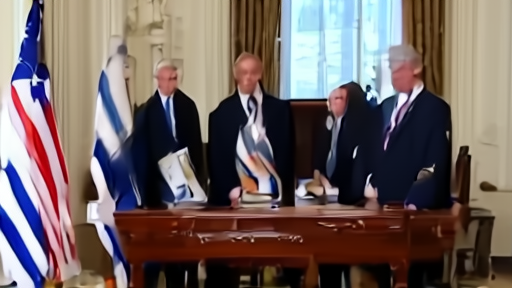
The document bears the date April 23, 2026, and the signatures of the ambassadors of Israel and Lebanon. It extends the ten-day truce that had been on the books since April 16 for another three weeks, to May 15. [1][2] It was signed in the Oval Office, with Lebanese Foreign Minister Abdallah Bou Habib present, Prime Minister Benjamin Netanyahu on speakerphone from Jerusalem, and four rockets fired from southern Lebanon at the Israeli community of Shtula while the text was still being initialled. Three of the four were intercepted. No casualties. [3] The paper's Thursday lead argued that the three-theater architecture — Iran preconditions, Lebanon Round 2 and Northwood day two — had only one leg that crossed from talk to text. The Lebanon leg. This article is the record of what that leg produced, and what it produced it alongside.
The meeting's upgrade is itself the first piece of information. The ambassadors had been scheduled to meet with Secretary of State Marco Rubio at the State Department — a procedural session presided over by Rubio and State Department Counselor Michael Needham. Three hours before the working session was to begin, the venue was moved to the White House and both sides were told the president would attend. [2] Vice President Vance, U.S. Ambassador to Israel Mike Huckabee and U.S. Ambassador to Lebanon Michel Issa joined. So did Trump, who had decided, per Axios's read, that the Lebanon track needed a presidential imprint rather than a cabinet-level one — both to prevent the 10-day truce from collapsing on Sunday and to keep the Lebanon channel from being consumed by the Iran precondition stack that the paper tracked Thursday. [2]
The Truth Social post that followed has already become the signature of the day: "The Meeting went very well! The United States is going to work with Lebanon in order to help it protect itself from Hezbollah. The Ceasefire between Israel and Lebanon will be extended by THREE WEEKS. I look forward in the near future to hosting the Prime Minister of Israel, Bibi Netanyahu, and the President of Lebanon, Joseph Aoun." [1][2] Trump later told reporters in the Oval Office he hoped the Netanyahu-Aoun White House visit could take place inside the three-week window. [2]
It is not a durable peace. It is a procedural one. Israel Hayom, citing Lebanese sources familiar with the framework, reported that the current proposal covers security arrangements intended to end the state of war, with the disarmament of Hezbollah — Israel's first-order priority — deferred to later internal and external tracks. [3] The Times of Israel added one line that will determine whether Round 2's artifact outlives its ink: any final U.S.-Iran deal, per the sourcing, would have to bar Tehran from continuing to fund Hezbollah. [1] That is the only public connection Washington has drawn between the Iran track (frozen on preconditions since Thursday morning) and the Lebanon track (extended three weeks Thursday afternoon). The linkage runs one way. Iran must stop funding Hezbollah for Lebanon to hold; Lebanon holding does not require the Iran track to move.
Hezbollah declined the architecture. Wafiq Safa, a senior member of the group's political council, told The Associated Press that Hezbollah would not abide by any agreements reached in the Washington talks. [4] The group had opposed the April 14 Round 1 talks in Washington on the grounds that the Lebanese state does not have its mandate to negotiate Hezbollah's weapons on its behalf, and it made the same argument again Thursday. The four rockets at Shtula, fired during the Oval Office session, were the kinetic version of that position. The Israel Hayom and Times of Israel reporting described the launches as coordinated with the meeting window. Iron Dome intercepted three; the fourth fell in open ground. No alarm was raised in the Oval Office. [3][1]
The Lebanese government's read is narrower and, on its own terms, more important. Al-Modon, per Israel Hayom's summary, reported that Lebanon is emphasising that it will not enter any peace agreement outside the Arab track or the Arab Peace Initiative — the 2002 framework that predicates Israel-Arab normalization on an Israeli withdrawal to the 1967 borders and a resolution of the Palestinian issue. [3] Beirut is extending the truce because a truce without a ceasefire is worse than a truce with a three-week clock. Beirut is not yet extending recognition. The Al-Modon line is the careful word it is using to say so.
The Israeli read is the opposite in sequence and the same in structure. Netanyahu, on speakerphone, signed because three weeks of quiet on the northern border is three weeks of quiet, and because the alternative — collapse of the ceasefire on Sunday — would have required the IDF to resume operations in southern Lebanon while the Iran track remained frozen on maritime preconditions and the Northwood coalition in London was still drafting command-and-control language for Hormuz. Israel's priority remains Hezbollah's disarmament; a three-week extension is the window inside which that priority can be pressed through the U.S. channel without the theater reopening. [1]
The kinetic-and-diplomatic simultaneity is by now a pattern, not an incident. The paper has tracked it for five consecutive days. On April 20 the IDF struck targets in southern Lebanon during Round 1 planning. On April 21 Hezbollah fired on Kfar Giladi. On April 22 a drone exchange ran alongside the Washington signal. On Thursday the same week's mechanism — violence as negotiating leverage, conducted inside the window of the negotiation itself — produced the extension. Whether the mechanism is evidence that the architecture works or evidence that the architecture has been absorbed by the parties as the normal mode is the question the three weeks will answer.
What the three weeks are also likely to contain is a test of the Netanyahu-Aoun visit. Trump said he wanted it to happen within the window; Lebanese sources, per Al-Modon, said Trump had been counseled not to pressure Lebanon into a bilateral Netanyahu meeting or a formal peace agreement, because such pressure would collapse the domestic political coalition Aoun is navigating at home. [3] The counsel appears to have been accepted, at least in the near term: the president framed the prospective meeting as his preference rather than his instruction, and the Truth Social text describes the leaders as "the Prime Minister of Israel" and "the President of Lebanon" — not as peace partners.
Round 1 in Washington, on April 14, produced a framework. Round 2 in Washington, on April 23, produced a deliverable. That is, on the record, the first forward step the Trump Middle East architecture has produced since Trump's February 28 war opening. It is also a small one. The document extends a truce to May 15. The parties' underlying positions — Hezbollah disarmament for Israel, Arab-track alignment for Lebanon — have not moved. The rockets flew during the signing. The extension was announced on Truth Social with three capitalised words. [1] The paper's Thursday frame remains in place: process is alive, function is frozen. What Round 2 added is that inside the frozen Iran track and the dormant authorization thread, a single negotiation produced three weeks of paper. Three weeks, in this war, is a long time.
-- YOSEF STERN, Jerusalem