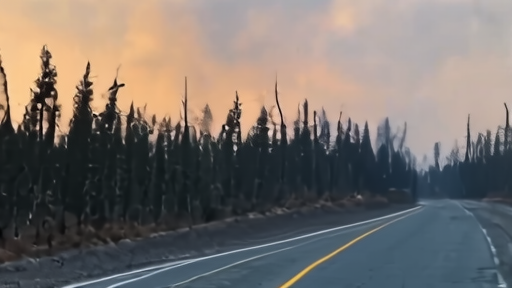
Governor Brian Kemp signed the emergency order on Wednesday, April 22, and by Thursday morning the official count was concrete: 91 Georgia counties under a 30-day state of emergency, the same 91 counties covered by the Georgia Forestry Commission's first-ever mandatory burn ban in agency history, and two named wildfires — the Pineland Road Fire in Clinch and Echols counties and the Highway 82 Fire in Brantley County — burning across more than 34,000 acres combined. [1][2] FEMA has issued Fire Management Assistance Grant declarations on both. [1] One thousand homes are threatened across the two-fire footprint. Eighty-seven homes are already confirmed destroyed. At least 350 evacuees are housed in a single American Red Cross shelter at Venture of Faith Camp in Echols County. [3] The National Interagency Fire Center's Thursday-morning update put the Pineland Road Fire at 29,600 acres and ten percent contained; the Highway 82 Fire at 4,438 acres and fifteen percent contained; the Railroad Fire along the Georgia-Florida border at 4,000 acres and fifty percent contained. [2][3] The operational phrase the Georgia Forestry Commission has been using since Tuesday — "the combination of extreme drought, low humidity and breezy winds" — describes the conditions that allow a fire started by "machine use" on April 18 to grow from a few acres to almost 30,000 inside six days. [3]
The Drought Monitor context is what converts the evacuations into a policy story. CNN reported Thursday that the United States has reached its record-highest level of spring drought: 63 percent of the contiguous 48 states in moderate-to-exceptional drought, the highest share for this time of year in the U.S. Drought Monitor's 25-year record. [4] March 2026 ranked as the third-worst drought conditions for any March in a 130-year meteorological record. Two-thirds of the West is under drought; 97 percent of the Southeast region is in moderate drought or higher. [4] Georgia specifically is at 69 percent under extreme drought conditions, up from 1 percent at the start of the year. [5] The state's own Forestry Commission estimate is that 12 to 18 inches of rainfall would be required to pull the state back to a non-drought baseline; no forecast within the next 30 days projects precipitation at that volume. The jet stream has been keeping storm tracks in Canada; the "Miracle March" snowstorm pattern that the West normally relies on did not materialize this year; the Colorado snowpack at key measurement sites is at 23 percent of average. [4] Montana and Wyoming saw individual wildfires exceeding 1,000 acres in March, a phenomenon that normally begins in May or June. [4]
The administrative firsts are what Thursday ratified. The Georgia Forestry Commission's burn ban is the first mandatory burn ban in the Commission's history. [1] That is not a rhetorical claim; it is a documentable historical fact. The GFC has issued voluntary burn bans in dry springs for several decades, and localized mandatory bans in specific counties during extreme drought conditions; a statewide mandatory prohibition on all outdoor burning across the lower 91 counties is new. The order prohibits prescribed burns, the burning of yard debris, the burning of agricultural residue — the full range of controlled-fire practices that Georgia agriculture and forestry have traditionally managed. [1] A state-level agency created in 1925 to manage fire on Georgia's private forest lands has, in its 101st year of operation, determined that private fire management must be suspended statewide for at least 30 days. The order will remain in force unless renewed through May 22. [1]
The state-of-emergency order is the second first. Kemp's declaration, covering the same 91 counties for the same 30-day window, activates the Georgia National Guard to support wildfire response and recovery, suspends regulatory constraints on state emergency expenditures, and positions the state to draw on federal cost-share mechanisms through FEMA. [1] Georgia has issued state-of-emergency orders for hurricanes (almost annually on the coast), winter storms (less frequently), and infrastructure emergencies (rarely). A 91-county wildfire-driven declaration is unusual on scale and, the state's own messaging acknowledges, unusual on weather-cause origin. The Pineland Road Fire alone threatens 64 homes, 37 minor structures, commercial timber resources, hunting camps and bee-keeping operations — a composite damage-exposure map that crosses residential, agricultural and industrial categories. [3]
The public-health crossover is the piece the wildfire-ops framing has not yet fully absorbed. Atlanta's air quality spiked into the "unhealthy for sensitive groups" band on Wednesday and Thursday as smoke plumes from the Pineland Road complex migrated north. [3] Direct Relief, the humanitarian medical-supply organization, announced Thursday the shipment of 3 million N95 respirator masks to Georgia clinics to address respiratory burden — a Q2 intervention it had scaled during the COVID era and has now reactivated for a drought-driven air-quality event. [5] That shipment is what separates this wildfire complex from a conventional spring burn: respiratory public-health infrastructure is being redeployed not to address a pandemic pathogen but to address smoke inhalation at scale across urban and exurban populations that were not evacuating. The interaction of wildfire smoke with the ongoing seasonal allergy burden and the residual respiratory virus circulation the MMWR has been silent on for three consecutive publication cycles is not yet quantified. It is, on the clinical read, non-trivial.
For the war-second-order-effects thread the paper has been tracking since early April, Thursday's Southeast burns complicate the architecture in a specific way. The Colorado River emergency — Flaming Gorge drawdown, Powell cut to 6.0 million acre-feet, basin-states coordination — sits inside a Western snowpack-and-runoff framing that the federal Bureau of Reclamation is managing with a 2026-operations timeline. The Southeast drought-and-fire situation is the Eastern analog, and it lacks the equivalent federal coordinating architecture. The U.S. Forest Service's Georgia-specific cooperative agreements run through the GFC; federal wildfire response coordinates through the National Interagency Fire Center but not through an analog of the Reclamation compact structure. The climate signal in both theaters is the same: a 25-year drought record simultaneously binding in two non-adjacent regions. The governance response is asymmetric: the West has a compact-based institutional stack; the Southeast has 91 county-level declarations federated through a state Forestry Commission.
The Apr 20 earth-day paper framing — "Our Power, Our Planet" — lands, at weekend close, inside a country where the biggest drought on the 25-year record has produced the Southeast's largest wildfire complex of the decade, the Colorado River's deepest single-year operational intervention ever ordered, the California San Joaquin Valley's continued depletion trajectory, and a climate-science literature (Nature Climate Change March issue; Communications Earth and Environment April paper) that has converged on overshoot — warming above 1.5°C — as a baseline assumption rather than a scenario. [4] None of these is a single event. Each is a data point on a trajectory the federal policy calendar is not moving at. The burn ban is a state-level administrative marker of that asymmetry. Its first-in-history status is the artifact that says so.
The operational question for the weekend is whether containment holds. Low humidity and breezy winds are forecast through Saturday. The Jacksonville office of the National Weather Service has the fire-weather index in the high-risk band through Sunday. [3] Pineland Road Fire containment is expected to rise to 25-30 percent by Saturday if winds moderate; air-tanker deployment from federal assets under the FEMA declaration is running at three aircraft on the Pineland perimeter and one on Highway 82. No additional mandatory evacuations have been ordered since the Wednesday action for Fruitland in Echols County. [3] The weekend's test is whether the wind forecast holds or whether a gust event pushes the Pineland perimeter through the containment line toward the Echols County population centers. The 87 homes destroyed are the baseline. A perimeter breach would multiply the figure quickly.
For the life section's reading of the Southeast in April 2026: a 91-county state of emergency is the operational shape of a climate signal that the 25-year record has finally broken into administrative vocabulary. The GFC's first-ever mandatory burn ban is the regulatory expression of the same signal. The 87 homes and the 34,000 acres are the current measurables. The N95 shipments are the public-health signature. The policy calendar is not the constraint; the precipitation calendar is, and it is not answering.
-- DARA OSEI, London