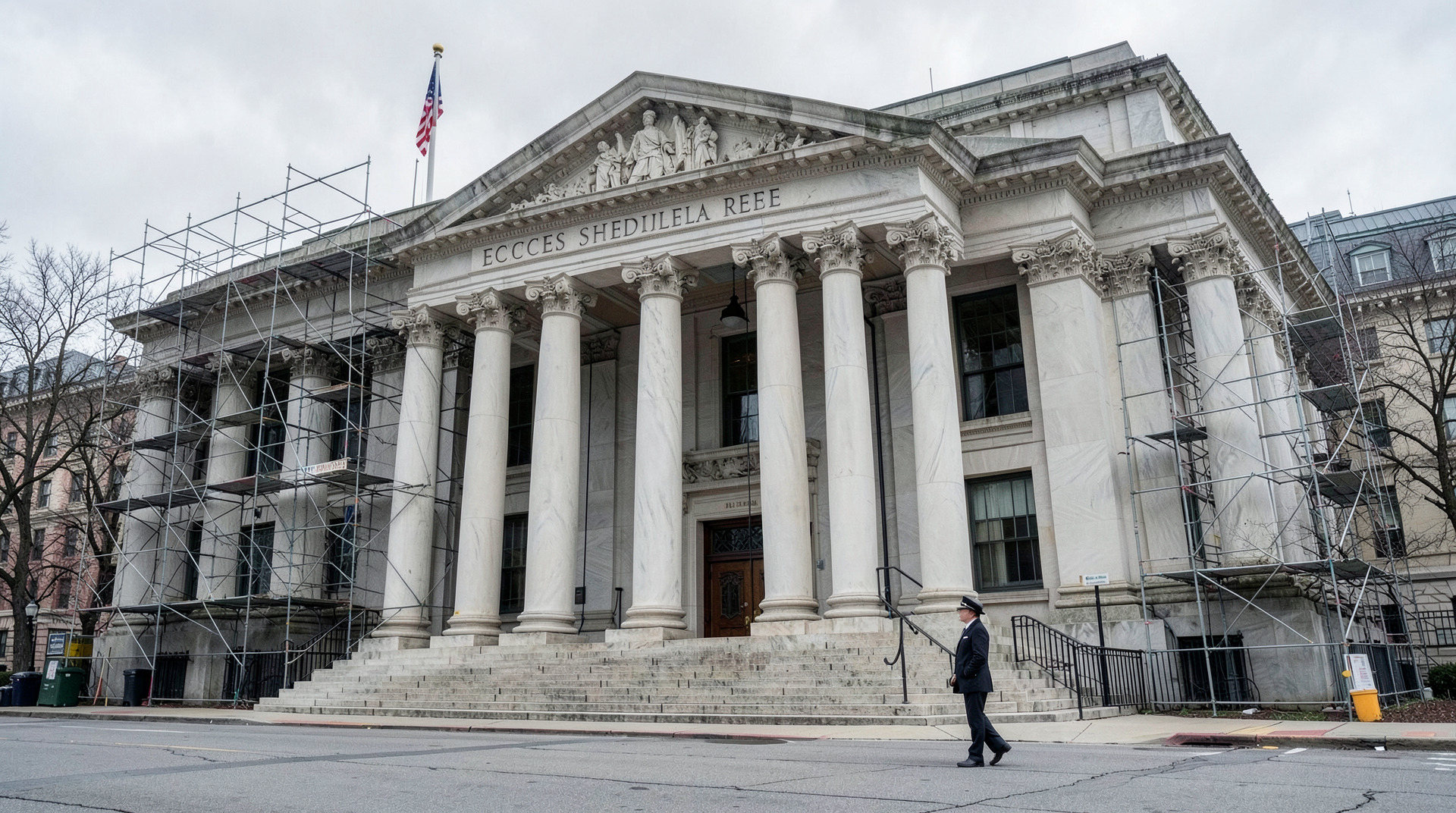
The Justice Department closed its criminal investigation into Federal Reserve Chair Jerome Powell on Friday, removing the obstacle Senator Thom Tillis had placed in front of Kevin Warsh's confirmation as Trump's choice to lead the central bank. [1][2] Yesterday, this paper treated Navy Secretary John Phelan's firing as a concrete artifact of civilian-command erosion. The Powell reversal is the same week speaking in a different institutional accent.
The official story is tidy. U.S. Attorney Jeanine Pirro said the Fed's inspector general would scrutinize the renovation-cost questions, so her office would close its investigation while reserving the right to restart it. [1][3] Reuters reported that the move removes a major obstacle to Warsh's confirmation and could put him in the chair by May 15, when Powell's leadership term ends. [1]
The untidy story is the important one. A federal judge had already found that prosecutors had shown "essentially zero evidence" Powell committed a crime and described the subpoena justification as thin and unsubstantiated. [1][2] Tillis had vowed not to support Warsh while what he called a baseless investigation into Powell remained open. [1][3] Once the probe closed, the hold's practical purpose disappeared.
That is why the closure should not be read simply as Trump backing down. The investigation created the pressure environment, delayed the confirmation fight, and then ended at the precise moment its removal unlocked the president's preferred chair. A failed prosecution can still be a successful political instrument.
Powell's position is more complex than the headline implies. His term as chair ends May 15, but his separate board term runs to 2028. [2] AP notes that he has said he would not leave until the investigation was dropped, but he did not promise to resign once it was. [2] If he stays on the board, Trump gets the chair but not a second immediate governor seat. That is the remaining institutional defense.
NPR framed the closure as the administration backing down from a norm-busting challenge to Fed independence. [4] That is true in court-process terms. It is less true in power terms. Norm-breaking often works by moving the boundary, forcing defenders to spend institutional capital, then withdrawing the tool once the desired appointment path clears.
The Warsh timing is the tell. Reuters and CNBC both emphasize the May 15 window. [1][3] Monetary-policy independence is usually defended through abstraction: central banks, credibility, inflation expectations. Here it is defended or eroded through calendar mechanics. Who sits in the chair before the next rate decision is the concrete fact.
The Phelan parallel matters because the mechanisms differ. Phelan was removed after a force-structure fight over shipbuilding, hypersonics, and the Pentagon's wartime budget doctrine. Powell was investigated until the chair transition could proceed. [5][1] One case used personnel shock. The other used criminal-process pressure. Both reduce institutional independence to an output problem: remove the blocker, clear the path, call the result order.
Pirro's reservation of restart authority keeps the pressure alive. [2][3] A closed investigation that can be reopened is not the same as exoneration. It is a sword placed back on the wall where everyone can see it. Powell, Warsh, Senate Republicans, and markets all know the sword is there.
Elizabeth Warren's response, carried in CNBC's account, captured the Democratic line: the closure was an attempt to clear the path for Trump's "sock puppet" at the Fed. [3] Strip out the campaign language and the procedural point remains. The same investigation Warren calls bogus is also the investigation whose removal Senate Republicans needed to proceed.
The MSM-X split is mostly about verb tense. MSM says the probe ended. Finance X asks what the probe did while it existed. It did not convict Powell. It did not produce evidence a judge found persuasive. It did, however, hold the Warsh confirmation in a suspense structure that could be resolved by the administration's own withdrawal.
Markets tend to prefer closure, even ugly closure. The danger is that closure can be mistaken for restoration. Fed independence is not restored merely because a weak investigation ends. Restoration would require an observable norm that the Justice Department will not be used to pressure central-bank leadership. Friday supplied the opposite lesson: the tool can be used, rebuked, and then holstered after political utility is extracted.
Congress has an obvious question to ask before any Warsh vote: did the nominee, the White House, or any senator communicate with DOJ about the timing of the closure? The answer may be innocent. The question is mandatory. A Senate that confirms first and asks later will have treated the investigation as atmospherics rather than as the confirmation mechanism it became.
The paper's position is therefore simple. The Powell probe collapsed legally. It succeeded institutionally unless Powell holds his board seat and Congress documents the sequence. Without that, the case becomes precedent: a criminal investigation with nearly no evidence can still be enough to reorder the leadership of the world's most important central bank.
-- SAMUEL CRANE, Washington