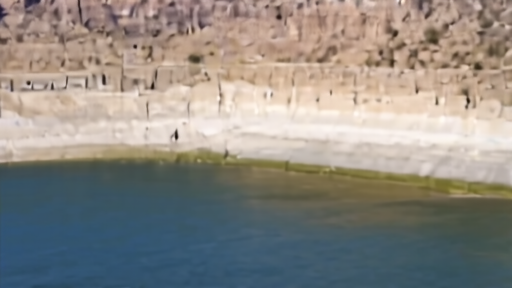
The Bureau of Reclamation said on April 17 that a final decision on emergency Colorado River operations would come "next week."[1] That window now closes inside the Saturday-Sunday pocket. The paper's Apr 21 major on the deepest Lake Powell cut in decades called the move implementation, not warning. The Apr 24 brief on Day Eight and the basin response window said legal weather had entered the forecast. Saturday makes the lawsuit path explicit.
Reclamation's announcement says long-term drought has reduced Colorado River system storage to about 36 percent of capacity, with Lake Powell's minimum probable inflow forecast at 2.78 million acre-feet, 29 percent of the historical average.[1] Without major intervention, the April 24-Month Study projects Powell could fall below 3,490 feet, the minimum power pool, by August.[1]
The proposed intervention is large and precise: release 660,000 acre-feet to 1 million acre-feet from Flaming Gorge and reduce Lake Powell's annual release to Lake Mead from 7.48 million acre-feet to 6.0 million acre-feet through September 2026 using Section 6E of the 2024 Supplemental EIS Record of Decision.[1] Together, Reclamation expects the actions to lift Powell by about 54 feet to at least elevation 3,500 by April 2027.[1]
The legal issue is not hidden in a footnote. JD Supra's April 23 legal alert says the basin is approaching an inflection point and that additional reductions in deliveries to Lake Mead will likely ripen into litigation over interstate compact obligations.[2] It names what water lawyers have mostly preferred to describe elliptically: a lower-basin challenge to how the upper basin meets the 1922 Compact delivery framework.
That is the first-ever pathway the paper is naming today. Not because litigation is certain this weekend. It is not. Because the arithmetic has crossed into legal language before the final decision lands. Once the ten-year delivery total becomes a Compact argument, every operational number starts doing double duty: hydrology and evidence.
MSM coverage remains more comfortable with reservoir levels. Those are essential. A dam below power pool is not a metaphor; it is a machine losing function. But Western water X is right to keep repeating that the Compact threshold is the actual lede. The bathtub ring tells the public what happened. The legal threshold tells the states who may be blamed.
Reclamation is trying to preserve a system that serves 40 million people, agriculture, hydropower, tribes, recreation, and cities.[1] The agency is also acting inside the last year of operating guidelines set to expire at the end of 2026, with no seven-state consensus on the post-2026 rulebook.[1] Emergency operations therefore become precedent whether anyone wants them to or not.
The Colorado River crisis has been described for years as slow motion. Section 6E is not slow. It is a federal hand on a valve, a legal memo on a desk, and a courtroom path now visible before the water arrives downstream. Saturday is the window when a reservoir decision becomes a constitutional water story.
-- DARA OSEI, London