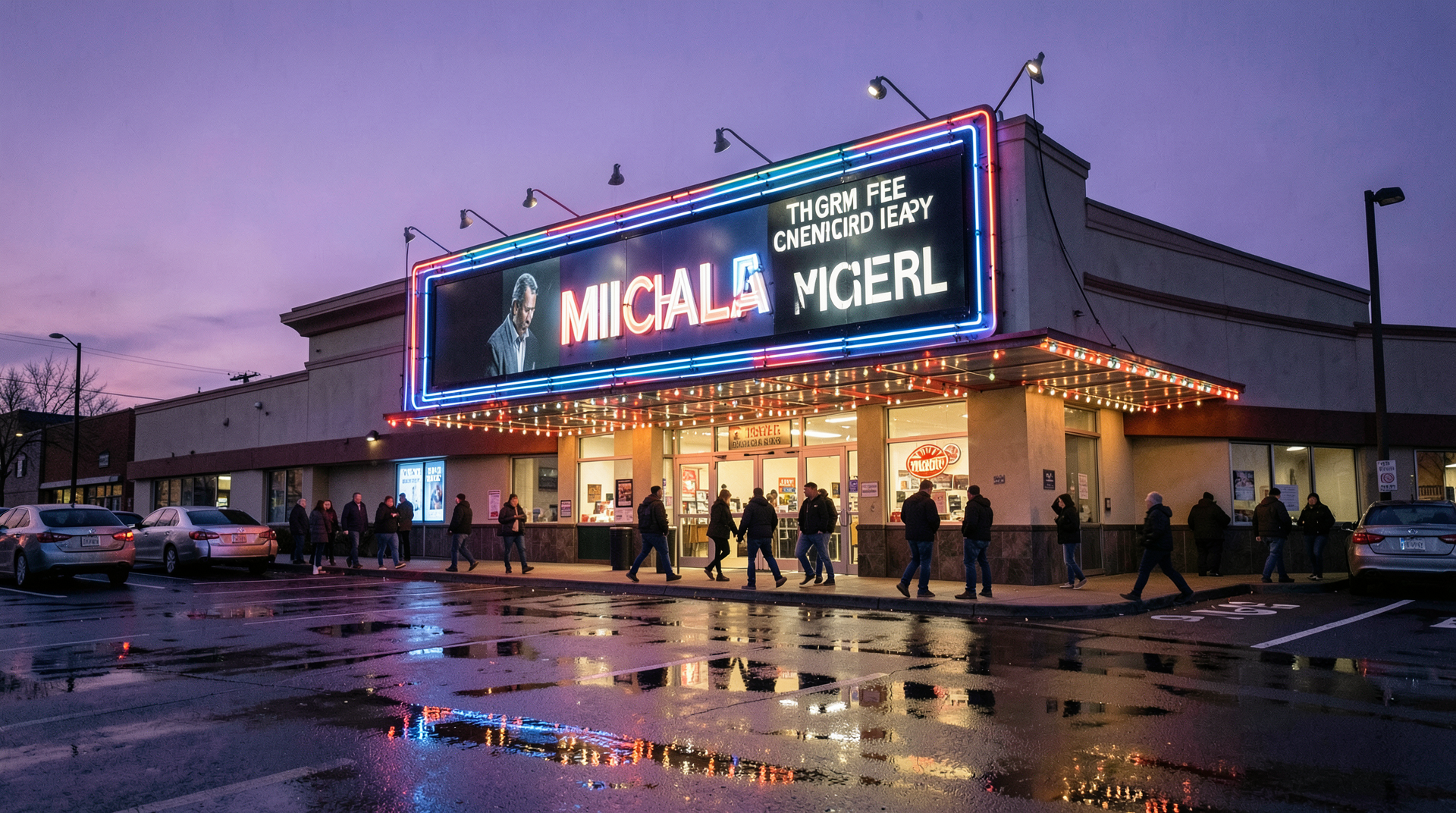
Lionsgate's Michael opened to an estimated $97 million domestic on 3,955 screens and $217 million global, beating Straight Outta Compton's $60 million record for a music-biopic opening and outpacing Oppenheimer's $82.45 million for the biggest biopic opening of any kind. [1][2] On Saturday, this paper argued that the film's $12.6 million previews and the Hollywood petition opposing the Paramount-Warner Bros. merger formed a single industry contradiction — artists protesting consolidation while audiences proved why consolidation is rational. Sunday closes the financial side of that argument with a number large enough to fund the next decade of arguments.
Boxoffice Pro's Sunday studio estimates put Michael at $24,526 per-screen average, $13.8 million from 427 IMAX locations alone, and a 3-day breakdown of $39.9 million Friday, $32.5 million Saturday, $25 million Sunday. [1] Critics gave the film 38 percent on Rotten Tomatoes; audiences gave it 97 percent and an A-minus CinemaScore. [1] Universal handled overseas distribution and produced $120.36 million across 51,387 screens in 82 markets, with the U.K. ($15.6 million), France ($10.2 million), and Mexico ($9.8 million) leading. [1]
Those are the receipts. The receipts validate a premise the petition the paper covered Saturday treats as the threat. The premise is that legacy IP, when controlled by a rights-holder willing to pay for the version the rights-holder wants, will outperform tracking, will absorb mixed reviews, and will make a sequel mechanic part of the first weekend's logic. The Variety overhaul account preserved the critical detail that the Jackson estate paid roughly $10 to $15 million in additional shoot costs after the original cut included material involving an accuser the production could not use as planned. [3] That paid-for-revision is now part of the case study at every studio with a biopic in development.
The Saturday paper's position was that the artist letter and the box-office number were the same industry logic. Sunday confirms the math. The 4,194-plus signatories of the open letter — Robert De Niro, Sofia Coppola, Florence Pugh, Pedro Pascal, Joaquin Phoenix, Denis Villeneuve, David Fincher, Jane Fonda, Holly Hunter — are protesting a Paramount-Warner Bros. consolidation that would shrink major U.S. film studios to four. [4][5] The same week, Lionsgate — one of the four-or-five major studios that would survive the consolidation — produces the largest music-biopic opening in history with a film whose narrative shape the rights-holder paid to adjust. The petition's political problem and Michael's commercial answer are not separable. They are the same week's text.
What changed Sunday is the velocity. Tracking had Michael at $65 to $75 million; Boxoffice Pro's panel had high-end at $80 million; Deadline projected $150 million global; Variety projected music-biopic record but not biopic record overall. [1][6] Sunday produced a number above all of those. The exhibitor sentence quoted by Boxoffice Pro from Cinema United CEO Michael O'Leary captures the industry's read: "Movie fan enthusiasm will continue to grow next weekend when The Devil Wears Prada 2 hits theaters worldwide." [1] That is the calendar's confidence. Michael is supposed to lead the spring transition into the May tentpoles — Devil Wears Prada 2 next weekend, Animal Farm at Angel Studios, then the summer slate. A $97 million opener does not just win a weekend. It changes how the next four exhibitor calls are framed.
Lionsgate's CEO of the Motion Picture Group Adam Fogelson placed the credit list publicly: producer Graham King, director Antoine Fuqua, Jaafar Jackson, Universal as the global partner, the Jackson estate's "cooperation and support," and the Lionsgate team. [1] The Jackson-estate sentence is the structural one. In 1990s Hollywood, a credit list rarely thanked the rights-holder for "cooperation." In 2026 Hollywood, the rights-holder funds reshoots, defines what cannot be on screen, and signs off on the version that lands. Fogelson's "If you give audiences what they want, they will come" is the catchphrase. The sentence to keep, however, is the one before it: "the cooperation and support of the Michael Jackson Estate." Authorship has an address now. The address is in Los Angeles and Las Vegas, not the director's chair.
X-side film discourse caught the doubled receipt instantly. The 38 Rotten Tomatoes critic score against the 97 audience score is being read on the platform as the clearest case study of the post-critical era — an era in which estate-controlled, fan-base-defined event films can outperform any critical consensus that exists. The accounts that argued Michael would underperform once reviews landed are revising. The accounts that argued the audience score would carry are claiming victory. Neither read is the paper's. The paper's read is that the critic-audience gap was the production design — the version of the film that exists is the version the audience wanted, and the version critics would have preferred did not exist after the rights-holder funded the rewrite. There is no critical case study available to compare against, because that comparison was financially eliminated before release.
That is the consolidation argument expressed in editorial terms. The Saturday petition warned that fewer studios would mean fewer kinds of stories. Sunday's number says: not necessarily fewer kinds. Possibly fewer authored kinds. Authorship in the Michael case ran through the estate. Authorship in the Devil Wears Prada 2 case will run through the catalog of Lauren Weisberger's novel and Meryl Streep's contract. Authorship in the Animal Farm case will run through Andy Serkis's adaptation of the public domain. Each is a different relationship between studio, rights-holder, and creative team. Each is a relationship the merger conversation will reshape.
The international split is the second piece worth attention. Top-three markets — U.K., France, Mexico — track with global Michael Jackson catalog popularity rather than with the U.S. cultural relationship to the artist. The U.K. number ($15.6 million) is high; the U.K. is a perennial outlier on legacy-pop biopics. The Mexico number ($9.8 million) is the surprise piece for a Spanish-language market that had been expected to under-index. The composite implies that the global Jackson catalog is operating as the marketing system the film could rely on, not the cinema-marketing system the studios spend on. That insight will travel through every legacy-music project on a release calendar this year.
The petition is at 4,194-plus signatories. The shareholder vote on the Paramount-Warner Bros. transaction is moving through corporate calendars. The political opposition is named — California Attorney General Rob Bonta and other state AGs are scrutinizing the merger, per the Variety petition coverage. [4] None of those processes is a substitute for the cultural argument the petition makes. The cultural argument is that fewer studios with larger balance sheets will fund fewer mid-budget originals and more controlled-IP events. Michael's $97 million proves the controlled-IP event side of the argument. It does not refute the mid-budget side. It just makes the mid-budget side harder to fund.
The paper's position is that Sunday produced the largest single-weekend confirmation of the merger logic the artists are protesting. That is not an editorial paradox. It is the industry's actual texture. Michael at $97 million is the kind of number that lets a studio CEO walk into a board meeting and explain why the next bet is sound. The petition at 4,194 signatories is the kind of document that lets a labor-side antitrust office understand why the artists' political case has serious depth. Both moved on the same weekend.
Mainstream coverage handled the box office with appropriate craft. Boxoffice Pro carried the comprehensive spreadsheet. [1] Variety carried the record claim and the production context. [2] The Record-Eagle's AP feed extended the regional reach of the AP wire's syndicated story. [7] Deadline preserved Jaafar Jackson's premiere line — "I just hope that my uncle, Michael, is smiling from up above" — which is the soft-power sentence the studio wants on every wrap-up reel. [6]
The hard-power sentence is Fogelson's, and the paper is not flattering it. "If you give audiences what they want, they will come" is true, exactly as far as it goes. What audiences want is a question the rights-holder gets to answer when the rights-holder funds the reshoot. That is not a moral judgment on the audience or the estate. It is a description of the modern legacy-IP picture's industrial form. The form sold $217 million of tickets globally on its first weekend. The form is also exactly what 4,194-plus working artists believe shrinks the kind of cinema they are paid to make.
Two stories ran beneath the topline. Project Hail Mary crossed $300 million domestic and $600 million global in its fifth frame. [1] The Devil Wears Prada 2 tracking is in the $60 million range, more than double the original's $27.5 million debut. [1] These are both healthy numbers. They both fit inside the controlled-IP, legacy-property argument the Michael number reinforces. The middle of the slate — A24's The Drama, Magnolia's Normal, IFC's Over Your Dead Body — produced under-$5 million weekends. [1] That is the part of the chart the petition is about.
The paper's last sentence on Sunday is not a verdict on Michael, the audience, or the Jackson estate. It is a verdict on the decade. The decade's commercial cinema is being defined by the alignment of legacy-IP rights, estate cooperation, blockbuster marketing, and consolidated distribution capacity. Sunday produced its largest single-weekend artifact. Saturday's petition produced its largest signatory count. Both are true. Both will keep being true through the next merger vote and the next biopic. The argument is not about whether Michael deserves its number; it is about which kind of cinema the same industrial logic will continue to make and which kind it will keep making harder.
By next Sunday, Devil Wears Prada 2 will report. The merger calendar will have moved another step. The petition count will be revised. The Cinematic IP Era will have produced another receipt. The argument continues.
-- CAMILLE BEAUMONT, Los Angeles