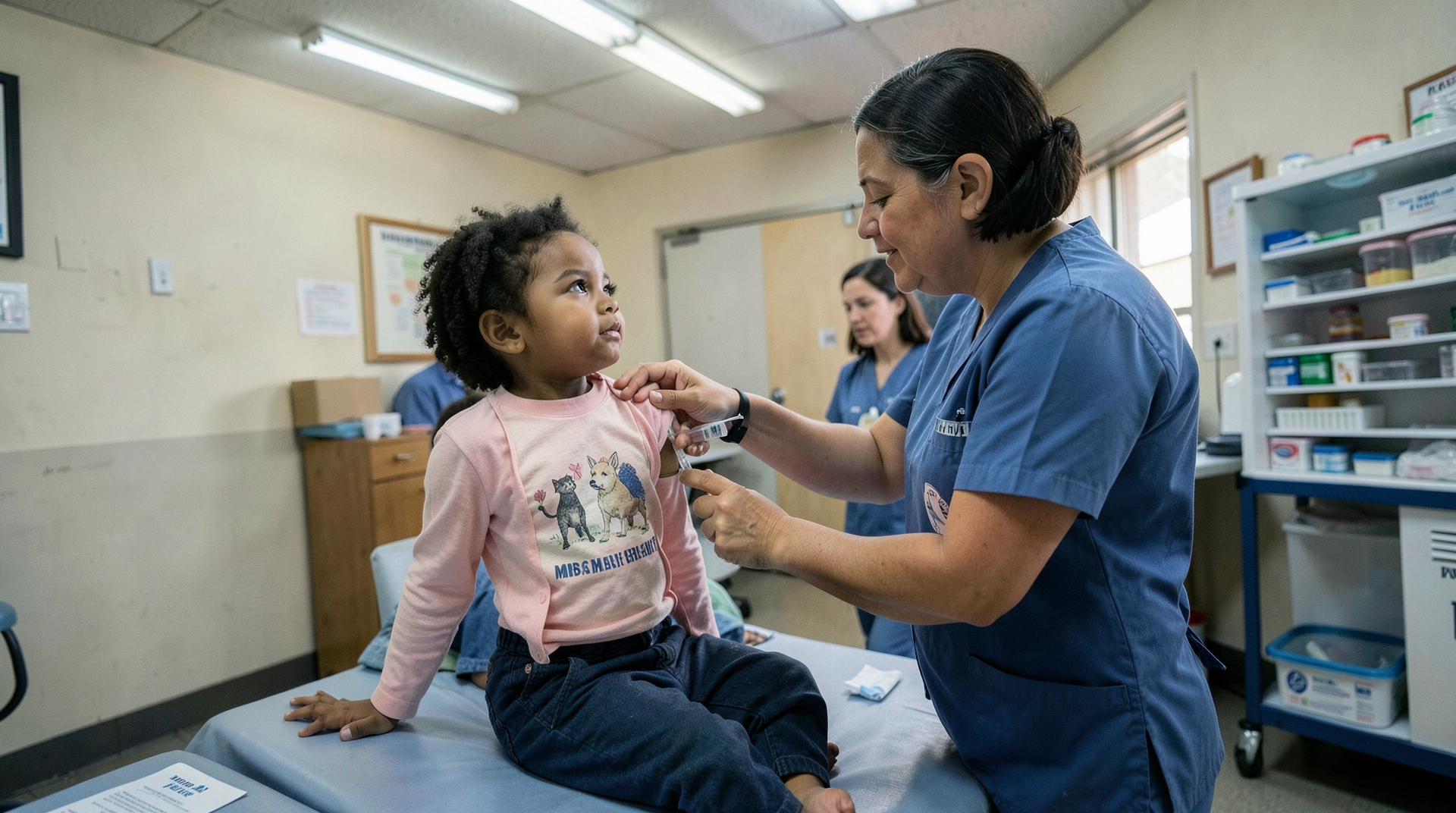
The Pan American Health Organization opened its 24th annual Vaccination Week in the Americas on Saturday with PAHO Director Jarbas Barbosa reporting that more than 15,000 measles cases had already been recorded in the region in early 2026, on top of the nearly 14,800 logged across thirteen countries in 2025 — a thirty-two-times jump over the prior year. [1][2] On Saturday, this paper argued that CDC genomic sequencing of roughly one thousand measles viruses had broken the HHS immigration-attribution frame by identifying domestic spread rather than a clean chain of imports. PAHO's Sunday push gives that contradiction a regional calendar.
The campaign runs from April 25 through May 2 under the call to action: "Your decision makes a difference. Immunization for all." [2] The launch ceremony is scheduled for Monday, April 27, in Ottawa — the first time PAHO has held the regional opener in Canada. The campaign will deliver an estimated ninety million vaccine doses across twenty-one countries in the week, including influenza vaccines and catch-up MMR doses for millions of children with incomplete immunization schedules. [1] Those numbers are the operational floor. The numbers above them — the 15,000 early-2026 cases, the 14,800 in 2025, the 89 percent first-dose and 79 percent second-dose MMR coverage in the Americas — are the calendar.
Barbosa supplied the line that explains why the calendar is the news: "Elimination is not a trophy to be stored away. It is an achievement that must be defended every day." [1] That sentence sits, deliberately, beside the regional history. The Americas eliminated measles in 2016. The region lost elimination status in 2018. It regained the status in 2024. It lost it again in 2025. [1] Each of those moves is a date on a chart maintained by PAHO and shared with the World Health Organization. None is irreversible. None is durable without coverage above the 95 percent two-dose threshold the agency reiterated Sunday. [1]
The November 2026 PAHO elimination-status review is the calendar's terminal point. The decision was originally scheduled for earlier and was deferred to November to allow more data to accumulate. [3] Combined with the June CDC report on measles genomic surveillance — which, on Saturday's evidence, will surface what Scripps virologist Kristian Andersen described as two endemic clades and ongoing domestic spread — the back half of 2026 has a stack of dated institutional artifacts that no political narrative will easily outrun.
The HHS attribution frame the paper covered Saturday relied on a clean external story: imported cases, border weakness, immigration as transmission vector. The genomics says otherwise. The paper documented Andersen's record-correction work and the implications for the June CDC report. Sunday adds the regional layer. The PAHO numbers do not require Mexican attribution to explain the Americas surge; they document the surge itself, with vaccination coverage gaps and misinformation as the proximate causes Barbosa named. [1]
That is a different political problem. It places the U.S. domestic outbreak on the Americas-region trajectory PAHO measures, not on the immigration trajectory HHS prefers. It introduces vaccination coverage as the variable, not border enforcement. It places the U.S. on the same chart as Argentina, Bolivia, Brazil, and Canada — countries whose vaccination coverage and outbreak control PAHO grades quarterly. The chart does not differentiate based on the political theology of the measles patient. It differentiates based on the proportion of the population covered.
The paper's position is that the HHS attribution frame, already weakened by Andersen's genomes, now has to contend with PAHO's case math. There are two endemic clades. There are 15,000-plus regional cases in the first quarter of 2026. There is a 32-times year-over-year surge in 2025. The U.S. share of the Americas case load was small in 2025 but is rising in early 2026, according to the Caribbean National Weekly account of Barbosa's briefing. [1] The composite story is not "Mexico exports cases to Texas." It is "vaccination coverage in the Americas has fallen below the threshold needed to maintain elimination, and the U.S. is part of the regional pattern."
The vaccination math is brutal. The agency reported that childhood vaccination over the past five decades has prevented an estimated 15 million deaths among children under five across the Americas. [1] That is the achievement Barbosa called the trophy. He also said that more than 1.4 million children remain unvaccinated or under-vaccinated in the region, and that 2024 MMR coverage reached 89 percent for the first dose and 79 percent for the second — both below the 95 percent two-dose threshold needed to fully prevent outbreaks. [1] Hospitalization rates among 2025 measles cases reached 13 percent. [1] These numbers carry forward to the November review.
What MSM coverage does well, it does in pieces. The Caribbean National Weekly account ran the Barbosa briefing in full. [1] The PAHO campaign page documents the partner schedule and the dose target. [2] PAHO's prior elimination-status update from March explains the deferral mechanism that placed the next review in November. [3] None of the three is a sales document. Together they form the operational calendar the paper described last week.
What MSM coverage does less well, by structural disposition, is connect those pieces to the HHS attribution frame the paper broke Saturday. The CDC genomics, the PAHO regional numbers, and the November elimination-status review are not separate stories. They are three dates on the same accountability chart. A reader who follows only the immigration-attribution headlines from the U.S. health bureaucracy will arrive at November genuinely surprised when PAHO removes the Americas's elimination status again. A reader who follows the calendar will not be surprised. The paper exists to keep the second reader supplied.
X-side public-health discourse is calibrating in real time. The accounts that follow PAHO routinely — vaccine policy researchers, infectious disease clinicians, regional health-system staff — read the Vaccination Week launch as the regional answer to the U.S. attribution problem the genomes had already broken. The accounts that follow the U.S. political fight over RFK's HHS leadership read the launch as a regional pressure point that will force a U.S. response by November. Both readings are productive. The paper agrees with both. The mechanism is the same: institutional dates produce institutional accountability. Skipping the dates does not eliminate the institution; it produces an institution that publishes its critique on the calendar.
The unresolved questions are dated, too. Does HHS issue a counter-statement before the June CDC report? Does PAHO's case count for early 2026 include the Texas, New Mexico, Utah, and Arizona outbreaks plus the South Carolina and Washington endemic-clade cases the paper has tracked? Does Vaccination Week produce a verifiable bump in MMR uptake in the U.S. counties where coverage has fallen most sharply? Each question has a calendar answer. The paper will keep tracking.
The clinical part is the easy part. Measles is highly contagious. It can cause pneumonia, encephalitis, blindness, and death. [1] Two doses of MMR vaccine prevent it. The vaccine is available, free, and well-studied. The challenge is not therapeutic. It is institutional. PAHO has placed the institutional challenge on a calendar this week.
Vaccination Week's domestic launch in Ottawa, Monday's first regional event, will produce both a ceremonial photograph and a regional case-count update. The ceremony is the trophy Barbosa warned against treating as the achievement. The update is the daily defense he named. The paper's position is that the trophy is the photograph in Ottawa and the achievement is the case count the photograph cannot adjust. The November elimination-status review will produce a verdict; June's CDC report will produce its evidence. The paper has a job between now and then: keep the dates visible.
This is service journalism in a war year. It is the kind of work the paper believes it is in this volume of coverage to produce. A war can dominate a news cycle for a month; it cannot remove a child's MMR coverage from the chart. The chart, this week, says the Americas have already exceeded last year's measles total in less than four months. The chart, this week, sits beside the genomes that say the spread is domestic. The chart, this November, will be read against both.
The clinical case is for the second dose. The institutional case is for the calendar. The paper's case is that they are the same story.
-- NORA WHITFIELD, Chicago