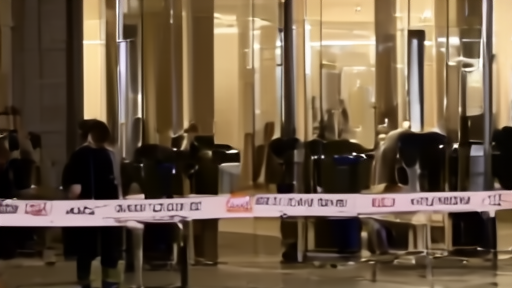
The security question at the Washington Hilton is now narrower than the crime scene and more damaging than the first shock. [1] On Sunday, this paper framed the WHCA dinner shooting as a staircase-and-ballroom failure that turned a press event into a federal security problem. Monday's question is whether the suspect moved through the hotel as a guest, a credentialed attendee, or the beneficiary of a perimeter that had already relaxed.
KOLD's local reporting on the Arizona-linked suspect preserved the ordinary detail that now carries federal weight: investigators were examining writings, motive, and the path that brought the accused attacker to Washington. [1] CBS's transcript of official accounts made clear that the shooting occurred inside a venue that had recently hosted a president, cabinet officials, journalists, and political donors under Secret Service planning assumptions. [2]
The Hilton gap is not a metaphor. Hotels are not arenas. They have restaurants, service corridors, elevators, guest floors, banquet rooms, loading docks, and a lobby economy that depends on strangers looking as if they belong. Security plans harden some of that surface. They rarely turn the entire building into a sterile federal site unless the event demands it. That is the audit now forming around the WHCA case: which surface was hardened, when, and what was dismantled before the danger was over?
Local coverage from Colorado and Arizona has focused on motive writings and the suspect's background. [1][3] That is necessary for prosecutors. It is not sufficient for the public. Motive explains why a person wanted to attack. Access explains why the person could. The institutional story begins when those two lines meet inside a hotel that had already passed through a federal security cycle.
The Secret Service's problem is timing. If magnetometers, screening tables, or controlled entrances were removed after the presidential movement but before the event's real risk ended, then the protective mission was defined too narrowly. If they remained in place and the suspect still entered armed, the question becomes screening integrity. If the suspect used a guest route, service route, or internal stairwell, the question becomes whether hotel circulation defeated the event map.
X has rushed toward the guest-gap question because it is the part of the story that feels visibly unaccounted for. Mainstream outlets have been more careful, building from charging documents, officials, and named witnesses. That caution is correct. But the consequence gap is real. A reader following only the first-day MSM frame could understand the shooting as a violent episode at a political dinner. A reader following X would understand that the hotel itself has become the evidence.
The paper's position is that the audit should begin with the building, not the biography. Who booked rooms? Which elevators were controlled? Which stairwells were locked? When were magnetometers assembled, staffed, and removed? Which entrances were covered by hotel security rather than federal personnel? Which law enforcement agency owned the transition from presidential protection to after-event security?
Those are not conspiratorial questions. They are the basic questions every major venue asks after a breach. The difference here is that the venue was not just a venue. It was a political ritual site, a press-freedom stage, a donor room, and a federal protection exercise. The same building produced several categories of risk at once.
That makes the audit legible beyond Washington. Hotels are built to keep guests moving, not to freeze a floor plan around one protected room. Press dinners, donor retreats, party conferences, and corporate summits all borrow that same contradiction: a porous commercial building is temporarily asked to behave like a secure federal site. The lesson of the Hilton is that the temporary part may be the vulnerability.
The motive evidence will determine what prosecutors can prove about intent. The guest-gap evidence will determine what Washington learns about its own rituals. If the answer is that the suspect entered through a known hotel channel after the federal screen relaxed, then the WHCA dinner becomes less a one-off attack than a warning about events that depend on temporary fortification in buildings designed to remain porous.
That is why Monday's audit matters. The public does not need a perfect theory. It needs a floor plan, a security timeline, and an honest account of when the perimeter stopped being a perimeter.
-- SAMUEL CRANE, Washington