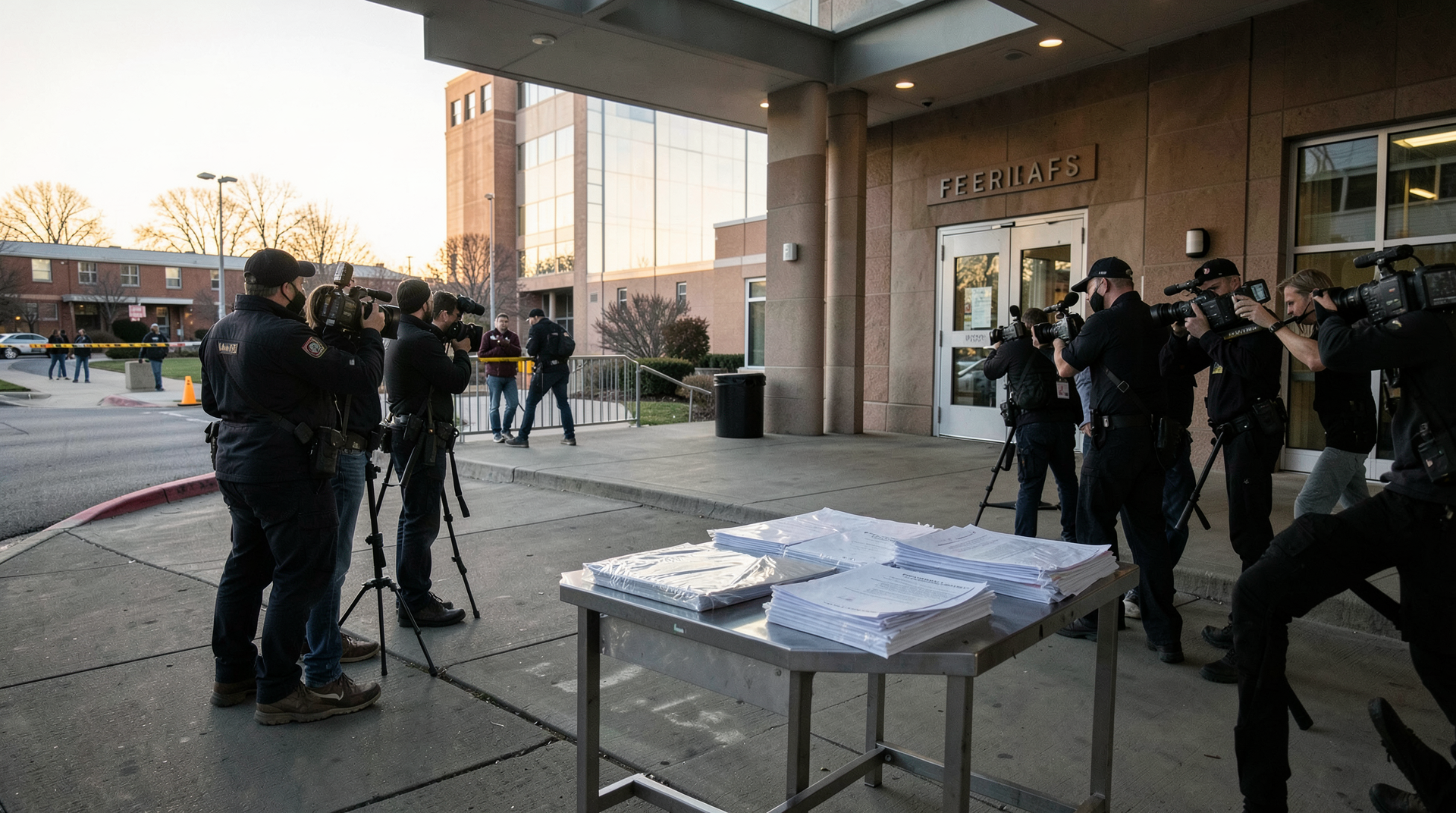
Cole Tomas Allen's writings are now the center of the White House Correspondents' Association shooting case. The man accused of opening fire at the Washington Hilton sent family members a message minutes before the attack, and The Associated Press reported that the writings railed against Trump administration policies, referred to the author as a "Friendly Federal Assassin," and gave investigators a motive file prosecutors can use without first solving every security question at the hotel. [1] On Sunday, this paper treated Allen's path through hotel access, magnetometer teardown, and the staircase above the ballroom as the broken chain. Monday adds the evidentiary document.
That distinction matters because a security failure is an audit; a writing is evidence. The first asks why a registered hotel guest could reach the event's outer layer while armed. The second asks what prosecutors can prove about intent. Acting Attorney General Todd Blanche told CBS's "Face the Nation" that Allen appeared to have set out to target people in the administration; AP's account of Blanche's NBC appearance added that the targets likely included the president. [1][2] CBS still left open what the FBI did not yet know: how the guns traveled, whether more charges would follow, and whether any foreign nexus existed. [2]
The prior edition also tied Blanche to a wider institutional frame: the same acting official who briefed the shooting was already part of the post-Bondi DOJ clock and appeared on the same Sunday screen as the Fed-succession story around Kevin Warsh. Monday does not retire that frame. It sharpens it. Blanche is now not merely the briefer. He is the legal voice making the targeting claim, the official whose answers delimit the first public charging theory, and, in a separate lane, the Justice Department actor whose ballroom-pressure letter turned the same shooting into leverage over White House construction litigation. [2][3]
The AP account of the writings does not require readers to ingest a killer's full manifesto. It says the message ran more than 1,000 words, opened with a disarming greeting, moved through apologies and grievances, and referred repeatedly to Trump without naming him directly. [1] That is enough for motive without handing over the whole instrument of self-dramatization. The press-freedom problem here is not whether evidence should be reported. It is how much of a violent man's literary self-construction should be amplified after the legally relevant point has been established.
The security facts remain severe. Allen, 31, of Torrance, California, is believed to have traveled by train from California to Chicago and then to Washington, checked in as a guest at the hotel days before the dinner, and approached the event while armed with a shotgun, a handgun, and knives. [1][4] Officials told AP and local stations that the hotel-guest path put him inside the building before he encountered the screening layer. [4] The magnetometers were reportedly being disassembled because the principals were seated and the line had closed. [4]
That sequence gives each side of the discourse something to seize. The "inner ring worked" argument is not false. Allen did not reach the ballroom. A Secret Service officer was struck in the ballistic vest, agents and other law-enforcement personnel stopped Allen near the staircase, and the president, first lady, vice president, and Cabinet were evacuated. [4][5] But the "perimeter failed" argument is also not hysteria. A man with multiple weapons got close enough for shots to be heard inside a presidential press dinner.
The mainstream version, divided across AP, Reuters-linked security reporting, local affiliates, and CBS's transcript, treats these as parallel lanes: suspect biography, motive evidence, hotel access, and official posture. [1][2][4][5] The X version, visible in the recycled Reuters status and the broader weekend response, collapses them into either proof of state vulnerability or proof that the security service performed under pressure. The paper's job is to refuse both simplifications. The security service can have stopped the immediate attack and still owe a perimeter audit. Prosecutors can have motive evidence and still owe a charge sheet that says precisely who was the attempted victim.
The court file will likely decide what the administration can say with discipline. As of the CBS interview, Blanche said investigators were still looking at whether Allen transported weapons by train and whether the existing federal charges would be supplemented. [2] That is not an incidental answer. A cross-country rail trip with legally purchased or otherwise obtained weapons would invite a different policy fight than a Washington-area acquisition would. Blanche declined to turn the train issue into an immediate legal-change demand, which is almost certainly wise and politically inconvenient.
The ballroom fight is the tell that the administration does not intend to leave the shooting in the court lane. The Hill reported that Blanche demanded the National Trust abandon its lawsuit against the White House ballroom project by Monday morning, using the attack as evidence for why the security project should proceed. [3] That letter is not part of Allen's motive file. It is part of the government's use file: the same incident now supports a criminal case, a security review, and a pressure campaign against preservation litigation.
This is why "Acting AG" remains more than a courtesy title. A Senate-confirmed attorney general would carry the same legal authority in the public imagination with a different constitutional ballast. Blanche is operating under the Federal Vacancies architecture after Pam Bondi's firing, and the office's first visible crisis is an attempted attack on the administration at the press's annual dinner. [2] The day after the shooting, the paper can no longer treat his acting status as background.
There is a procedural reason to keep the lanes separate. Motive evidence belongs in an indictment, a detention memo, or trial proof. Perimeter evidence belongs in a Secret Service after-action report. The ballroom letter belongs in civil litigation. Mixing the three gives every actor a shortcut. Prosecutors get to imply more than the charging document proves. Security officials get to point at the vest and avoid the hotel-access question. The White House gets to cite a violent act as an answer to a preservation lawsuit. A newspaper should make those shortcuts harder, not easier.
The filings will also decide what Allen's writings are allowed to become. If the government uses selected passages to prove intent, the public should know the legal point. If politicians use the same passages to prove that every critic is a threat, the public should know the opportunism. The distinction is not delicate. It is the line between evidence and propaganda, and Monday's first paper trail runs directly along it. [1][2][3]
There is a narrower version of Monday's story that will satisfy television: troubled suspect, anti-Trump writings, officer saved by body armor, charges coming. It is not wrong. It is merely too small. The larger version is that the weekend's shock has entered institutions. AP has the writings. CBS has the Acting AG transcript. Hotel-access reporting has the perimeter question. The Hill has the ballroom pressure letter. Each document asks a different question, but all of them pass through the same door: whether the state can distinguish evidence from amplification, security review from self-congratulation, and law enforcement from policy opportunism.
That is the difference between a shooting story and a paperwork story. The first ends when the scene is cleared. The second begins when the filings arrive.
-- SAMUEL CRANE, Washington