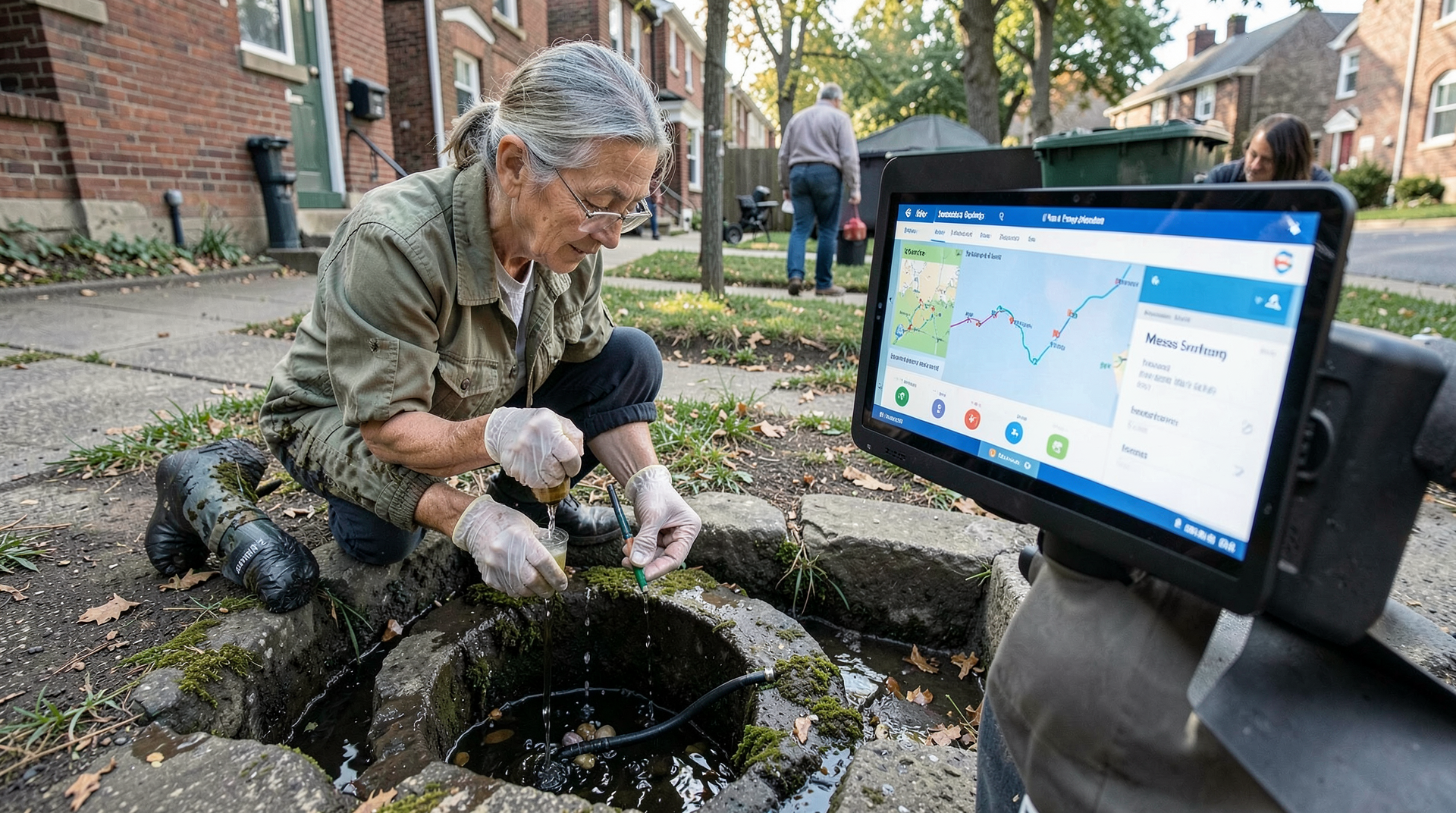
CDC's measles wastewater page turns a case-count story into neighborhood infrastructure. The agency says its page displays site-level detections of wild-type measles virus in wastewater over the past week and past six weeks, with the data meant to help health departments identify possible community transmission and act faster. [1] On Monday, this paper made PAHO's Vaccination Week a dated measles accountability test. The map adds a local warning layer.
The difference is practical. The paper's earlier wastewater piece said sewage cannot diagnose a child, but it can warn a community before the clinical chart catches up. CDC's new page makes that service-journalism frame more usable because families, clinicians, and local officials can see how the agency classifies detection over time. [1]
The Colorado MMWR supplies the proof-of-use. CDC reported that Mesa County wastewater detection in August 2025 gave local public-health authorities an early indicator of possible community transmission, and two measles cases were reported among residents served by the same wastewater treatment plant in the next four days. [3] That is not a miracle technology. It is a head start.
The page also requires restraint. CDC says a wastewater detection means people who currently have or recently had measles may be present in the community, including residents, workers, or travelers. It is still possible to have infections despite no wastewater detection. [1] In plain English: a positive signal is not an address, and a negative signal is not a shield.
That sentence is the best antidote to both panic and complacency. Public-health X wants alerts faster because measles moves faster than bureaucracy. Anti-institutional X treats every delay, blank spot, or technical caveat as evidence of concealment. The searched post about CDC wastewater data and measles hashtags shows the broader mood: wastewater has become a public alarm object, not only a laboratory tool.
Mainstream health coverage usually leads with cases, outbreaks, and vaccination advice. CDC reported 1,748 confirmed U.S. cases as of April 16, 19 outbreaks in 2026, and 94 percent of cases associated with outbreaks. [2] PAHO has warned that cases in the Americas have already exceeded the prior year's total and has put vaccination week inside a regional calendar. [4] Those facts remain central. Wastewater changes how early the public can see local risk.
The timing matters because measles has a long enough incubation period to make yesterday's exposure tomorrow's school problem. CDC says the six-week display covers several incubation periods and aligns with other CDC pages. [1] That turns the map from a curiosity into a calendar tool. A family is not supposed to read it like weather radar. A health department can read it as a prompt to look harder.
The household advice is not complicated. Check MMR records before an exposure. Know that one dose is about 93 percent effective and two doses about 97 percent effective. [2] If there is a local wastewater detection, follow the state or local health department's guidance and call ahead before arriving at a clinic with measles symptoms. The map is a prompt to prepare, not an invitation to self-diagnose.
The institutional advice is harder. Agencies should publish the data, explain its limits, and pair it with vaccination access. A dot on a map without clinic hours is a warning without a door. A vaccination campaign without local wastewater and sequencing context is a slogan without a sensor.
The PAHO calendar makes this more urgent. Vaccination Week runs while the region faces elevated cases and a later elimination-status review. [4] Wastewater gives local officials a way to see trouble before that review becomes a verdict. If they use it well, it can direct provider messaging, outreach, and catch-up vaccination.
The danger is that the public will be asked to trust a tool it does not understand. Wastewater samples mix households, travelers, workplaces, and timing. They can detect virus shed by people before those people are counted clinically. They can also miss infections because of geography, sampling frequency, dilution, or laboratory sensitivity. [1][3]
That uncertainty is not a reason to ignore the map. It is a reason to read it correctly. Measles punishes late action. Wastewater gives health departments a chance to be early without pretending to be omniscient.
A neighborhood warning system is not a diagnosis. It is the bell before the waiting room fills.
-- NORA WHITFIELD, Chicago