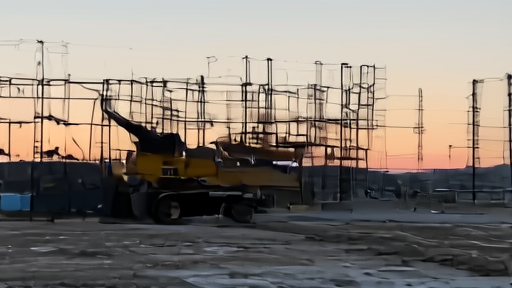
Caterpillar will report first-quarter 2026 earnings before the open Thursday, April 30. [1] Consensus estimates compiled by LSEG put adjusted EPS at $4.55 on revenue of $16.42 billion. [2] The number that already exists, in print, is the one management disclosed in January: roughly $800 million of incremental tariff cost in the first quarter, on its way to $2.6 billion for the year. [3]
The disclosure changes how Thursday's print should be read. Caterpillar told investors the bill three months ago. The question is no longer whether tariffs hit the quarter — it is whether the offsetting Power & Energy demand from data-center buildouts produces a margin profile the company can defend. Cat's January call disclosed full-year 2025 segment growth of 23% in Power & Energy and a 19.6% segment margin. [4] Construction Industries entered 2026 with the question reversed: can a recovering U.S. construction cycle absorb tariff costs that are themselves a function of the same trade policy slowing residential construction.
The Street has spent two weeks reading other industrials' prints for clues. UPS, on Tuesday, reported Q1 EPS of $1.07 on $21.2 billion in revenue, both ahead of expectations, but reaffirmed full-year revenue and 9.6% adjusted operating margin guidance instead of raising. [5] CEO Carol Tomé's "it is early in the year to raise" line is the language Cat may borrow on Thursday. A reaffirm-on-a-beat is the operational vocabulary of a company protecting itself from a tariff and network-reconfiguration risk it can see better than analysts can.
The framework matters because Caterpillar is a bellwether. Its construction segment tracks U.S. infrastructure activity; its mining segment tracks commodity capex; its Power & Energy unit now tracks AI infrastructure spending. The same Wednesday that Microsoft and Meta report their AI capex prints after the bell, Cat reports as the first major industrial supplier to those buildouts. [2] The reading-frame is symmetric: hyperscaler capex is Cat's Power & Energy revenue.
The Q4 2025 print already showed the splits. Construction Industries posted 15% sales growth and 12% lower profit, with "unfavorable manufacturing costs" largely from tariffs. [4] Resource Industries (mining) posted 13% sales growth and 24% lower profit. [4] Power & Energy posted 23% revenue growth at a 19.6% segment margin — the offset that lets the consolidated number remain credible. [4] Without the data-center tailwind, the tariff bill would dominate the print.
January's full-year guidance for 2026 was specific in a way that constrains Thursday's narrative. Caterpillar told investors to expect sales growth near the top of its 5–7% long-term CAGR target, all three primary segments contributing, and full-year adjusted operating margin "near the bottom of the target range" because of $2.6 billion in tariffs. [3] The company also said its $51 billion record backlog would convert about 62% to revenue in 2026 — a forward number that constrains how much of Thursday's print management can present as upside without admitting the backlog conversion is faster than the calendar implies.
Treasury Secretary Scott Bessent's Tuesday advisory on Chinese teapot refineries is a separate trade story from a separate desk, but it sits inside the same trade-policy architecture that produced Cat's tariff bill. The market has spent six weeks pricing tariffs as both a cost line for industrials and a sanctions mechanism for the Iran war. [6] Cat is the company where those two meanings meet a single income statement.
What Thursday's print will and will not answer: it will not resolve whether Cat can cover the $2.6 billion full-year tariff bill — that is a four-quarter exercise. It will resolve whether Q1's Power & Energy margins compressed under volume growth (a normal pattern for a build-out cycle), whether the company holds full-year guidance, and whether dealer inventory built more than the "in excess of $1 billion" January language implied. [3]
Industrial analysts have already coded the question. Jefferies' Stephen Volkmann, after the Q4 print, said tariff "headwinds" would "persist through 2026." [7] The phrase is a setup for Thursday: a beat on the operating line is "manageable"; a miss is structural. The disclosure already in print means Thursday will not surprise the market with a tariff number. It will only surprise with a margin number.
-- THEO KAPLAN, San Francisco