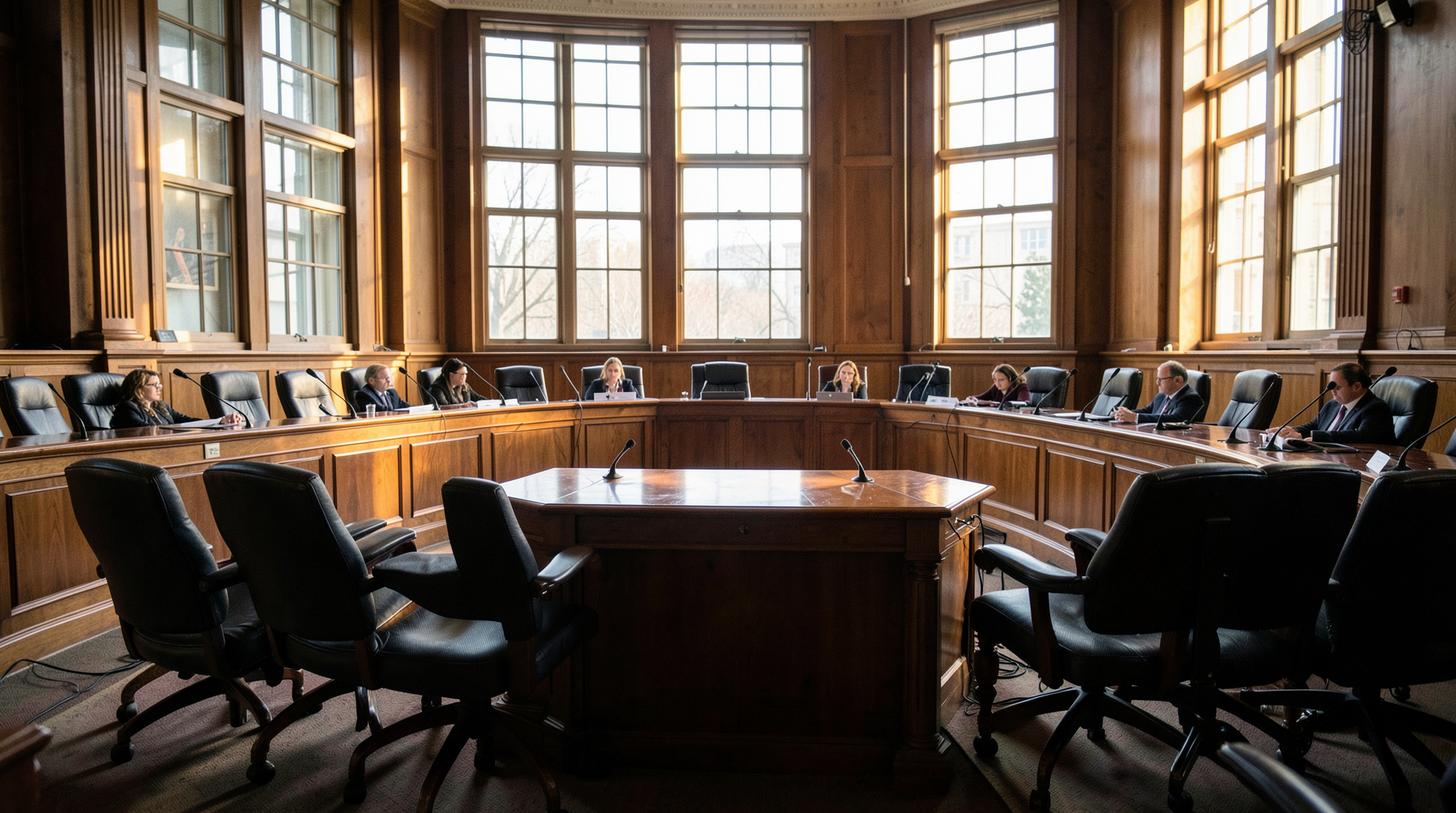
The House Rules Committee was scheduled to meet Tuesday morning to mark up a procedural rule that would have brought a three-year reauthorization of Section 702 of the Foreign Intelligence Surveillance Act to the House floor before the statute expires at midnight Thursday. The committee briefly reconvened, then indefinitely postponed. The Senate, which had planned a parallel procedural vote on a clean three-year extension Tuesday afternoon, postponed that vote as well. By Wednesday morning, with one day left until lapse, neither chamber has a floor schedule, neither chamber has a deal, and neither chamber's leadership has whipped a hold-out coalition that has now blocked Section 702 through three successive weekends of failed reauthorization. [1] [2] [3]
The dormancy is not a delay. The dormancy is the policy.
The April 28 paper argued that FISA had a real deadline and a fake cliff at the same time — that Section 702's operational authority would not vanish at midnight because the Foreign Intelligence Surveillance Court had recertified the underlying program in March, allowing collection to continue through March 2027 even if Congress let the statute lapse. [4] What the paper called the cliff was political and procedural: telecoms still refusing to participate without an active statute, intelligence agencies losing their cleanest legal posture for new compulsory orders, and Congress publicly failing to renew an authority both parties have voted for ten times since 2008. The framing held that the dormancy on the Rules calendar was the data point to watch. Wednesday's news is that the dormancy resolved into a non-event that is itself the event. The Rules markup did not happen. There is no replacement scheduled. The post-cliff calendar is empty.
Speaker Mike Johnson can lose two House Republicans on a procedural rule, given Democratic discipline. He has lost twenty in two prior Section 702 votes this month — the five-year reauthorization that failed 200-220 in the small hours of April 17 and the eighteen-month "clean" extension that failed 197-228 immediately after. [5] [6] On April 24 he unveiled a third version: a three-year reauthorization without a warrant requirement, with new monthly FBI reporting language and "willful abuse" criminal penalties tacked on. [7] The rule for that bill was supposed to clear committee Tuesday and the bill was supposed to clear the House before Thursday. Tuesday's meeting failed because the same Rules Committee Republicans who killed the prior versions — Reps. Chip Roy of Texas, Ralph Norman of South Carolina, and Morgan Griffith of Virginia — declined to deliver the votes that would have moved a rule with no warrant amendment to the floor. [3] Roy told reporters earlier in the cycle that any extension without a warrant requirement was "sorely lacking." [8] Tuesday he and his colleagues let the meeting end without a vote.
Rep. Thomas Massie, in an X post at the start of the dormancy, captured the holdouts' working theory: "Both would have allowed Feds to unconstitutionally spy on Americans. We stopped both versions, but the fight isn't over. Eventually, it was decided to give them two more weeks to fix FISA." [9] Two weeks expires Thursday. The hardline Republican coalition has spent the interval rejecting every proposed fix that does not require a judicial warrant before searching American data. The Trump administration, the Speaker's office, and Senate leadership have spent the same interval refusing to attach a warrant requirement. The dormancy is the architecture of that refusal made visible.
The Senate side has its own version of the same problem. Majority Leader John Thune scheduled a starter vote Tuesday on a clean three-year extension that would let the Senate begin debate. Thune did not have the votes to invoke cloture, in part because Senators Mike Lee of Utah and Dick Durbin of Illinois have spent the cycle promoting their own warrant-reform alternative — a bill that would close both the Section 702 backdoor-search problem and the data-broker loophole that allows the FBI, ICE, CBP, and the Pentagon to purchase Americans' location data without a warrant. [10] FBI Director Kash Patel confirmed the data-broker purchase practice on the record this month, which broadened the privacy coalition. [10] Wyden has called Lee-Durbin "the only bill in town that protects Americans," and on the Senate floor Tuesday Wyden said the government's appeal of a March 17 FISC ruling against the program's existing safeguards "is the policy choice that disqualifies the clean extension." [10] Thune pulled the procedural vote to negotiate. By Wednesday morning it had not been rescheduled.
Two paragraphs of the cliff that bear underlining for any reader following the operational stakes: First, the FISC recertification means the wiretaps that exist today continue to exist tomorrow even if Congress lapses. The Foreign Intelligence Surveillance Court approved certifications in March that authorize the program through March 2027 under existing rules. [4] The Office of the Director of National Intelligence's transition language permits "in-progress" collection to continue under the prior statutory authorities for new orders issued before the lapse. Second, the lapse is real for everything that comes after midnight Thursday — new directives to telecoms, new selectors added to the targeting database, new compelled-cooperation orders to providers that have not previously been served. Telecom counsel began this week telling the executive branch the companies will not voluntarily honor new compelled directives in the gray zone after a statutory lapse without a covered statute. The Lawfare analysis published Tuesday calls this "the soft-shutdown problem" — collection that is technically lawful under the FISC recertification, with which the providers will not in practice comply because their general counsels' offices will not write the cover memo. [11]
The political authority is gone before the operational authority is. That has been the paper's frame since the first failed vote on April 17, and it remains the frame. What changed Wednesday is the Rules calendar. The fake cliff has hardened, in the absence of a procedural mark-up, into the only cliff that matters this week.
Senator Mike Lee and Senator Dick Durbin co-authored an op-ed in the New York Times on April 17 arguing that Section 702 had been routinely used to query Americans without a warrant — that the FBI ran roughly 200,000 such searches a year at the program's height — and that the right way out of the lapse was a bill that closed both the backdoor and the data-broker loopholes. [10] On the floor Tuesday Lee said the administration's appeal of the FISC ruling "tells you what they think the program is for, and it isn't what's printed on the box." Wyden, for the Democratic side, picked up the same theme: "If the government says there's a danger to America under my warrant system, the government can go get the warrant immediately so that Americans are protected, and come back after the fact." [10] Both senators are working from a bill that has bipartisan co-sponsorship and a clear path through committee. Neither senator can get it past Thune without Thune's consent. Thune has so far declined.
Privacy advocates outside Congress, who have spent two cycles arguing Section 702 was structurally unfit for renewal under any administration with a record of weaponizing intelligence-community data, are reading Wednesday's calendar as proof that they have won by attrition. Demand Progress, the ACLU, and FreedomWorks all issued statements after the Tuesday postponement claiming the lapse as the first real reform in fifteen years of Section 702 reauthorizations. [12] EFF's Cindy Cohn told Common Dreams, "Of course, this fight is nowhere near over. Speaker Johnson can still force a vote any time with extremely short notice, but our coalition feels the wind at our backs." [12]
That coalition's wind is, mechanically, what is keeping the Rules Committee dormant. Chip Roy and his bloc do not have to pass a bill. They have to keep declining to vote a rule out of committee. Johnson's options narrow to four. He can attach Section 702 to a must-pass continuing resolution, which would alienate appropriators and trigger a Rules Committee fight on a different calendar. He can bring the three-year extension to the floor under suspension of the rules, which requires two-thirds — a math problem given twenty Republicans against. He can accept a short-term extension of thirty or sixty days, which the Senate could probably pass and which Roy himself proposed in an interview last week — "guys, just do a 30 or 60 day extension, let's do one, get out here, right, and let's go keep negotiating." [13] Or he can accept lapse and let the FISC recertification do the political and operational work for the next eleven months while the negotiation continues.
The fourth option is the one Wednesday's calendar increasingly looks like.
The legal terrain after lapse is novel rather than uncharted. The 9/11 Commission's Section 702 architecture was built on the premise that the FISC recertification would bridge any short statutory lapse, and the program's general counsels have prepared lapse-bridging packages before. What is novel is that the FISC's March recertification was conditioned on the government fixing the backdoor-search problem the court found in its March 17 order, and the Trump administration is appealing that fix. [14] If the appeal succeeds, the recertification's conditions soften and the operational authority continues without remediation. If the appeal fails, the FISC could in principle reopen the certification mid-cycle and force compliance. The administration has bet on the appeal, which means the post-lapse posture is not "operational continuity with a fix" but "operational continuity without a fix while the fix is being litigated." That is a posture privacy reformers and intelligence committee Democrats describe as exactly the abuse pattern the warrant requirement was supposed to close.
There is one frame from the paper's earlier coverage that carries forward intact. The "real-deadline-and-fake-cliff" framing held that the operational authority would survive midnight even if Congress did not. That holds. What today's edition adds is the second leg: the political authority will not survive midnight either. Congress is rejecting Section 702's renewal not by voting against it but by not voting at all. That is its own kind of vote, and Wednesday is the day the count becomes legible. The number on the floor today is zero scheduled. The number for Thursday is the same.
Senator Wyden, in a Senate floor speech that did not move the cloture vote because the cloture vote was not held, said something that will read different in three weeks than it does Wednesday: "If we let this lapse, we will not get it back without doing the work this Congress has refused to do for two cycles. The work is the warrant. We can do it now. We can do it in May. We can do it never. The choice is ours, and the Court has made the choice survivable." [10] The Court — the FISC — is the silent third party that has made the dormancy strategy structurally available. Without it, Tuesday's postponement would be a crisis. With it, Tuesday's postponement is a tactic.
The administration's allies have read the same FISC language and concluded that the easiest version of victory for them is also the dormancy version. The clean extension survives intact and the warrant fight is deferred. Privacy reformers reach the same operational conclusion via the opposite political route: the dormancy is the closest they have come to forcing the warrant fight onto the table. Neither side wants to move first.
The reader's stake, in plain English: from Thursday morning on, the FBI's existing wiretaps still run; new ones get harder; the executive branch is appealing the safeguards the court ordered; and Congress is, by procedural inaction, telling the country that this is the version of Section 702 it can live with. That is a position. It is the paper's job to name it. Rejection by dormancy is rejection. The Rules Committee did not just postpone Tuesday. It chose. So did the Senate. So, by silence, did the President.
Whether that choice is reversible by Friday morning is the open question. The procedural levers are still in Speaker Johnson's hand. The FISC is still in place. The warrant coalition is still small. But two weeks of no votes across two chambers, with one day to spare, is not a cliff that will be walked back without a deal that does not yet exist. The deal that does not yet exist is the warrant requirement Trump and Johnson have refused to accept. The deal that does not yet exist is the warrant requirement the holdouts will not accept its absence of. The dormancy is the gap between those two refusals, and the gap is now Wednesday's policy.
-- SAMUEL CRANE, Washington