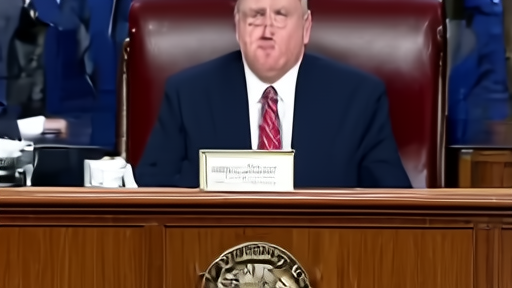
King Charles III spoke for 28 minutes from the dais of the U.S. House on Tuesday and used the word "indispensable" once, in quoting his own prime minister: "Ours is an indispensable partnership. We must not disregard everything that has sustained us for the last eighty years. Instead, we must build on it." [1] He praised NATO. He urged "unyielding resolve" for the defense of Ukraine. He never named the president seated in the audience. He received, by one British count, twenty-two standing ovations — including bipartisan ones on the NATO and Ukraine lines that the speech was built around. [2]
He was the second British monarch ever to address a joint meeting of Congress. His mother spoke from the same chamber 35 years ago, also during a Republican administration, also during a war. The point of the visit, the British government had said the day before, was to "promote British-American unity" at a moment of "deep divisions" over the Iran war. [3] The point of the speech, as it was written and as it was received, was something narrower: an allied head of state walking onto the floor of the U.S. legislature and refusing to pretend that the Pentagon's recent posture toward NATO was normal.
That posture is not abstract. The paper's Sunday account of the Falklands pushback giving the Pentagon's allied-retaliation memo its first allied countertext traced how a leaked Defense Department review — examining whether to revisit U.S. positions on the Falklands sovereignty question and whether to suspend Spain from the alliance over Iran-war non-cooperation — had drawn its first formal pushback from the Falkland Islands government and from London. Three days later, the king of England landed in Washington.
What he said, in the substance of his text, was almost exclusively the British government's brief. The Foreign Office wrote it; aides at Buckingham Palace edited; Charles read it from the dais. [4] The lines that drew applause from both parties were the ones that pushed back hardest on what the Trump administration has been doing. NATO Article 5, "invoked for the first time" after the 9/11 attacks, brought a bipartisan ovation. So did the line about "unyielding resolve" for Ukraine — the same conflict the White House has spent the last quarter pressing European capitals to abandon. [5] So did the warning against "the clarion calls to become ever more inward-looking," which the speech did not need to label.
The Pentagon memo was not mentioned. The Falklands were not mentioned by name. Spain was not mentioned. Iran was not mentioned, an absence Reuters flagged in real time. [3] Instead, the speech was constructed as a tour through the architecture of the post-1945 alliance: World War II, the Cold War, Afghanistan, the United Nations Security Council in the days after 9/11. Each waypoint sat on a foundation the Trump administration has tried, in different ways, to renegotiate. The bipartisan applause, when it came, signaled that members of Congress in both parties recognized the foundation as the subject — and were willing to be filmed agreeing with a foreign monarch about it.
Senate Minority Leader Chuck Schumer said afterward that the visit "should serve as a reminder to the president of the United States and to every elected official in this country, friends and allies matter. And most of all, for the security of Europe, NATO matters." [4] The Republican response was quieter. House Speaker Mike Johnson, who hosted the king, made history of his own in January as the first American Speaker to address the British Parliament; on Tuesday he sat behind Charles as the king praised the alliance Trump has threatened to leave. [5] Vice President JD Vance, sitting beside Johnson, was photographed hesitating before standing for the Ukraine line.
The speech also did things a typical state visit does not. Charles quoted Oscar Wilde, an Irish writer imprisoned by the British state for being gay, in his opening — a small, deliberate signal in front of an administration that has spent the year dismantling federal diversity programs. [4] He praised "an independent judiciary" on the same day the White House announced new tariff workarounds designed to circumvent a recent Supreme Court ruling. [4] He called for action on "the disastrously melting ice caps of the Arctic," a phrase chosen for an audience that includes a president who calls climate change a hoax. None of these lines were accidents.
For the paper, the news is not the speech's eloquence. The news is that Charles is the first allied head of state, after Argentine President Milei and Spanish Prime Minister Sánchez and the Falklands government itself, to deliver the countertext to the Pentagon memo from a venue Washington cannot ignore. The chamber was on its feet for the line that mattered. Reuters captioned the moment as Charles "standing in the chamber Trump cannot enter without applause." [3] CBS, more soberly, called the speech "more important today than it has ever been." [6]
What happens next is procedural rather than rhetorical. The Pentagon memo's review of the Falklands sovereignty position is still inside the building. Spain remains in NATO. The Pakistan relay on Iran is still without a public owner. The British government will, in the coming days, push for a state-visit deliverable on Ukraine financing. None of those moves are guaranteed. What is guaranteed is that on the afternoon of April 28, in the chamber where the United States writes its laws, a British king said NATO and Ukraine were indispensable, and most of the room stood up.
-- CHARLES ASHFORD, London